What the business is
J&T Global Express moves parcels bought through e-commerce. Merchants, platforms, businesses and individuals pay delivery charges. J&T collects, sorts, transports and delivers each shipment through its own network and local partners. It also provides cross-border B2B logistics, moving goods between businesses across countries.
Revenue reached $12.16 billion in 2025. China handled 22.07 billion parcels and Southeast Asia handled 7.66 billion. Costs cover pickup, sorting, transport, last-mile delivery and partner payments. Profit depends on density: many nearby parcels allow trucks, sorting centres and couriers to serve more shipments without proportional cost increases. In the first half of 2026, average revenue was $0.44 per parcel against average cost of $0.38. Platform concentration remains important because large customers can redirect volume or demand lower prices.
The latest quarter and year
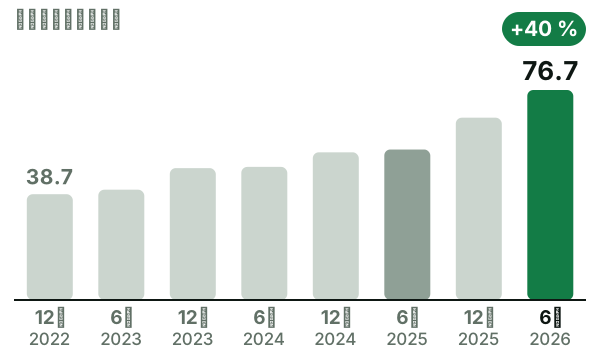
The latest quarter showed strong volume but no separate profit disclosure. In Q3 2026, parcel volume reached 9.58 billion, up 24.8% year on year. Southeast Asia grew 44.5%. China grew 15.3%. The first half of 2026 had already delivered 39.5% revenue growth and a sharp rise in operating income.
For FY2025, revenue reached $12.16 billion, up 18.5%. Operating margin was 3.9%, while real free cash flow was 0.0% of revenue. Southeast Asia gained volume and market share, but revenue per parcel fell from $0.71 to $0.59. China’s adjusted EBIT fell from $147.2 million to $93.9 million despite higher volume. Cross-border shifted toward B2B and produced $4.48 million of adjusted EBITDA profit in 2025. J&T also issued shares to acquire shares in S.F. Holding, while moving to one reportable segment in 2026, making regional profitability less visible.
Five fiscal years (US$ millions; per share in US$)
Operating margin — Financing-related share compensation cost $1.26 billion in 2023; without it, the operating margin would have been −5.7%, compared with −20.0% reported.
EPS, diluted — A $746.71 million preferred-share valuation gain reduced the 2023 loss; without it, diluted EPS would have been −$0.44, compared with −$0.26 reported.
Last eight reported periods (US$ millions; per share in US$)
Who runs it
Founder Jet Jie Li is chief executive and chairman. CFO Dylan Say Keong Tey oversees finance, legal affairs, investments and capital markets. Li controls 52.82% of votes and owns 971.39 million Class A shares plus 7.94 million Class B shares as of June 2026.
In 2025, Li received $38.94 million of remuneration, including $35.80 million of stock-based pay. His major award vests for continued executive service rather than a stated profit target. J&T recorded $112.83 million of stock pay and spent $45.15 million on buybacks in 2025. Year-end shares outstanding were 8,897.92 million.
Guidance and our forecast
Management has no formal quarterly or annual results forecast. It targets Southeast Asian parcel-volume growth of 50%–55% in 2026 and Latin American growth of 100%–120%. Nine-month Southeast Asian growth was 61%, while Q3 growth slowed to 44.5%. Adjusted EBIT per parcel is targeted at 2.4–2.6 cents. Capital-expenditure guidance is $800–$900 million. J&T exceeded 2025 adjusted-net-profit consensus by 16%; first-half 2026 revenue and adjusted EBIT beat consensus by 7% and 6%.
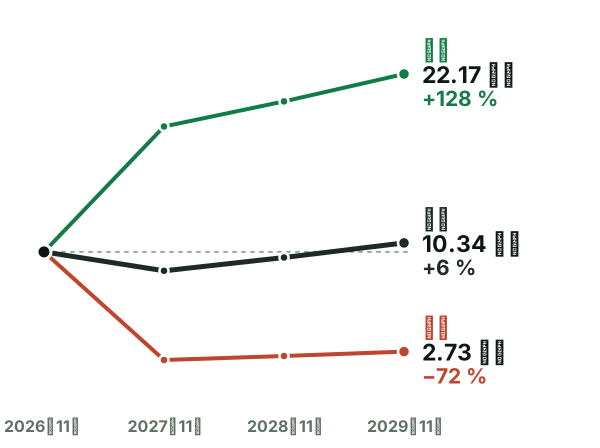
Our probability-weighted value is HK$8.46 in November 2027, a negative 13% return including dividends. It is HK$10.34 in November 2029, a positive 6% return including dividends. Bear, base and bull probabilities are 28%, 54% and 18%.
Peak-season execution in Q4 2026, pricing in 2027–2028 and New Markets returns by 2029 decide the outcome. J&T is a fast-growing network whose valuation depends on turning more parcels into durable cash.