What the business is
CR Mixc runs shopping centres and properties in China. It sells mall planning, tenant leasing and daily operations to owners. Before opening, it positions centres, recruits retailers and prepares launches. Afterward, it manages tenants, promotions and the shopping experience. It also provides security, cleaning, repairs and landscaping for homes, offices, industrial parks and public spaces. Developers, residents, institutions and public-sector clients pay management fees. CR Mixc can also sublease space, earning rent while carrying vacancy risk. Smaller ecosystem activities include membership, marketing, cosmetics, consulting and cultural operations.
At 30 June 2026, CR Mixc provided commercial services at 138 opened malls and managed 441 million square metres outside malls. Revenue was RMB18.02 billion in 2025. Commercial management produced the larger reported segment result despite lower revenue. Cash comes from fees, rent and related services. Staff, subcontractors, utilities, maintenance, leases and overhead consume it. Profitability rests on higher-margin mall work, tenant demand, fee collection and disciplined leasing. CR Land supplies a major project pipeline; third-party wins test whether the model travels beyond its parent.
The latest quarter and year
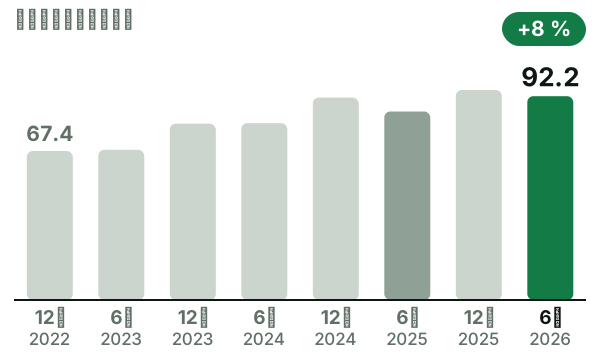
CR Mixc does not separately report a quarter; its latest reported period is the six months to June 2026. Revenue rose 8.1% to RMB9.22 billion. Shareholder profit rose 10.3% to RMB2.24 billion. Core profit rose 10.8% to RMB2.23 billion. Commercial revenue grew 13.2%. Same-mall sales, measured at malls open in both periods, rose 10.2%. Occupancy, the share of rentable space leased, reached 97.4%.
Property-management revenue grew 3.4%, but gross profit rose only 0.6%. Its margin fell from 18.8% to 18.3%. Ecosystem revenue accelerated from a small base, while cosmetics expansion lowered its margin.
In 2025, revenue growth slowed to 5.1% from 16.2% in 2024. Commercial management reached RMB6.91 billion, while property management reached RMB10.85 billion. Developer-facing services weakened as CR Land acquired less land and completed less area. CR Land properties generated about 86% of mall commercial-operational and property-management revenue. Residential current-year collection was 74.7% in the first half of 2026, while older receivables and impairment allowances rose.
Five fiscal years (RMB millions; per share in RMB)
Last eight reported periods (RMB millions; per share in RMB)
Who runs it
President YU Linkang has led Mixc since 2020 and CFO NIE Zhizhang has held the finance role since 2023. Chairman LI Xin also chairs CR Land. Yu received RMB3.22 million in 2025, including a discretionary bonus of RMB2.03 million. Nie received RMB2.68 million. The president’s assessment includes energy conservation and safety, while senior incentives can be clawed back after disciplinary breaches. No published formula ties pay to collections, cash or shareholder returns.
At 30 June 2026, Yu owned 317,400 shares and Nie owned 50,000. There was no stock-based pay or buyback through 2025. Diluted shares remained 2,282.5 million. China Resources controls Mixc; four of 11 directors are independent.
Guidance and our forecast
Management’s 2026 target is double-digit profit growth. First-half reported profit grew 10.3%; core profit grew 10.8%, so it met the target so far. It has no established habit of issuing detailed quarterly or annual earnings forecasts, so there is no prior formal forecast record to grade.
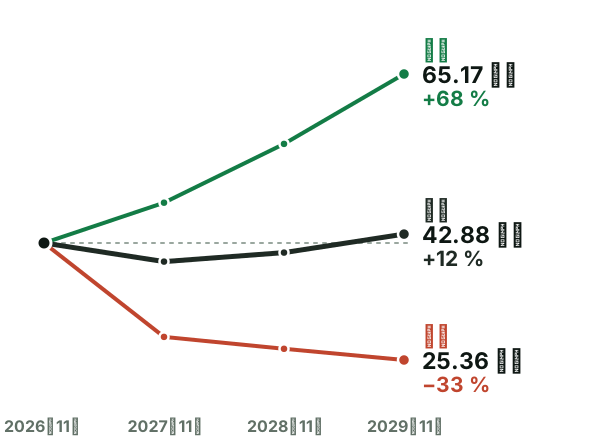
Our weighted forecast is HK$37.76 in November 2027, a 7% loss including dividends. It reaches HK$42.43 in November 2029, an 11% gain including dividends. The bear case has 28% probability and the base case 52%; the bull case has 20%.
The 2027 annual results should show whether openings, same-mall demand, collections and margins are becoming cash. Deployment of the remaining IPO proceeds by December 2027 tests capital allocation. By 2028, the Hangzhou lease tests fixed commitments. The stock is a high-quality commercial operator priced for growth, but its return depends on turning mall strength and parent access into cash from profitable, collectible contracts.