What the business is
Budweiser Brewing Company APAC Limited is a regional brewer focused on Asia. It sells mainstream and value beers such as Harbin, premium beers including Budweiser and Cass, and Super Premium brands such as Corona, Stella Artois, Hoegaarden and Budweiser Magnum. Core+ beers sit between premium and mainstream. Cass 0.0 and Zero Sugar products target new tastes and occasions.
The company sells through distributors, retailers, restaurants, bars and online platforms. A distributor buys beer from the brewer and resells it to sellers. In 2025, Bud APAC generated $5.76 billion of revenue and sold 79.7 million hectoliters, a hectoliter being 100 liters. Asia Pacific West, led by China, supplies most revenue; Asia Pacific East is mainly South Korea.
A dollar of revenue follows a clear path. About 50 cents pays for beer and packaging. Distribution takes roughly 8 cents. Sales and marketing take about 19 cents; administration takes another 8 cents. About 17 cents remains as operating profit before separately identified non-underlying items. Profitability depends on premiumization, strong revenue per hectoliter, and enough volume to spread brewery and distribution costs.
The latest quarter and year
In the third quarter of 2026, revenue was $1.45 billion and operating income was $180 million. Net income was $92 million. China volume fell 16.8%, while China normalized EBITDA fell 30.2%. China organic revenue fell 16.9%. India grew volume at double-digit rates, South Korea gained share, and online-to-offline sales grew strongly. O2O links a digital order to a nearby physical shop or delivery service.
The pivot is toward in-home consumption, O2O and BEES, the company’s digital ordering platform for wholesalers and retailers. Management is spending to repair China while expanding India. Excess Chinese trade inventory, promotions and lower brewery utilization remain the main concerns.
In 2025, revenue fell 7.7% to $5.76 billion. Volume fell 6.0% organically, and net income was $489 million. Free cash flow after capital spending and lease payments was $593 million. After $58 million of stock pay, $535 million remained on a stricter basis. Net cash was $2.72 billion.
Five fiscal years (US$ millions; per share in US$)
EPS, diluted — In 2025, $177 million of exceptional charges reduced diluted earnings per share; without them, earnings were $0.05 per share.
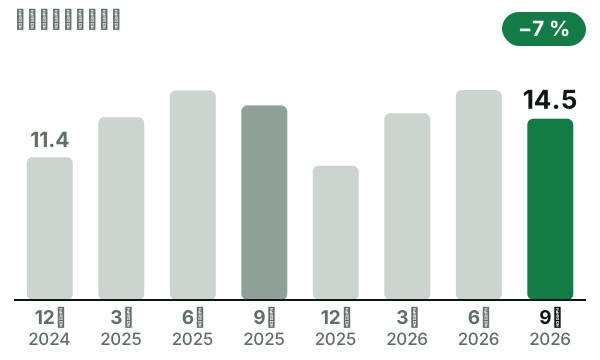
Last eight reported periods (US$ millions; per share in US$)
Operating margin — In fourth-quarter 2025, $46 million of exceptional operating charges turned a 2.0% operating margin into a reported loss.
Who runs it
Yanjun Cheng became chief executive and co-chair in April 2025. Bernardo Novick became finance chief in April 2026. Cheng’s bonus framework rewards operating earnings, revenue, investment spending, resource allocation, brand development and operations. His disclosed 2025 remuneration was $1.93 million.
Cheng owned 1.66 million ordinary shares as of June 2026. Company stock pay was $58 million in 2025, while buybacks were zero. Year-end shares were 13,243 million. Diluted average shares rose 0.3% in 2025, so stock awards create modest potential dilution without a recent buyback offset.
Guidance and our forecast
Management gives no quantified forecast. Its promise is to stabilize China’s volume and market share before pursuing margin recovery. It has not yet kept that promise: China share was still falling in the third quarter of 2026, and management said performance remained below potential.
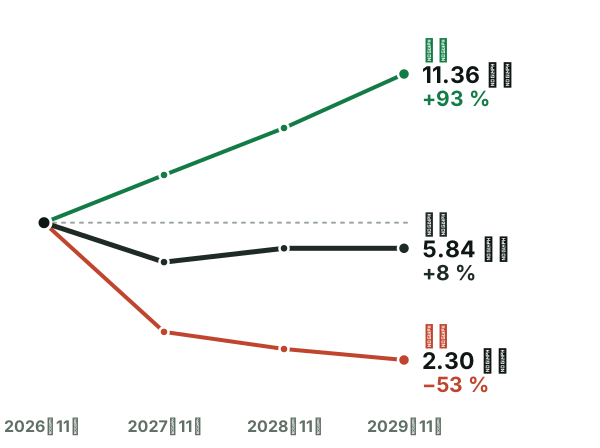
At November 2027, the weighted price is HK$4.90, a 20% loss. At November 2029 it is HK$5.15, a 5% loss. Both returns include dividends. The bear case has a 35% probability. The base case has 55%. The bull case has 10%.
By November 2027, China volume and share must stabilize. By November 2028, utilization and margins must improve. By November 2029, cash conversion must support investment and dividends. The stock is priced for a China repair that has not yet arrived; India, Korea and O2O must turn that repair into cash.