What the business is
Li Auto is a China-focused maker of premium electric family vehicles. In 2025 it delivered 406,343 vehicles and reported RMB112.31 billion of revenue. Its main customers are families buying directly through Li Auto’s stores and delivery network.
The L series consists of extended-range electric vehicles (EREVs): electric motors drive the wheels, while a fuel-powered generator supplies electricity when the battery needs help. The i series consists of battery-electric vehicles (BEVs), which depend entirely on stored electricity and charging. Li MEGA is a premium electric family MPV. Accessories, repairs, charging stalls, membership, and agency services add smaller revenue streams.
A customer’s payment becomes vehicle revenue when Li delivers the car. In 2025, vehicle sales produced RMB106.7 billion and other sales and services RMB5.6 billion. Li then pays for batteries, materials, labor, factories, stores, service, software, and charging infrastructure. Profit depends on price and model mix, vehicle costs, factory utilization, and whether volume covers research and selling expenses. Direct selling strengthens customer control but leaves Li carrying retail and service costs. The investment question is whether profitable vehicle scale can fund the wider electric ecosystem.
The latest quarter and year
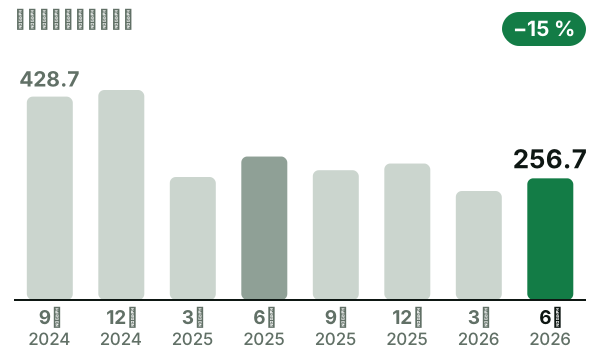
The latest reported quarter, June 2026, was better than March but much weaker than a year earlier. Revenue was RMB25.67 billion, down from RMB30.25 billion a year earlier. Deliveries were 98,330, down 11.5%. Gross margin was 11.0%, versus 20.1%. Vehicle margin was 9.4%, versus 19.4%. Operating loss was RMB2.30 billion and net loss RMB1.70 billion. Free cash flow computed as cash from operations minus capital spending was negative RMB1.30 billion, after negative RMB7.39 billion in March.
In 2025, revenue fell 22.3% to RMB112.31 billion. Deliveries were 406,343, down from 500,508 in 2024. Vehicle margin ended at 17.9% and operating margin at negative 0.5%. Net income attributable to ordinary shareholders was RMB1.12 billion, but computed free cash flow was negative RMB13.48 billion. Net cash remained RMB91.16 billion.
Li is shifting from its EREV-led franchise toward i-series BEVs and MEGA. Investors worry that BEVs may replace EREV demand before their margins, charging returns, inventory and cash generation are ready.
Five fiscal years (RMB millions; per share in RMB)
Operating margin — Extra tooling depreciation of RMB851.46 million lowered the 2025 operating margin; without it, the margin was 0.3%.
Real free cash flow, % of revenue — Excluding the RMB636.31 million founder award from stock pay raises the 2024 real free cash flow margin to 4.3%.
Last eight reported periods (RMB millions; per share in RMB)
Who runs it
Xiang Li, founder, chairman and chief executive, still runs Li Auto. Tie Li is chief financial officer. Xiang held approximately 22.34% of issued shares and controlled 68.42% of votes in the 2026 interim report. Tie held 14.37 million Class A shares at June 30, 2026.
Management’s share awards reward delivery milestones and performance conditions. Xiang Li’s founder award included RMB636.31 million of 2024 stock pay. It followed a rolling 12-month delivery threshold above 500,000 vehicles. Company stock pay fell to RMB1.26 billion in 2025 from RMB2.63 billion in 2024. Buybacks reached US$631.5 million by August 26, 2026, while diluted average shares rose 0.6% in 2025.
Guidance and our forecast
Management guided to 95,000–100,000 deliveries and RMB26.6–28.0 billion of revenue for the quarter to September 2026. Deliveries came in at 99,964, inside the range; financial results were not yet published. Past guidance earns 3/5. Delivery guidance was met or exceeded in six of eight quarters. Revenue guidance was met or exceeded in six of seven.
Our weighted value is HK$55.93 in November 2027, a 16% return. It is HK$70.46 in November 2029, a 46% return. The returns include dividends. The bear case carries 35% probability. The base case carries 47%. The bull case carries 18%.
The decisive evidence arrives through November 2029: refreshed L-series demand must hold, BEVs must scale at healthy margins, charging and factories must earn their cost, and cash burn must turn into computed free cash flow. Remember: Li Auto has the cash and brand to recover, but the investment works only if BEVs replace lost EREV economics with profitable volume.