What the business is
Sino Biopharmaceutical Limited develops, makes and sells medicines, mainly in China. Its products reach patients through hospitals, distributors and pharmacies. Patients, public insurance, private insurers and hospital budgets ultimately pay.
Its largest business is oncology, or cancer treatment. In the six months to June 2026, oncology generated RMB8.06 billion of product revenue. Liver and cardiometabolic medicines generated RMB3.38 billion, surgery and pain relief RMB3.21 billion, and respiratory and autoimmune medicines RMB1.36 billion. Brands include Focus V, Annike, Yilishu, Tianqing Ganmei, Zepolas and Anhengji. Biosimilars are biologic medicines highly similar to existing reference medicines.
Money comes mainly from medicine sales, with additional income from licensing and investments. It pays for ingredients, factories, promotion, distribution and research. In 2025, selling and distribution costs were RMB10.99 billion and R&D expense was RMB5.87 billion. Profit depends on new products gaining reimbursement, hospital access and prescriptions before price cuts and competition erode older products.
P/E, last 12 months — For earnings over the last 12 months to June 2026, removing RMB2.33 billion of net investment charges lowers P/E from 36.0 to 18.2.
The latest quarter and year
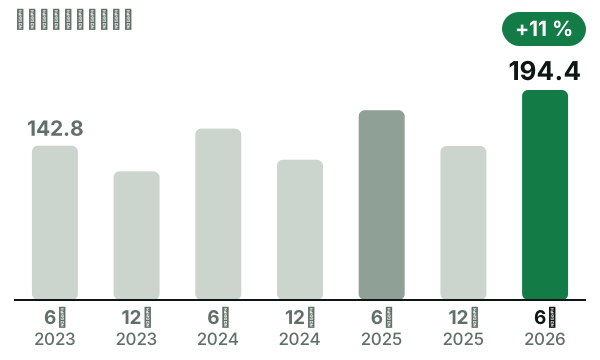
The latest reported period is the six months to June 2026. Revenue rose 10.6% year on year to RMB19.44 billion. Gross margin reached 83.0%, up from 82.5%. Net income was RMB3.43 billion, while diluted EPS was RMB0.19.
Innovative-drug sales rose 29.2% to RMB7.81 billion. Out-licensing contributed RMB0.98 billion after Sanofi paid US$135 million upfront for rovadicitinib. Profit rose only 1.4% because the prior-year half included an after-tax Sinovac dividend of RMB1.35 billion. Selling and distribution costs fell despite higher sales.
In fiscal 2025, revenue grew 10.3% to RMB31.83 billion. Innovative-product revenue reached RMB15.22 billion, or 47.8% of sales. Real free cash flow was RMB7.62 billion. Reported net income was RMB2.34 billion, against adjusted net income of RMB4.54 billion. The pivot toward innovative medicines, licensing and acquired research platforms is accelerating, but licensing is lumpy, procurement pressures mature products and acquisitions raise execution risk.
Five fiscal years (RMB millions; per share in RMB)
EPS, diluted — In 2025, removing RMB2.06 billion of net investment charges raises diluted earnings per share from RMB0.13 to RMB0.24.
Last seven reported periods (RMB millions; per share in RMB)
EPS, diluted — For July–December 2025, removing RMB2.39 billion of net investment charges changes diluted earnings per share from a RMB0.06 loss to a RMB0.07 profit.
Who runs it
Eric Tse has been chief executive since 2022. Li Chunling is CFO and joined the group in 1996. Eric Tse received RMB64.52 million in 2025, including a discretionary bonus of RMB41.49 million. The report does not disclose a formula linking that bonus to specific results.
Eric Tse disclosed 21.68% of the company. Cheng Cheung Ling disclosed 15.90%, while Tse Ping disclosed 9.06%. Stock pay was RMB115.97 million in 2025 and buybacks were RMB87.18 million. Average diluted shares fell 1.3%. The founding family therefore retains substantial influence alongside outside shareholders.
Guidance and our forecast
Management historically gave no quarterly or annual financial guidance. Its current targets include a 50% share of 2026 revenue from innovative drugs and out-licensing, with gross margin of 80%. It also targets 27 innovative products in 2026 and 30 launches by 2027. Seven siRNA candidates are expected to submit applications to begin human testing between the second half of 2026 and the first half of 2027. The company met its 2025 innovative-product target, reporting 47.8% against 45%.
Our weighted price is HK$6.18 in November 2027, implying a 12% return, and HK$6.90 in November 2029, implying a 29% return. Returns include dividends. The bear case carries 30%. The base case carries 50%. The bull case carries 20%.
The view turns on the 2026 full-year mix of medicine sales and licensing. TQB2102’s application was accepted on September 16, 2026. HJY-22 is planned for human-testing submission in the first quarter of 2027, while a bepirovirsen decision is expected in the first half of 2027. Remember: the shares work if innovative products become recurring, parent-attributable sales.