What the business is
CSPC Pharmaceutical Group is a Chinese drugmaker with RMB26.01 billion of 2025 revenue. It sells finished medicines, bulk pharmaceutical ingredients (APIs—the substances used to make medicines), functional-food products and licences to develop its discoveries. Finished drugs, including the stroke medicine NBP, are its largest business, with RMB20.58 billion of 2025 revenue.
Distributors and hospitals buy its prescription medicines. Public insurance, hospitals and patients ultimately fund demand. Manufacturers buy vitamin C, antibiotics and caffeine ingredients. Pharmaceutical partners pay for development and commercial rights.
Cash usually comes in after product deliveries, when distributors pay. Licensing brings upfront payments, milestones and royalties, but these arrive unevenly. Cash then leaves through manufacturing, selling, research, clinical trials, capital spending and dividends. Profit depends on established brands retaining clinical relevance, new products reaching hospitals, and prices surviving China’s reimbursement and volume-based procurement system. Bulk ingredients add scale but bring commodity cycles. The central question is whether CSPC can replace price-eroded medicines with differentiated products.
The latest quarter and year
The June 2026 quarter was spectacular on reported numbers. Revenue was RMB12.13 billion and net income was RMB5.23 billion. AstraZeneca licence recognition contributed RMB5.74 billion. Underlying goods revenue was about RMB6.38 billion, up 8.1% year on year. First-half goods sales rose 4.1%. Finished-drug goods sales rose 10.8%, and nervous-system sales grew 27.6%.
AstraZeneca paid US$1.2 billion upfront on 29 May 2026. A US$25 million research milestone arrived on 10 July. These validate the platform but do not create recurring prescription sales.
In 2025, revenue fell 10.4% to RMB26.01 billion. Finished-drug goods sales fell 20.8%, while licence income rose to RMB1.79 billion. Net income fell to RMB3.88 billion. R&D rose to RMB5.81 billion. Selling and distribution expense fell to RMB6.46 billion. Oncology and NBP faced price pressure after procurement and reimbursement changes. The recovery in product sales is encouraging, but licence income and lower prices make earnings quality the worry.
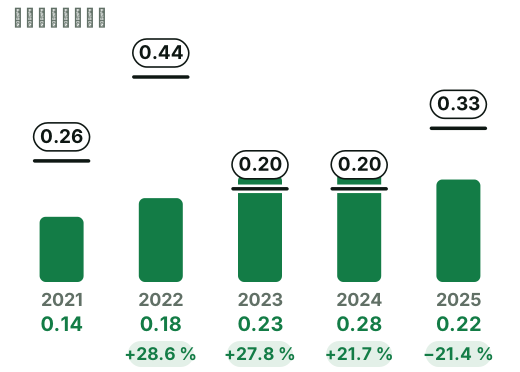
Five fiscal years (RMB millions; per share in RMB)
Last eight reported periods (RMB millions; per share in RMB)
Who runs it
Cai Lei became chief executive and vice-chairman in December 2025. Qu Zhiyong handles Hong Kong listing and financial affairs, while disclosures do not identify a group CFO. Cai Dong Chen remains chairman and owns 26.39% of the company. Cai Lei owns 40,000 shares; Qu Zhiyong owns 90,003.
The remuneration framework rewards group performance, individual responsibility and market practice. Cai Dong Chen received RMB14.27 million in 2025, including a RMB9.16 million performance bonus. Stock pay was a negative RMB65.95 million after awards lapsed, while CSPC spent RMB140.81 million buying shares for employee awards. Average diluted shares were 11,423.692 million in 2025, down 2.7%.
Guidance and our forecast
Management targets at least 50 IND approvals in 2026. It also expects 15 major readouts in the six months to December 2026. The plan calls for 20 generic launches in 2026–27 and 30 launches in 2026–28. The 2025 record included five new-drug approvals and 20 pivotal-trial starts, but commercial productivity remains unproved.
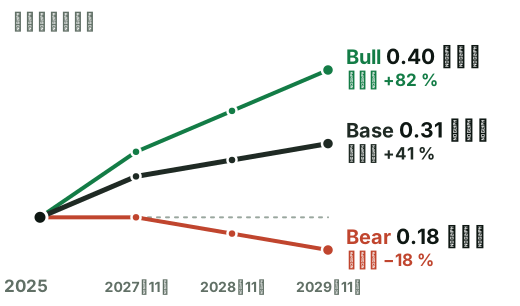
Our weighted price is HK$4.68 in November 2027, a 40% loss including dividends. It is HK$6.35 in November 2029, a 12% loss. The bear case carries 28%. The base case carries 53%, and the bull case 19%.
The view turns on procurement recovery, recurring product cash and pipeline conversion. Provisional results are due on 13 November 2026. Dollar forwards settle on 25 November and 18 December 2026. The August 2026 SYS6010 result and anbenitamab’s regulatory review are near-term tests.
The stock is a bet that CSPC can replace price-eroded medicines with recurring product cash before licence income fades.