What the business is
MTR Corporation Limited sells Hong Kong rail and bus journeys, station access, property development and rent, and railway services. Its customers include passengers, retailers, advertisers, telecom providers, property developers, tenants and public-sector railway partners. It carried 975.4 million rail and bus journeys in the first half of 2026 and reported HK$55,465 million revenue in 2025. Money comes from fares, rents, property profits and railway-service contracts.
- The Fare Adjustment Mechanism sets annual fare changes using half the change in consumer prices, half the change in transport wages and a productivity factor.
- Under Rail plus Property, developers usually pay the land premium and construction costs. MTR receives an agreed share of profit, cash or property.
- Malls, offices and station shops provide rental income, while overseas railway contracts expose MTR to operating costs and performance obligations.
- More journeys do not guarantee transport profit: Hong Kong transport operations carried more than 970 million journeys in the first half of 2026.
The challenges
Lumpy property profits. Development profit depends on project timing and market conditions. In the first half of 2026, property profit was HK$12,233 million against HK$3,434 million of recurrent business profit. Earnings can therefore swing sharply.
Regulated fares, costly railway. The fare formula limits how quickly prices respond to costs. In the first half of 2026, transport operations recorded a HK$141 million EBIT loss despite carrying more than 970 million journeys.
Construction and renewal cash demand. Expansion and upkeep require cash before benefits arrive. MTR cited about HK$140 billion of committed railway investment, while its own free cash flow was negative in each of the five years shown.
Public duties and project exposure. Government ownership and project agreements shape commercial choices. The Government held 74.45% of ordinary shares, and MTR agreed to pay HK$2,250 million over the High Speed Rail delay dispute.
The numbers
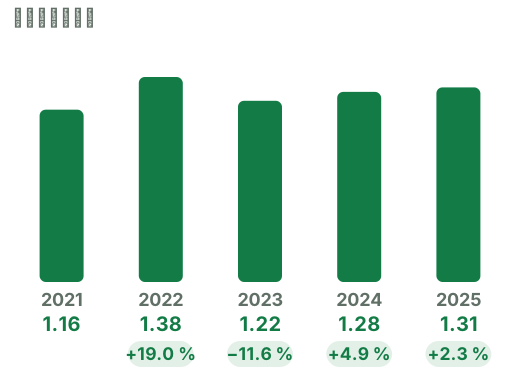
Revenue fell from HK$60,011 million in 2024 to HK$55,465 million in 2025. Net debt rose from HK$21,356 million in 2021 to HK$37,255 million in 2025, while real free cash flow stayed negative in all five years shown. The key figure is 2025 real free cash flow per share of -HK$1.71. Diluted EPS was HK$2.36.
How it earns, and what can hurt it (HK$ millions)
Operating margin — The HK$1,360 million mall valuation gain increased operating margin; without it, the margin was 16.6%.
What one share gets (HK$ per share; share-count changes in %)
EPS, diluted — The HK$1,478 million THE SOUTHSIDE valuation gain lifted diluted earnings per share; without it, earnings were HK$2.12.
The verdict
MTR's weighted forecast points below today's HK$32.38, hinging on property cash receipts, recurring business performance and debt growth.
Management forecasts expenditure of HK$27,200 million in 2026 and HK$29,800 million in 2027. Two projects are expected to be tendered in the 12 months from August 2026. Fares remain unchanged for 2026/27, with a 1.4% adjustment expected to be recouped in 2027/28.
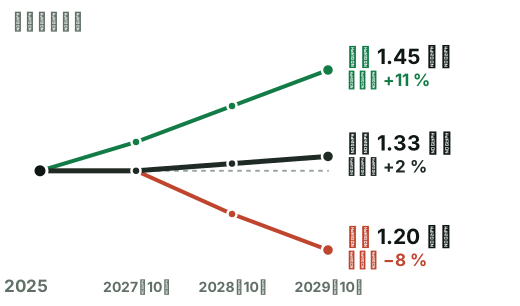
The weighted forecast is HK$20.72 in October 2027, a -32% total return. It is HK$16.64 in October 2029, a -36% total return. The bear case carries 25% probability. The base case carries 55%, and the bull case 20%.
The coming 12 months will test whether property proceeds can support railway investment as projects move from tender to cash receipt. Fare recoupment in 2027/28 and transport results through 2027–2028 will show whether fares keep pace with operating costs. Cash conversion and net debt through 2028 and 2029 will test dividend resilience.
The investment turns on whether property cash can fund railway growth without worsening cash conversion, debt or dividend pressure.