What the business is
Power Assets Holdings Limited is an investment holding company, not a single operating shopfront. Its stakes span electricity networks, power generation, gas networks and pipelines, and renewables. It earns through the businesses it owns. In Victoria, its electricity distributors serve 2 million customers across 65% of the state, and customers generally cannot choose another local network for their address. A household pays its retailer; the retailer pays the distributor’s regulated charge for delivering power.
- Retailers collect household bills and pay the local network’s regulated charge, a fee set by a regulator; distribution was around 27% of the average South Australian residential bill in 2025/26.
- Regulators set what networks may charge and which investment can earn a return. Recovery is approval to include that spending in customer charges; the Victorian distributors cover 2 million customers across 65% of Victoria.
- Power Assets records its share of profits from joint ventures, businesses jointly owned with partners, and associates. In 2025, that share was HK$6,142 million. Parent revenue was HK$771 million, while cash reaches the parent later through dividends, interest or other distributions.
The challenges
Regulatory returns and recovery. A network can spend before higher charges take effect. Rejected or delayed recovery—approval to include network spending in customer charges—can leave it earning below its permitted return. Spending adds value only when regulators accept it for recovery.
Investee cash and control. Reported profits do not guarantee parent cash. Investees may retain earnings for investment, while partners, lenders and agreements shape distributions. Power Assets therefore cannot treat equity-accounted profit as cash ready for its own distributions.
Gas and transition risk. Electrification—replacing fuel-burning equipment with electrically powered equipment—may support power grids while reducing demand for gas assets. Australian Gas Networks expects South Australian system demand to fall 2.4% a year during 2026/27–2030/31.
Replacing UKPN income. The May 2026 sale brought cash but removed future earnings. Power Assets now depends on whether that capital can rebuild dependable income, making reinvestment the test of the portfolio’s next earnings base.
The numbers
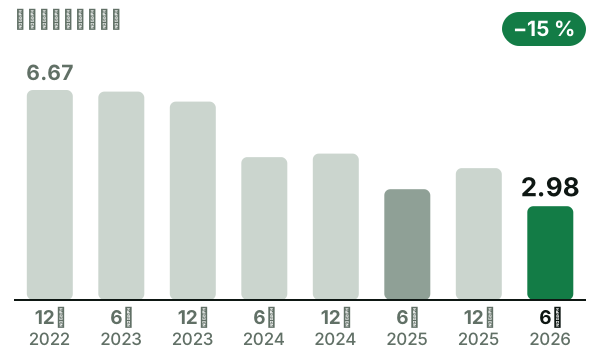
The stock is valued above book, with its forward earnings multiple making expectations visible. Five-year net income shows the underlying direction, while disposal gains and other one-off items interrupt recurring portfolio earnings. In 2025, FFO was below shareholder dividends, and investee distributions were about 71% of equity-accounted profit, the owner’s reported share from jointly owned or associated businesses. Book value per share rose in 2025 after declining in 2024. Dividend per share stayed unchanged across five years.
How it earns, and what can hurt it (HKD millions)
What one share gets (HKD per share)
The verdict
The price could be broadly flat through October 2029, hinging on stable post-UKPN earnings, cash reaching the parent and productive reinvestment. Management gives no regular quarterly or full-year results forecast. Its stated aim is stable returns from mature, well-regulated, low-risk markets.
The weighted price is HK$54.33 in October 2027, a 6% loss with dividends. It is HK$53.28 in October 2029, a 2% gain with dividends. The bear case has 26% probability, and the base case 56%. The bull case has 18%.
The base case needs recurring earnings to stabilize after the UK disposals while the dividend stays at HK$2.82 per share. GT8 and GT10 must enter service progressively from early 2027, with GT9 following by late 2028. HK Electric’s L13 gas-fired unit is scheduled for commissioning—testing and preparing new equipment before it operates—in 2029. AVR’s full electricity generation was expected to restart in the second half of 2026. The investment turns on dependable post-UKPN cash and returns from new capacity.