What the business is
CLP Holdings Limited sells electricity, gas and energy services to households, businesses, public bodies and wholesale buyers—organisations that buy electricity in bulk for resale or use. CLP Power Hong Kong serves 2.895 million customer accounts and more than 80% of the city’s households. The group reported HK$88,018 million in 2025 revenue. Money arrives through regulated electricity bills, retail plans, wholesale power sales and service contracts across Hong Kong, EnergyAustralia, CLPe and regional generation and network investments.
- In Hong Kong, tariffs—regulated electricity prices—recover approved costs and provide an 8% permitted return on average net fixed assets.
- Fuel adjustments pass differences between standard and actual fuel costs through customer bills over time.
- EnergyAustralia combines retail earnings with generation and wholesale trading. Hedges limit exposure to future price moves, but retail prices and wholesale costs can diverge.
- Generators sell power to wholesale buyers or under PPAs, long-term electricity purchase contracts; CLPe also earns from equipment, installation and ongoing services.
The challenges
Hong Kong returns and investment. CLP Power’s allowed return depends on average net fixed assets. The HK$52.9 billion 2024–2028 development plan must add useful capacity without excessive cost or unused assets. Fuel adjustments protect the mechanism, but timing affects cash and bills.
Australian retail and generation. EnergyAustralia must balance generation, customer pricing and hedges. Its operating earnings contribution was HK$591 million in 2024. It fell to HK$85 million in 2025 as retail weakness offset improved wholesale energy. It also lost 83,000 accounts.
Yallourn replacement. Yallourn is a 1,480 MW station scheduled to retire in mid-2028. Wooreen is scheduled for Q3 2027 at 350 MW. Its stated capacity is 1,400 MWh. Timing and contribution do not prove an equal replacement of Yallourn’s earnings.
Funding the transition and dividends. CLP’s own 2025 free cash flow was below dividends paid, while capital investment was HK$16.4 billion. Net debt was HK$62,209 million at June 2026. Delays or weaker returns could pressure funding and distributions.
The numbers
The tables show revenue and margin moving with fuel pass-through and volatile Australian results, while diluted EPS remains volatile against steadier dividends. Net debt rises across the period shown. The key cash number is that CLP’s own 2025 free cash flow per share was below dividends paid per share.
How it earns, and what can hurt it (HK$ millions)
Operating margin — The HK$5,868 million Australian goodwill write-off lowered 2023 operating margin to 10.7%; without it, operating margin was 17.4%.
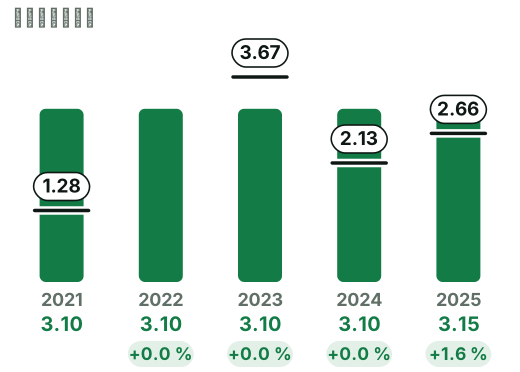
What one share gets (HK$ per share; change in %)
EPS, diluted — The HK$5,868 million Australian goodwill write-off reduced 2023 earnings per share to HK$2.63; without it, earnings per share were HK$4.96.
The verdict
CLP offers gradual appreciation, but the outcome hinges on Hong Kong’s regulated earnings base holding up while Australian operations recover and replacement projects arrive on time.
Management’s timetable targets Mount Piper’s 730 MW upgraded unit in 2026. It targets Wooreen in Q3 2027 and Hallett in the second half of 2027, alongside Indian transmission and solar milestones. The plan must fund Hong Kong network investment and regional growth while projects are completed on schedule.
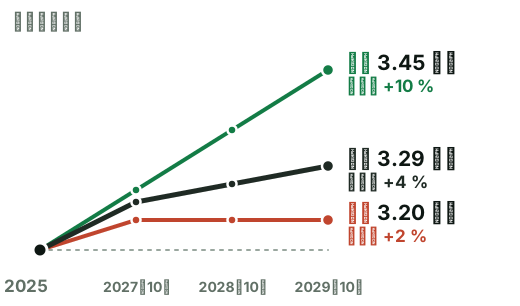
The weighted price is HK$81.48. It implies a 10% total return in October 2027. At the last forecast date, it reaches HK$88.09. That implies a 27% total return in October 2029. The bear case probability is 25%. The base case is 55%. The bull case is 20%.
Project delivery is the near-term test. Mount Piper is targeted for 2026. Wooreen and Hallett are due in 2027, ahead of Yallourn’s mid-2028 retirement. EnergyAustralia’s billing-platform choice is expected in Q4 2026, followed by implementation expected to take about two and a half years. Customer retention is the key recovery measure. From 2028 into 2029, new assets must generate cash after maintenance, investment and debt service.
The dividend case rests on turning regulated stability and project delivery into cash.