PG&E dividend
MyStockButler's October 2026 analysis: PG&E paid $220 million in dividends during 2025, after $86 million in 2024, and the board doubled the quarterly common dividend to 5 cents a share in December 2025. In 2025, PG&E spent more on capital projects than its operations generated, producing negative free cash flow.
How much does PG&E pay its shareholders?
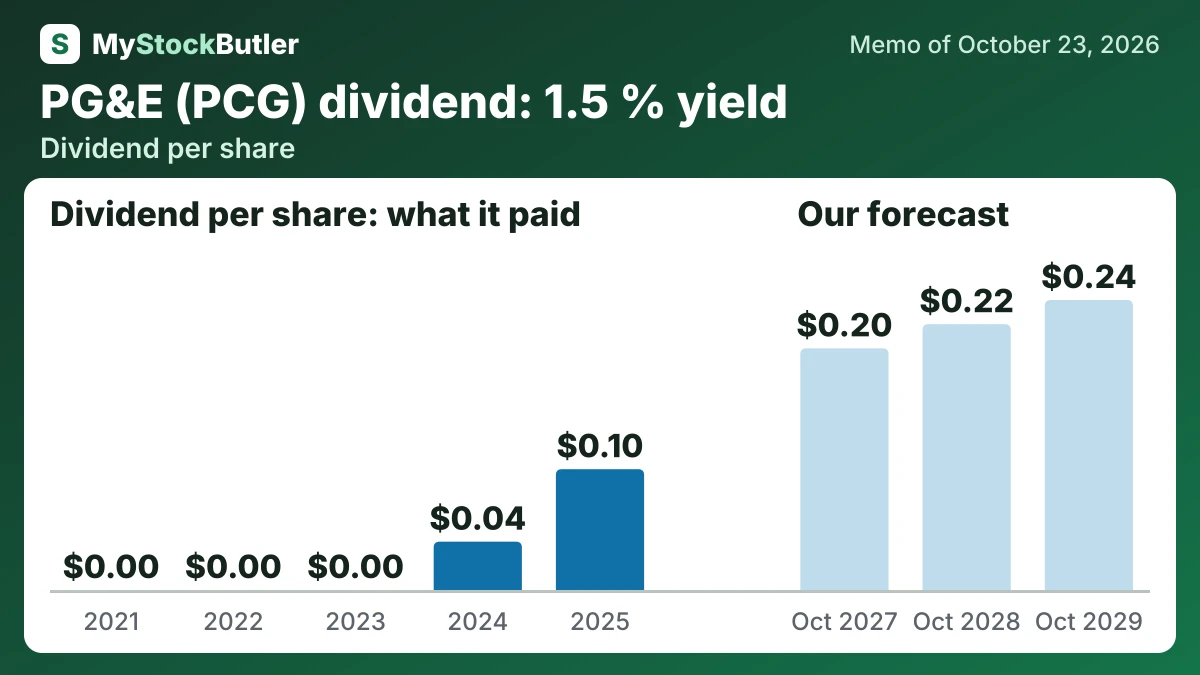
Dividends returned as the physical program continued. PG&E paid $220 million in dividends during 2025, after $86 million in 2024, and the board doubled the quarterly common dividend to 5 cents a share in December 2025. The payments remain small beside construction needs, but they compete with debt reduction and investment. PG&E produced tangible safety work and a larger system; it has not yet shown that the system can fund all of that investment and its distributions from internal cash. The real test is the risk removed and service gained per dollar—not the size of the spending alone.
| 2025 | 2024 | 2023 | 2022 | 2021 | |
|---|---|---|---|---|---|
| Free cash flow per share | -1.39 | -1.09 | -2.32 | -2.75 | -2.73 |
| − Dividends paid, per share | 0.10 | 0.04 | 0.00 | 0.00 | 0.00 |
| − Share buybacks, per share | 0.00 | 0.00 | 0.00 | 0.00 | 0.00 |
| = Paid out more than FCF, per share | 1.50 | 1.13 | 2.33 | 2.78 | 2.73 |
Does PG&E’s cash cover its dividend?
Construction is the central fact. In 2025, PG&E spent more on capital projects than its operations generated, producing negative free cash flow. Deducting stock compensation makes the ownership cost more visible because shares issued to employees dilute other shareholders. The deficit widened as capital spending rose faster than operating cash.
| 2025 | 2024 | 2023 | 2022 | 2021 | |
|---|---|---|---|---|---|
| Free cash flow | -3,071 | -2,334 | -4,967 | -5,863 | -5,427 |
| − Dividends paid | 220 | 86 | 0 | 0 | 0 |
| − Share buybacks | 0 | 0 | 0 | 0 | 0 |
| = Paid out more than the free cash flow | 3,305 | 2,434 | 4,981 | 5,933 | 5,427 |
| = Cash fell by | 320 | ||||
| Paid out, % of free cash flow | not meaningful | not meaningful | not meaningful | not meaningful | not meaningful |
What this means. The company’s negative free cash flow means it spent more cash than its business generated, so it used borrowing and other cash sources to cover its payouts and investments.
What could change PG&E’s dividend?
The dividend stays at $0.20 per share in 2027, matching the current annualized rate from the latest $0.05 quarterly payment. The base rises to $0.22 in 2028 and $0.24 in 2029. The bear remains flat because free cash flow has been negative, while the bull reaches $0.28 if recovery and funding improve.
A negative wildfire prudency ruling or delayed recovery between November 2026 and October 2027 would move the forecast toward the bear case by hurting earnings, cash flow and the multiple.
| October 2027 | October 2028 | October 2029 | |
|---|---|---|---|
| Earnings | 3,860 (3,450 / 4,060) | 4,150 (3,400 / 4,400) | 4,400 (3,500 / 4,800) |
| Shares (millions) | 2,207 (2,207 / 2,205) | 2,279 (2,389 / 2,271) | 2,283 (2,393 / 2,275) |
| Dividends per share | 0.20 (0.20 / 0.20) | 0.22 (0.20 / 0.24) | 0.24 (0.20 / 0.28) |
| Price to earnings | 9.00 (7.00 / 11.00) | 9.00 (6.00 / 13.00) | 9.50 (5.50 / 15.00) |