CPKC dividend: payout, cash cover and yield
MyStockButler's October 2026 analysis: CPKC pays dividends to shareholders, and its cash generation covers the dividend. In 2025, dividends and buybacks together exceeded free cash flow, so capital spending, debt and cash also matter.
How much does CPKC pay per share?
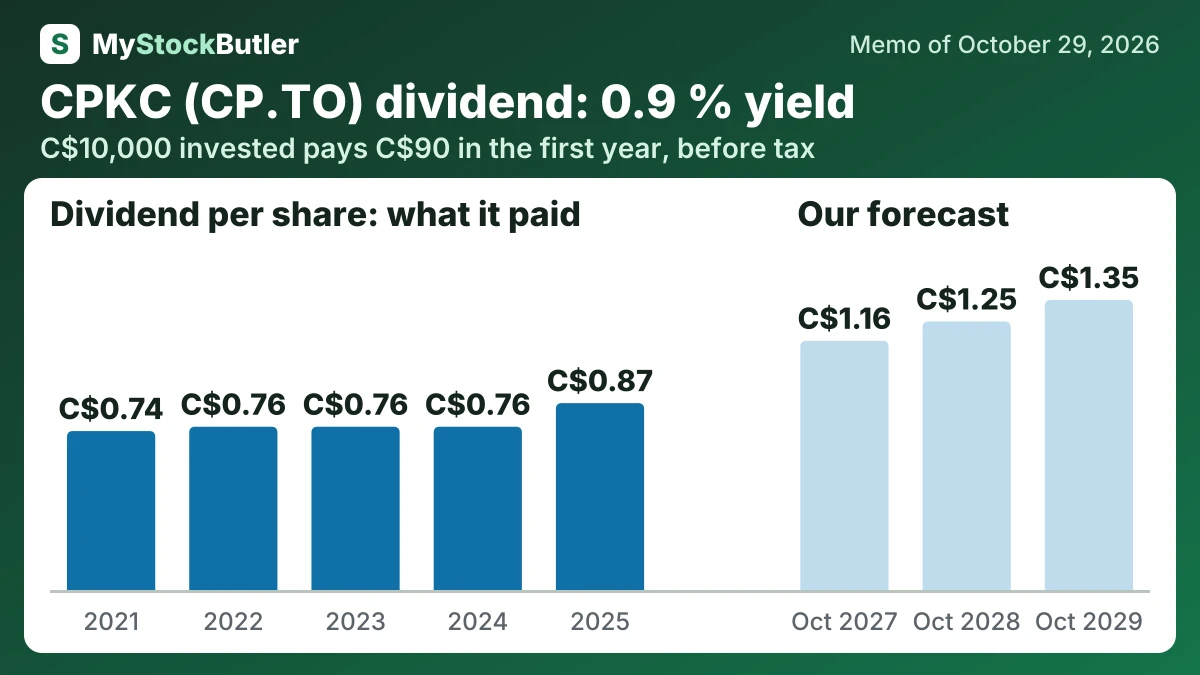
Dividends rise from the current annualized C$1.072 to C$1.35 in the base case by October 2029. The bear case holds the payment flat, while the bull case reaches C$1.63. The base uses 8% annual growth: below the low-double-digit EPS outlook because debt and capital spending compete for cash. The bull case requires sustained earnings and cash-flow strength; the bear case reflects the possibility that management protects investment and the balance sheet.
| 2025 | 2024 | 2023 | 2022 | 2021 | |
|---|---|---|---|---|---|
| Revenue | 15,078 | 14,546 | 12,555 | 8,814 | 7,995 |
| Net income | 4,141 | 3,718 | 3,927 | 3,517 | 2,852 |
| EPS, diluted | 4.51 | 3.98 | 4.21 | 3.77 | 4.18 |
| Dividend per share | 0.87 | 0.76 | 0.76 | 0.76 | 0.76 |
What this means. Revenue growth jumps in 2023 and 2024 mainly because the company added Kansas City Southern, not because sales from the existing business grew that fast.
How much would CPKC's dividend pay you?
C$10,000 invested in CPKC at its 0.9% dividend yield (our report of October 29, 2026) pays C$90.00 in the first year, before tax. If its dividend per share keeps changing 4.1% a year, as it did from 2021 to 2025, and the dividends are reinvested, year 10 pays C$142.48, with C$1,141.70 received in all.
Before tax. Past dividend growth is not a promise. Information only, not investment advice.
Does CPKC's dividend get covered by its cash?
Free cash flow is the cash left after operating and investing in the railway, but it is available to investors only after adequate spending on rails, bridges, locomotives and terminals. In the nine months ended September 30, 2026, operations generated C$4.252 billion. Investing used C$2.014 billion, leaving about C$2.238 billion before financing, against C$644 million of dividends paid. CPKC expects C$2.65 billion of capital spending in 2026, about 15% below 2025, so investors must decide whether the reduction reflects efficient timing or postponed maintenance.
Shareholder payments accelerated in 2025. CPKC bought back C$3.9 billion of shares and paid C$796 million in dividends. Together, those payments equaled 219.6% of that year’s free cash flow, funded partly by asset sales, existing cash and borrowing. The remaining question is whether the combined railway can earn enough to justify that choice.
| 2025 | 2024 | 2023 | 2022 | 2021 | |
|---|---|---|---|---|---|
| Free cash flow | 2,158 | 2,393 | 1,625 | 2,481 | 2,148 |
| − Dividends paid | 796 | 709 | 707 | 707 | 507 |
| − Share buybacks | 3,942 | 0 | 0 | 0 | 0 |
| = Free cash flow not paid out | 1,684 | 918 | 1,774 | 1,641 | |
| = Paid out more than the free cash flow | 2,580 | ||||
| Paid out, % of free cash flow | 219.6% | 29.6% | 43.5% | 28.5% | 23.6% |
What this means. The company's own net debt is higher because it adds certain pension and lease amounts that our simple calculation leaves out.
What could change CPKC's dividend?
Capital spending and debt service are the second test. CPKC’s 2026 programme is approximately C$2.65 billion, so spending above the forecast or weaker cash conversion would restrict buybacks and dividends. A miss against the next-twelve-month EPS estimate of 5.96444 would weaken the base case near October 2027.
| October 2027 | October 2028 | October 2029 | |
|---|---|---|---|
| EBITDA | 8,630 (7,898 / 8,875) | 9,148 (8,056 / 9,674) | 9,697 (8,298 / 10,545) |
| Shares (millions) | 850 (863 / 845) | 839 (861 / 826) | 829 (858 / 807) |
| Dividends per share | 1.16 (1.07 / 1.23) | 1.25 (1.07 / 1.42) | 1.35 (1.07 / 1.63) |
| Enterprise value to ebitda | 16.00 (14.50 / 18.00) | 15.50 (13.50 / 18.50) | 15.00 (12.50 / 19.00) |
| Net debt | 25,965 (26,001 / 26,621) | 25,075 (24,978 / 27,063) | 23,989 (23,646 / 27,328) |
What is CPKC's dividend yield against its price?
The price buys a valuable railway whose present cash return is modest, so the investment depends on future earnings growth.