PCA dividend: payout, cash cover and yield
MyStockButler's October 2026 analysis: PCA pays $6.00 per share annually, after raising its annual dividend from $5.00. Its cash record shows shareholder payments consumed nearly all free cash flow, so coverage depends on cash left after investment and debt needs.
How much does PCA pay its shareholders?
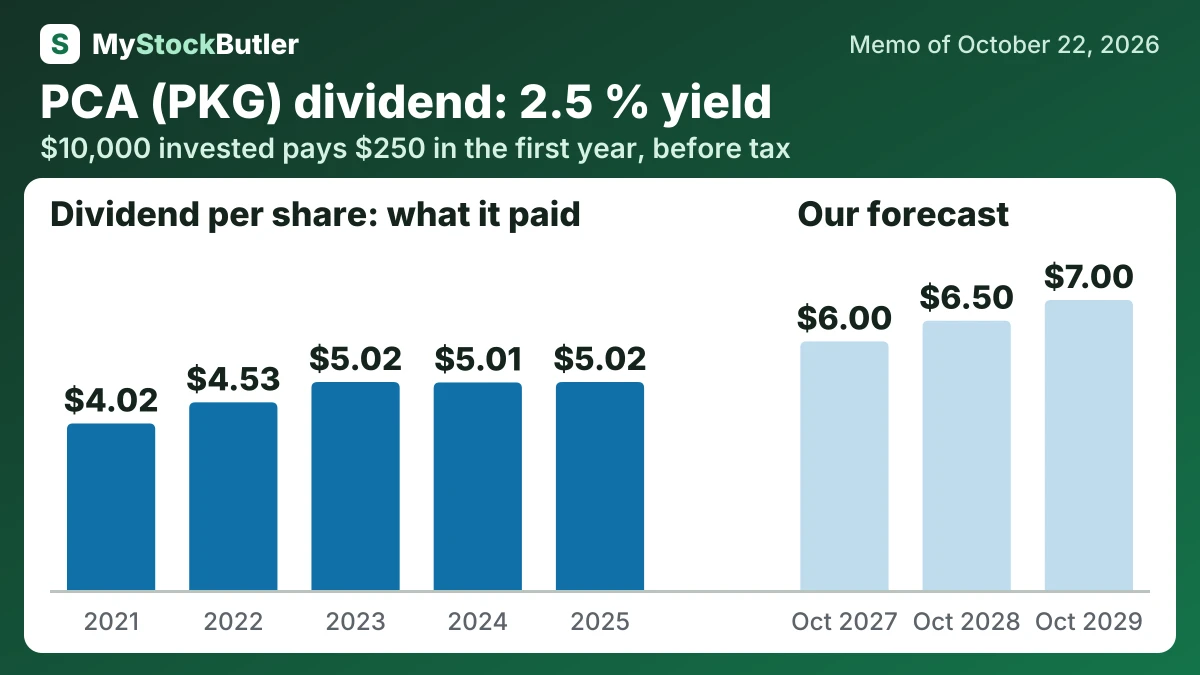
On May 12, 2026, PCA raised its annual dividend from $5.00 to $6.00 per share. The increase was 20%, which rewards shareholders but leaves less cash available for debt reduction, all else equal.
| 2025 | 2024 | 2023 | 2022 | 2021 | |
|---|---|---|---|---|---|
| Free cash flow per share | 8.13 | 5.83 | 9.45 | 7.24 | 5.17 |
| − Dividends paid, per share | 5.02 | 5.01 | 5.02 | 4.53 | 4.02 |
| = FCF not paid out, per share | 1.41 | 0.81 | 3.97 |
What this means. The company's own free cash flow per share is almost the same as ours because rounding changes it slightly, but our real figure is lower because it also counts shares given to employees as pay.
How much would PCA's dividend pay you?
$10,000 invested in PCA at its 2.5% dividend yield (our report of October 22, 2026) pays $250.00 in the first year, before tax. If its dividend per share keeps changing 5.7% a year, as it did from 2021 to 2025, and the dividends are reinvested, year 10 pays $544.95, with $3,768.27 received in all.
Before tax. Past dividend growth is not a promise. Information only, not investment advice.
Is PCA’s dividend covered by its cash?
Capital spending supported mills, reliability, and box-making facilities before cash became available for dividends or acquisitions. The company’s five-year record shows substantial investment alongside shareholder payments that consumed nearly all free cash flow. Free cash flow is the cash left after operating the business and paying for necessary plant and equipment.
In 2022, PCA paid out more than that year’s free cash flow, drawing on existing resources. That is possible because free cash flow is a yearly measure, while cash already on hand and borrowing can cover a shortfall. In 2024, PCA made no buybacks or acquisitions and repaid debt. In 2025, it paid shareholders, bought Greif, and increased debt to finance the expansion.
| 2025 | 2024 | 2023 | 2022 | 2021 | |
|---|---|---|---|---|---|
| Free cash flow | 728.6 | 521.5 | 845.4 | 670.8 | 489.0 |
| − Dividends paid | 449.6 | 448.8 | 448.9 | 420.3 | 379.8 |
| − Share buybacks | 153.0 | 0 | 41.5 | 522.6 | 193.0 |
| = Free cash flow not paid out | 126.0 | 72.7 | 355.0 | ||
| − Total debt | 3,974.5 | 2,483.0 | 2,882.5 | 2,486.3 | 2,485.9 |
| Paid out, % of free cash flow | 82.7% | 86.1% | 58.0% | 140.6% | 117.1% |
What this means. In 2022 and 2021, the company paid shareholders more cash than the business generated, so it had to use savings or borrow money.
What could change PCA’s dividend?
The base dividend rises from $6.00 to $7.00 per share. The bear case cuts it to $5.00 after 2027, while the bull case reaches $8.00. PCA raised the dividend to $6.00 in May 2026, but 2025 dividends consumed 61.7% of free cash flow.
The first near-term checkpoint is Q4 2026, when management expects adjusted EPS of $2.81. By September 2027, the key test is whether Greif benefits reach the $60M pretax target.
| October 2027 | October 2028 | October 2029 | |
|---|---|---|---|
| Normal operating profit | 1,370 (1,120 / 1,540) | 1,450 (1,050 / 1,680) | 1,500 (1,180 / 1,760) |
| Shares (millions) | 88.82 (89.10 / 88.42) | 88.56 (89.20 / 87.79) | 88.31 (89.30 / 87.19) |
| Dividends per share | 6.00 (6.00 / 6.00) | 6.50 (5.00 / 7.00) | 7.00 (5.00 / 8.00) |
| Net debt | 3,188 (3,448 / 3,081) | 3,076 (3,519 / 2,912) | 2,903 (3,410 / 2,679) |