PCA stock forecast 2027–2029
MyStockButler's October 2026 analysis: PCA's weighted scenario is $238.48 in October 2029, an 8% total return including dividends. PCA's outlook hinges on price realization, Greif returns and durable cash after upkeep.
Where could PCA's shares go?
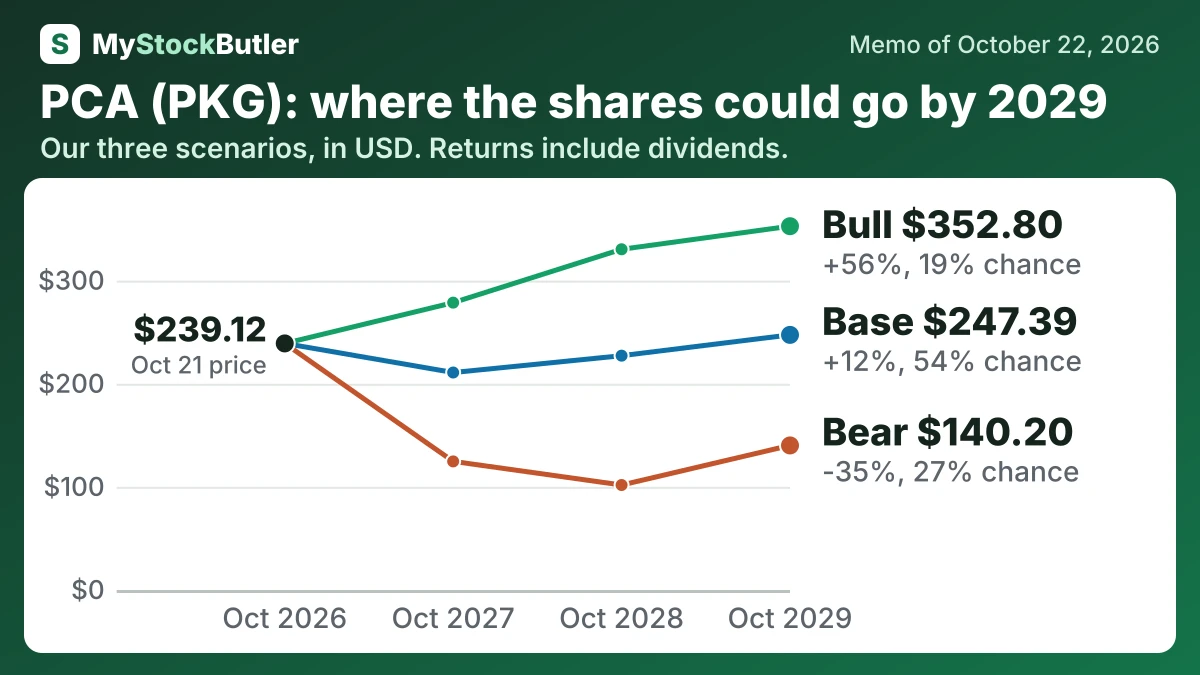
The base case carries the highest probability, 54%, and reaches $247.39 in October 2029. The bear case reaches $140.20; the bull case reaches $352.80. Probabilities are 27% bear, 54% base and 19% bull.
| Case | Probability | October 2027 | October 2028 | October 2029 |
|---|---|---|---|---|
| Bear | 27% | 124.71 (-45%) | 101.80 (-53%) | 140.20 (-35%) |
| Base | 54% | 210.90 (-9%) | 227.24 (+0%) | 247.39 (+12%) |
| Bull | 19% | 278.66 (+19%) | 330.42 (+44%) | 352.80 (+56%) |
| Weighted | 100% | 200.50 (-14%) | 212.98 (-6%) | 238.48 (+8%) |
What could make PCA's forecast work or fail?
Better reliability and freight savings lift margins toward the 2022 high. Stronger cash generation funds debt reduction and larger buybacks, while investors sustain a premium multiple. The bull price is $278.66 in 2027 and $352.80 in 2029. Its probability is 19% because several execution steps must succeed while capex and outage costs remain high.
The view would move toward the bear case if 2027 shipments weaken, excess capacity limits realized prices, or margins fall. Delayed synergies and rising outages would reduce free cash flow in 2027 and 2028. Heavy capex and dividends could then prevent debt reduction through 2029.
| October 2027 | October 2028 | October 2029 | |
|---|---|---|---|
| Normal operating profit | 1,370 (1,120 / 1,540) | 1,450 (1,050 / 1,680) | 1,500 (1,180 / 1,760) |
| Shares (millions) | 88.82 (89.10 / 88.42) | 88.56 (89.20 / 87.79) | 88.31 (89.30 / 87.19) |
| Dividends per share | 6.00 (6.00 / 6.00) | 6.50 (5.00 / 7.00) | 7.00 (5.00 / 8.00) |
| Enterprise value to normal operating profit | 16.00 (13.00 / 18.00) | 16.00 (12.00 / 19.00) | 16.50 (13.50 / 19.00) |
| Net debt | 3,188 (3,448 / 3,081) | 3,076 (3,519 / 2,912) | 2,903 (3,410 / 2,679) |
How much cash does PCA really make?
A stricter measure also deducts stock compensation. The expense does not usually require cash when recorded, but stock awards transfer value to employees and may prompt repurchases to limit dilution. Free cash flow is therefore a starting point for judging shareholder returns, not the final answer.
| 2025 | 2024 | 2023 | 2022 | 2021 | |
|---|---|---|---|---|---|
| Cash from operations | 1,557.5 | 1,191.2 | 1,315.1 | 1,495.0 | 1,094.1 |
| Of which, tied up in working capital | 54.7 | 210.6 | 6.8 | 85.1 | 287.4 |
| − Capital spending | 828.9 | 669.7 | 469.7 | 824.2 | 605.1 |
| = Free cash flow | 728.6 | 521.5 | 845.4 | 670.8 | 489.0 |
| − Stock pay | 45.2 | 48.8 | 40.0 | 35.6 | 35.5 |
| = Real free cash flow | 683.4 | 472.7 | 805.4 | 635.2 | 453.5 |
What this means. The company's own free cash flow is almost the same as ours because it rounds the numbers and handles a few small cash items differently; our count also subtracts shares given to employees as pay because they reduce shareholders' ownership.
What does an investor pay for PCA today?
Price to book and free-cash-flow yield provide useful cross-checks, but neither settles the question. The dividend comes from the same cash pool as free cash flow, not in addition to it. The next test is whether this premium is new or simply the market’s memory of a better year.