IDEX dividend: payment and coverage
MyStockButler's October 2026 analysis: IDEX pays an annualized dividend of $2.92 per share, based on a quarterly dividend of $0.73. IDEX generated $477.3 million of nine-month free cash flow, leaving room for dividends alongside other capital uses.
How much does IDEX pay per share?
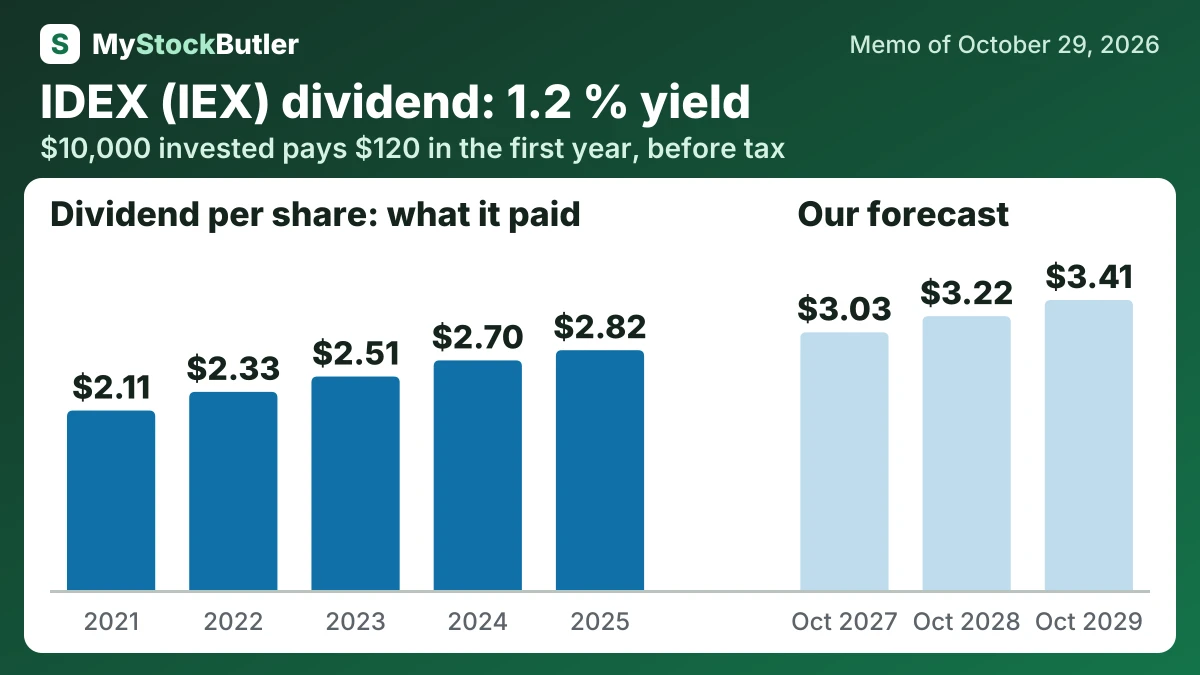
The base dividend rises from $3.03 per share to $3.41. The bear reaches only $3.13 after a first-year increase, while the bull reaches $3.75. The current annualized dividend is $2.92 per share, based on a quarterly dividend of $0.73. The base’s roughly 6.5% growth is below the recent pattern because earnings growth is expected to normalize. The bear allows a pause because demand is uneven, while the bull assumes stronger cash generation and repeat HST sales. Nine-month free cash flow was $477.3 million, leaving room for dividends alongside other capital uses.
| 2025 | 2024 | 2023 | 2022 | 2021 | |
|---|---|---|---|---|---|
| Real free cash flow per share | 7.83 | 7.60 | 7.97 | 6.16 | 6.18 |
| − Dividends paid, per share | 2.82 | 2.70 | 2.51 | 2.33 | 2.11 |
| − Share buybacks, per share | 3.29 | 0.00 | 0.32 | 1.95 | 0.00 |
| = FCF not paid out, per share | 2.08 | 5.24 | 5.43 | 2.16 | 4.34 |
What this means. The company's own free cash flow per share is higher because it does not subtract shares given to employees as pay; we subtract that cost, so our real figure is lower.
How much would IDEX's dividend pay you?
$10,000 invested in IDEX at its 1.2% dividend yield (our report of October 29, 2026) pays $120.00 in the first year, before tax. If its dividend per share keeps changing 7.5% a year, as it did from 2021 to 2025, and the dividends are reinvested, year 10 pays $266.60, with $1,834.61 received in all.
Before tax. Past dividend growth is not a promise. Information only, not investment advice.
Does IDEX cover its dividend with cash?
IDEX generated substantial free cash flow, but that cash had to serve several purposes. Free cash flow is the money left from operations after spending on equipment and facilities, so it is available for acquisitions, debt repayment and shareholders rather than reserved for only one use.
Acquisitions were the main strategic use of cash. Dividends rose across the period, and IDEX resumed substantial buybacks in 2025 after making none in 2024. Those payments can reward shareholders, but every dollar returned is unavailable for a purchase or for reducing debt.
| 2025 | 2024 | 2023 | 2022 | 2021 | |
|---|---|---|---|---|---|
| Free cash flow | 616.8 | 603.0 | 626.8 | 489.4 | 492.6 |
| − Dividends paid | 212.6 | 205.3 | 190.7 | 177.4 | 161.1 |
| − Share buybacks | 247.8 | 0 | 24.2 | 148.1 | 0 |
| = Free cash flow not paid out | 156.4 | 397.7 | 411.9 | 163.9 | 331.5 |
| Paid out, % of free cash flow | 74.6% | 34.0% | 34.3% | 66.5% | 32.7% |
What this means. The yearly change in cash may not match the cash balance because it can include restricted cash that the balance sheet leaves out.
What could change IDEX's dividend?
The view moves toward the bear case if HST programs are delayed or canceled from October 2027 onward, reducing backlog conversion and factory loading. Weak chemical, agriculture and energy demand would push FMT toward the bear path because orders have been stronger than sales.
| October 2027 | October 2028 | October 2029 | |
|---|---|---|---|
| Net asset value | 4,310 (4,170 / 4,400) | 4,600 (4,230 / 4,820) | 4,930 (4,270 / 5,300) |
| Shares (millions) | 72.50 (73.13 / 72.11) | 71.65 (72.84 / 70.76) | 70.88 (72.58 / 69.40) |
| Dividends per share | 3.03 (2.98 / 3.10) | 3.22 (3.13 / 3.41) | 3.41 (3.13 / 3.75) |
| Price to net asset value | 24.00 (20.00 / 28.00) | 23.00 (18.00 / 29.00) | 22.00 (17.00 / 30.00) |
What this means. Price to net asset value shows how much investors pay for each dollar of what the company owns after its debts are deducted.
What is IDEX's dividend yield today?
Free cash flow measures cash left after operations and capital spending. Its yield and the dividend yield describe current cash returns, but neither guarantees a future return: inventory, customer payments, acquisitions and reinvestment can change the cash available.