Dover stock forecast 2027–2029
MyStockButler's October 2026 analysis: Dover's weighted path reaches $243.40 by October 2029, with the bear case at 30%, the base case at 50%, and the bull case at 20%. It hinges on acquisition returns, aftermarket retention, capacity execution and backlog conversion into on-time shipments, recovered segment margins and collected cash.
Where could Dover's shares be by 2029?
The weighted path starts at $201.23 by October 2027. The return at that point is 4% including dividends. It reaches $243.40 by October 2029. The full-period return is 28% including dividends. The bear case has 30% probability and the base case 50%. The bull case has 20%.
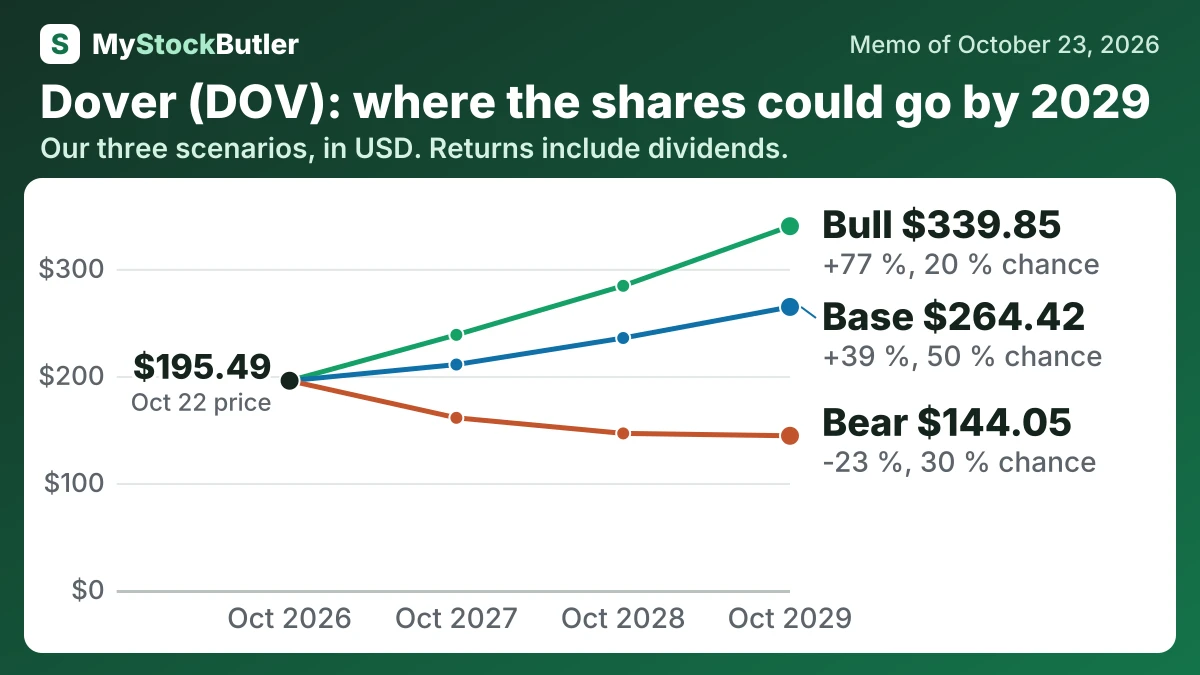
| Case | Probability | October 2027 | October 2028 | October 2029 |
|---|---|---|---|---|
| Bear | 30 % | 160.83 (-17 %) | 146.28 (-23 %) | 144.05 (-23 %) |
| Base | 50 % | 210.62 (+9 %) | 235.40 (+23 %) | 264.42 (+39 %) |
| Bull | 20 % | 238.35 (+23 %) | 284.17 (+48 %) | 339.85 (+77 %) |
| Weighted | 100 % | 201.23 (+4 %) | 218.42 (+14 %) | 243.40 (+28 %) |
What this means. The weighted row is the average estimated share price after giving more influence to the base case because it is considered more likely.
What has to go right or wrong for Dover?
The base path reflects rising reported equity and continued profitability. First-nine-month 2026 earnings from continuing operations were $888.114 million, while free cash flow was $702.9 million. The bear case assumes weak earnings, continued distributions and an impairment. The bull case assumes faster growth as capacity fills and transition costs fade.
The bull case requires faster backlog conversion, stronger Climate margins and profitable demand in cooling and biopharma applications. The price reaches $238.35 in October 2027 and $339.85 in October 2029. Its probability is 20% because capacity, margins and cash flow must improve across several businesses before the higher multiple is justified.
How much cash does Dover really make?
Dover generated $1.12 billion of free cash flow in 2025, equal to 84.4% of adjusted continuing earnings. That was encouraging despite higher capital spending. But free cash flow excludes acquisition payments, so it does not measure the full cost of an acquisition-led strategy.
| 2025 | 2024 | 2023 | |
|---|---|---|---|
| Cash and short-term investments (calculated) | 1,676,808 | 1,844,877 | 398,561 |
| Total assets | 13,422,423 | 12,509,160 | 10,812,073 |
| Total debt (calculated) | 3,337,621 | 2,938,548 | 3,469,002 |
What does Dover's stock cost today?
The 16.60-times next-12-month P/E implies about $11.78 of future earnings per share. That is above Dover’s 2026 adjusted continuing-operations guidance of $10.60–$10.75. “Continuing operations” means businesses Dover still owns; “adjusted” removes selected items such as purchase-accounting expenses, restructuring costs and disposition gains. Those adjustments may clarify ordinary earning power, but restructuring can still consume cash and acquisitions still cost money.
| Today (Oct 23, 2026) | |
|---|---|
| Share price | 195.49 |
| Market value (every class) (calculated) | 26,001,672.73 |
| Price to book (calculated) | 3.41x |
| P/E, next 12 months (calculated) | 16.60x |
| Dividend yield (calculated) | 1.1% |
What this means. The share price is the closing price from October 22, 2026, even though the table is dated October 23, 2026.