E.ON stock forecast 2027–2029
MyStockButler's November 2026 analysis: E.ON's weighted forecast is €19.96 in November 2029, including dividends. It hinges on regulation and funding.
Where could E.ON's shares be by 2029?
The weighted path is modest at first but reaches €19.96 by November 2029, including dividends. That means a 2% loss after one year, a 6% gain after two years and a 15% gain after three years from today's €18.91. The outcomes remain wide: the November 2029 bear case is €12.58, while the bull case is €27.87. The base case carries the highest probability because E.ON has confirmed guidance and growing adjusted earnings, but regulation and funding keep the upside from being the central forecast.
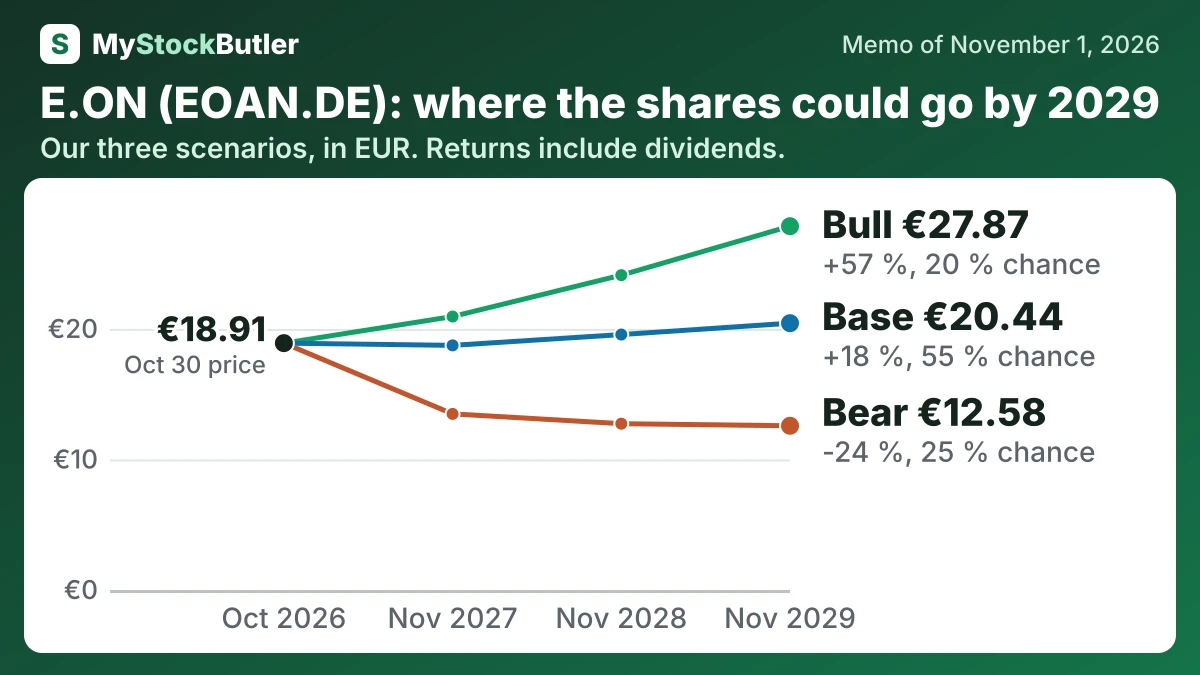
| Case | Probability | November 2027 | November 2028 | November 2029 |
|---|---|---|---|---|
| Bear | 25 % | 13.49 (-26 %) | 12.74 (-27 %) | 12.58 (-24 %) |
| Base | 55 % | 18.74 (+2 %) | 19.57 (+10 %) | 20.44 (+18 %) |
| Bull | 20 % | 20.95 (+14 %) | 24.12 (+34 %) | 27.87 (+57 %) |
| Weighted | 100 % | 17.87 (-2 %) | 18.77 (+6 %) | 19.96 (+15 %) |
What this means. The weighted row is the average value after giving each case its probability, so it can differ from the base case.
What has to go right or wrong for E.ON?
The bear case requires E.ON to spend heavily without converting enough investment into remunerated network assets. German electricity returns disappoint, projects are delayed and financing costs absorb earnings growth. Negative free cash flow and rising debt then constrain dividend growth. The multiple falls as investors question whether the investment programme creates shareholder value. This produces €13.49 in November 2027 and €12.58 in November 2029, including dividends. Its probability is 25% because the risks are credible, but confirmed guidance and first-half earnings growth argue against making it the central path.
The bull case requires favorable network rules, faster project delivery and improved cash conversion together. More investment becomes earning assets, earnings growth exceeds the base case and stronger cash generation eases funding pressure. The price reaches €20.95 in November 2027 and €27.87 in November 2029. Its probability is 20% because OVO's added customers provide scale but do not prove higher retail margins, while debt and investment remain significant constraints.
How much cash does E.ON really make?
E.ON produces substantial operating cash, but its investment program currently consumes more. Operating cash flow was €7 billion in 2025, against €7.94 billion of capital spending. After €421 million of lease payments, free cash flow was negative €1.36 billion; after stock pay of €140.1 million, “real” free cash flow was about negative €1.5 billion.
| 2025 | 2024 | 2023 | 2022 | 2021 | |
|---|---|---|---|---|---|
| Cash from operations | 7,003 | 5,673 | 5,654 | 10,045 | 4,069 |
| − Capital spending | 7,940 | 6,971 | 6,010 | 4,576 | 4,487 |
| − Lease payments | 421 | 377 | 383 | 357 | 363 |
| = Free cash flow | -1,358 | -1,675 | -739 | 5,112 | -781 |
| − Stock pay | 140.1 | 77.5 | 100.0 | 29.6 | 70.3 |
| = Real free cash flow | -1,498.1 | -1,752.5 | -839.0 | 5,082.4 | -851.3 |
What does an investor pay for E.ON today?
E.ON trades at 14.8 times trailing earnings and 15.1 times expected earnings for the next twelve months. EBITDA, or operating earnings before financing, tax and the accounting cost of using assets, shows the earning engine but not the cash left after maintenance. A toll road can collect strong toll revenue while still needing cash to repair the road; E.ON’s networks face the same issue. In 2025, E.ON reported adjusted EBITDA of €9.85 billion against investments of €8.51 billion.
| Today (Nov 1, 2026) | |
|---|---|
| Share price | 18.905 |
| Market value (calculated) | 49,423.0 |
| P/E, last 12 months (calculated) | 14.8x |
| P/E, next 12 months (calculated) | 15.1x |
| Free cash flow yield (calculated) | -2.7% |
| Real free cash flow yield (calculated) | -3.0% |
What this means. The negative free cash flow yields mean the company spent more cash than it generated recently, even though it still paid a dividend.