Edison dividend
MyStockButler's October 2026 analysis: Edison pays a current annualized dividend of $3.51 per share and raised its DPS each year from 2021 through 2025. Its dividend is not covered by free cash flow alone: free cash flow was negative every year from 2021 through 2025.
How much does Edison pay in dividends?
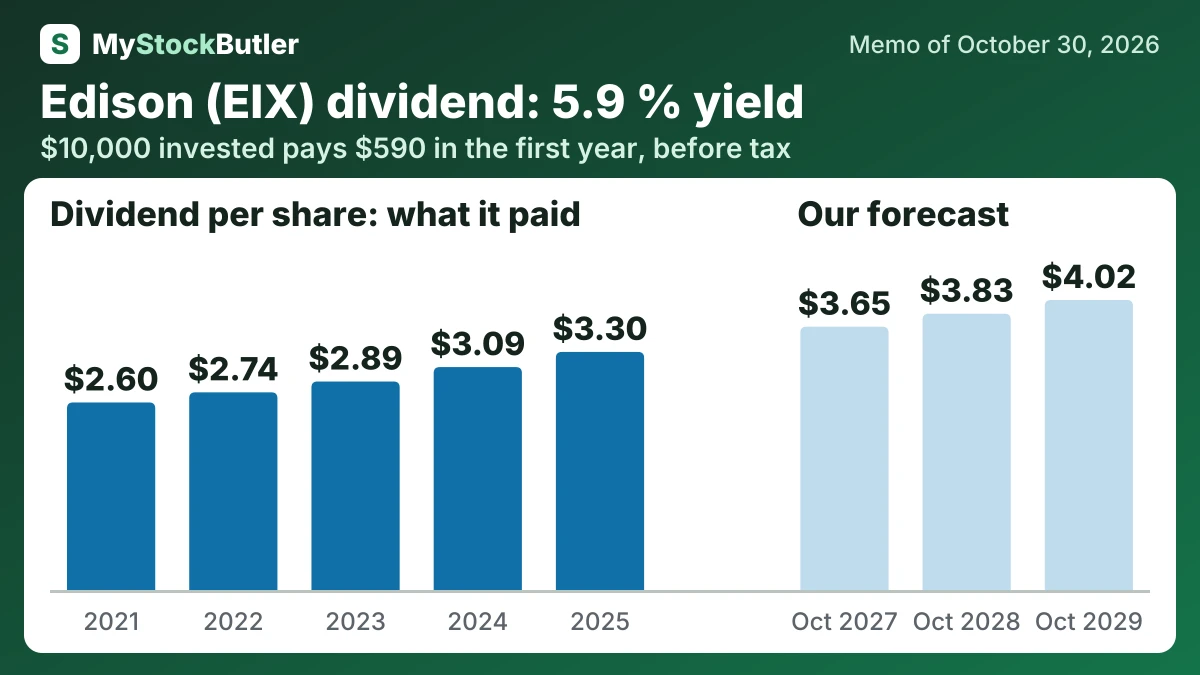
Dividends begin at the current annualized rate of $3.51. The base case reaches $3.65, $3.83 and $4.02 through growth below the EPS target, allowing for capital needs and parent costs. The bear case freezes the dividend at $3.51 before cutting it to $2.81 as wildfire funding overwhelms cash. The bull case reaches $3.69, $3.95 and $4.22 because recoveries support growth. Edison raised DPS each year from 2021 through 2025, but free cash flow was negative in every year of that period.
| 2025 | 2024 | 2023 | 2022 | 2021 | |
|---|---|---|---|---|---|
| Revenue | 19,317 | 17,599 | 16,338 | 17,220 | 14,905 |
| EPS, diluted | 11.55 | 3.31 | 3.11 | 1.60 | 2.00 |
| Dividend per share | 3.36 | 3.17 | 2.99 | 2.84 | 2.69 |
What this means. Gross profit here is not money left after all business costs; it only subtracts purchased power and fuel, leaving out maintenance and depreciation.
How much would Edison's dividend pay you?
$10,000 invested in Edison at its 5.9% dividend yield (our report of October 30, 2026) pays $590.00 in the first year, before tax. If its dividend per share keeps changing 6.1% a year, as it did from 2021 to 2025, and the dividends are reinvested, year 10 pays $1,945.72, with $11,232.65 received in all.
Before tax. Past dividend growth is not a promise. Information only, not investment advice.
Is Edison’s dividend covered by its cash?
Free cash flow was negative in every year from 2021 through 2025. That does not automatically mean the spending failed: a utility may build a transmission line today and recover its cost gradually through future rates. But it does mean dividends were not funded by that period’s free cash flow alone.
In 2025, Edison generated $5.8 billion from operations and spent $6.515 billion on capital projects, producing negative $715 million of free cash flow. A utility pays for equipment and construction before regulators allow it to recover the investment through customer rates over many years, so negative free cash flow can be normal. It still has to be financed.
| 2025 | 2024 | 2023 | 2022 | 2021 | |
|---|---|---|---|---|---|
| Free cash flow | -715 | -693 | -2,047 | -2,562 | -5,494 |
| − Dividends paid | 1,274 | 1,198 | 1,112 | 1,050 | 988 |
| − Share buybacks | 32 | 200 | 0 | 0 | 0 |
| Paid to shareholders | 1,306 | 1,398 | 1,112 | 1,050 | 988 |
| Paid out, % of free cash flow | not meaningful | not meaningful | not meaningful | not meaningful | not meaningful |
What this means. The company paid shareholders even though it had negative free cash flow, using money from new borrowing and selling investments.
What could change Edison’s dividend?
SCE is the shop; Edison is the parent above it. Customers pay SCE, which pays employees, suppliers, taxes, interest and construction costs. If cash remains and legal and regulatory conditions permit, SCE pays a dividend to Edison, which then pays parent-company costs and common dividends. That makes the 5.9% dividend yield attractive, but not secure: Edison’s policy targets 45%–55% of SCE’s core earnings, subject to board approval.
The decisive assumption is liability containment. Edison needs durable liquidity for claims and a shareholder liability cap that does not depend entirely on the state Wildfire Fund. Until investors can judge that outcome, the dividend is income with risk, and the low valuation is a price for uncertainty.
| October 2027 | October 2028 | October 2029 | |
|---|---|---|---|
| Earnings | 2,444 (2,175 / 2,541) | 2,637 (2,002 / 2,734) | 2,791 (2,041 / 2,945) |
| Dividends per share | 3.65 (3.51 / 3.69) | 3.83 (3.51 / 3.95) | 4.02 (2.81 / 4.22) |
| Price to earnings | 9.50 (7.50 / 11.00) | 10.00 (7.00 / 12.00) | 10.50 (7.00 / 13.00) |