Dow dividend: payment, cash coverage and yield
MyStockButler's October 2026 analysis: Dow pays $0.35 per share each quarter after cutting the quarterly dividend from $0.70. In 2025, real free cash flow was negative $1.8 billion while the dividend was $2.10 per share, so its cash did not cover the dividend.
How much does Dow pay in dividends?
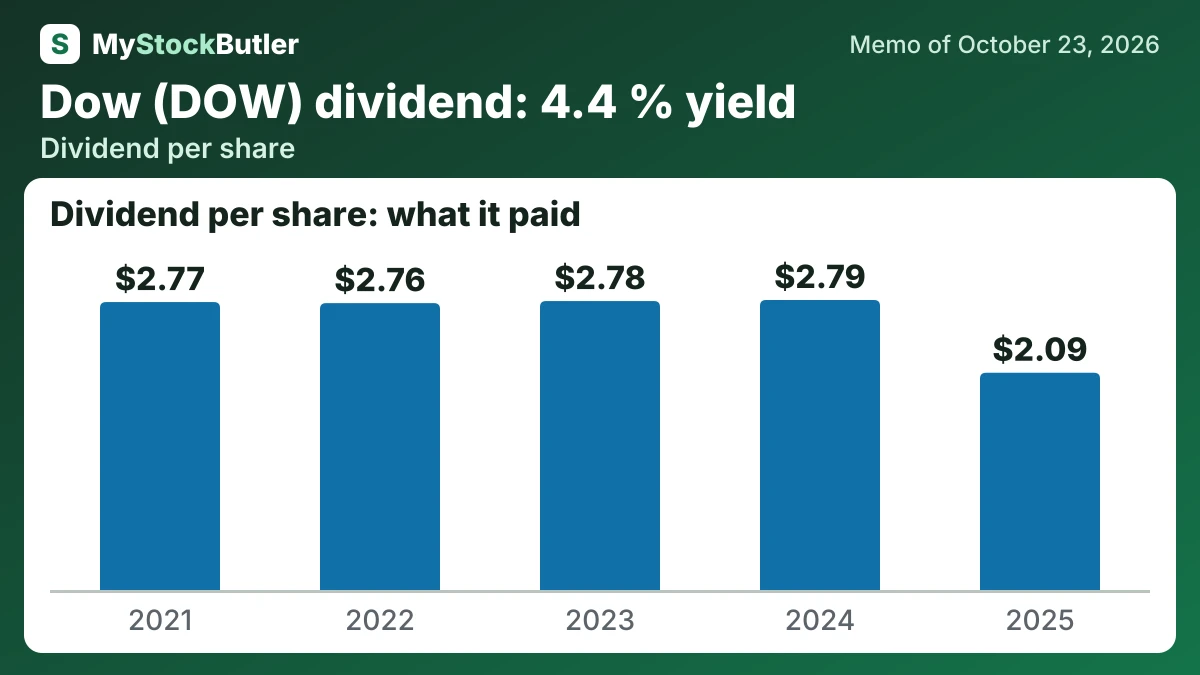
The position deteriorated. In 2023, free cash flow was $2.586 billion, slightly below the $2.597 billion paid to shareholders. In 2024, free cash flow was negative $240 million while shareholder payments reached $2.460 billion, including $494 million of buybacks. In 2025, free cash flow fell to negative $1.614 billion, and Dow cut its quarterly dividend from $0.70 to $0.35 effective in the third quarter.
Free cash flow was $5.5 billion in 2022. Real free cash flow was negative $1.8 billion in 2025, while the dividend was $2.10 per share. There was therefore no broad surplus from that year’s operations and investment to fund shareholder payments. The dividend competed with liquidity, asset sales and borrowing.
| 2025 | 2024 | 2023 | 2022 | 2021 | |
|---|---|---|---|---|---|
| EPS, diluted | -3.70 | 1.57 | 0.82 | 6.28 | 8.38 |
| Real free cash flow per share | -2.48 | -0.57 | 3.35 | 7.24 | 6.02 |
| − Dividends paid, per share | 2.09 | 2.79 | 2.78 | 2.76 | 2.77 |
| = FCF not paid out, per share | 1.45 | 2.18 |
What this means. The company’s own free cash flow per share is higher because it leaves out some spending on assets that our broader count includes.
Is Dow’s dividend covered by its cash?
Dow does not provide a consistent audited series for maintenance spending alone. The specialist’s test is therefore broader: can several years of cash after necessary plant investment, excluding litigation receipts and temporary working-capital releases, pay the dividend while funding obligations and reducing debt? So far, the accounts do not demonstrate that it can.
| 2025 | 2024 | 2023 | 2022 | 2021 | |
|---|---|---|---|---|---|
| Free cash flow | -1,614 | -240 | 2,586 | 5,466 | 4,782 |
| − Dividends paid | 1,490 | 1,966 | 1,972 | 2,006 | 2,073 |
| − Share buybacks | 0 | 494 | 625 | 2,325 | 1,000 |
| = Free cash flow not paid out | 1,052 | 1,636 | |||
| = Paid out more than the free cash flow | 3,277 | 2,777 | 100 | ||
| Paid out, % of real free cash flow | not meaningful | not meaningful | 109.4% | 82.4% | 68.2% |
What this means. The company's own net debt is 69 million dollars higher because it does not count some short-term treasury bills and time deposits as cash.
What could change Dow’s dividend?
Dividends remain $1.40 per share annually in the base case, or four quarterly payments of $0.35. The reduced rate has held since the 2025 cut, but negative free cash flow in 2024 and 2025 argues against restoration. The bear case declines to $0.70, then $0.35 and $0.35; the bull case rises to $1.40, $1.75 and $2.10 as cash improves.
What is Dow’s dividend yield today?
Debt also claims the recovery first. Using June 30, 2026 balances, Dow had about $18 billion of debt and $4 billion of cash, leaving roughly $14 billion of net debt. Dow later reported about $14 billion of liquidity and no substantial maturities until 2029. Liquidity buys time, but debt repayment, plant investment and the 4.4% dividend still compete for the same cash.
| Today (Oct 23, 2026) | |
|---|---|
| Share price | 31.81 |
| Free cash flow yield (calculated) | -7.0% |
| Real free cash flow yield (calculated) | -7.7% |
| Dividend yield (calculated) | 4.4% |
What this means. The negative free cash flow yields mean the company spent more cash than it generated during the latest year.