Dow stock forecast 2027–2029
MyStockButler's October 2026 analysis: The weighted forecast puts October 2029 at $31.00, with 30% bear, 50% base and 20% bull. It hinges on a recovery in operating profit and cash that funds investment and reduces debt.
Where could Dow's shares be by October 2029?
The weighted forecast puts October 2027 at $25.97, a negative 15% return including dividends. October 2029 is $31.00, a positive 9% return including dividends. Probabilities are 30% bear. 50% base. 20% bull.
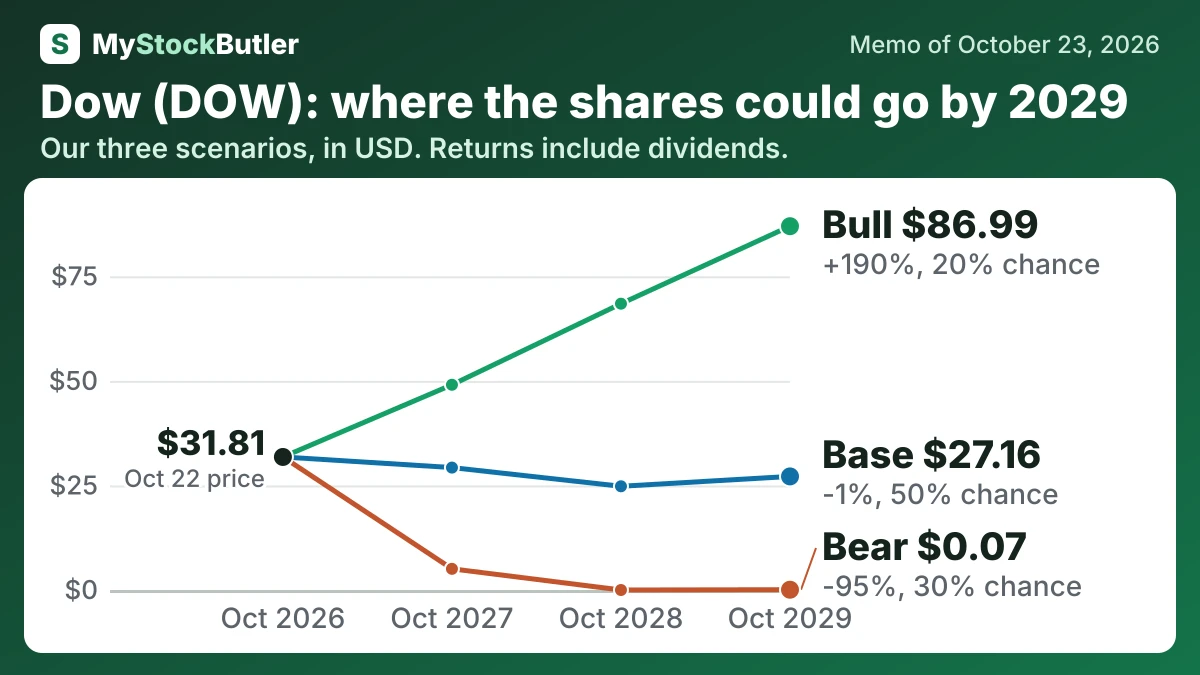
| Case | Probability | October 2027 | October 2028 | October 2029 |
|---|---|---|---|---|
| Bear | 30% | 5.06 (-82%) | 0.00 (-97%) | 0.07 (-95%) |
| Base | 50% | 29.27 (-4%) | 24.80 (-13%) | 27.16 (-1%) |
| Bull | 20% | 49.07 (+59%) | 68.46 (+125%) | 86.99 (+190%) |
| Weighted | 100% | 25.97 (-15%) | 26.09 (-11%) | 31.00 (+9%) |
What has to go right or wrong for Dow?
Operating profit recovers toward the historical average in the base case. It is $3,080 million in October 2027, $3,000 million in October 2028 and $3,100 million in October 2029. The first figure combines approximately $830 million of implied fourth-quarter operating income with three quarters at an annual operating-income rate of $3,000 million; the later figures stay near the $3,028 million five-year average. The bear case falls to $1,955 million, $1,600 million and $1,800 million as oversupply delays savings. The bull case rises to $3,680 million, $4,300 million and $4,800 million as closures, demand and durable cost savings improve spreads. Dow’s Q3 price and mix rose 14% despite a 1% volume decline, while management targets $1,300 million of annual self-help benefits.
| October 2027 | October 2028 | October 2029 | |
|---|---|---|---|
| Normal operating profit | 3,080 (1,955 / 3,680) | 3,000 (1,600 / 4,300) | 3,100 (1,800 / 4,800) |
| Shares (millions) | 728 (730 / 728) | 732 (736 / 727) | 736 (742 / 726) |
| Dividends per share | 1.40 (0.70 / 1.40) | 1.40 (0.35 / 1.75) | 1.40 (0.35 / 2.10) |
| Enterprise value to normal operating profit | 11.00 (9.00 / 13.00) | 10.00 (8.00 / 14.00) | 10.00 (8.00 / 15.00) |
| Net debt | 12,569 (13,904 / 12,119) | 11,844 (14,200 / 10,429) | 11,012 (14,348 / 8,842) |
How much cash does Dow really make?
Free cash flow is operating cash after capital spending. The memo’s broader calculation produced negative free cash flow of $1.6 billion in 2025 after $2.7 billion of capital spending. Subtracting $154 million of stock compensation produced real free cash flow of negative $1.8 billion. Stock pay does not immediately leave the bank account, but it gives employees part of the company.
| 2025 | 2024 | 2023 | 2022 | 2021 | |
|---|---|---|---|---|---|
| Cash from operations | 1,062 | 2,903 | 5,164 | 7,486 | 7,069 |
| − Capital spending | 2,676 | 3,143 | 2,578 | 2,020 | 2,287 |
| = Free cash flow | -1,614 | -240 | 2,586 | 5,466 | 4,782 |
| − Stock pay | 154 | 159 | 212 | 211 | 276 |
| = Real free cash flow | -1,768 | -399 | 2,374 | 5,255 | 4,506 |
| Real free cash flow, % of revenue | -4.4% | -0.9% | 5.3% | 9.2% | 8.2% |
What this means. The company's free cash flow is higher because it leaves out some asset spending, such as gas-field development and buying previously leased assets, that we count because the cash still left the company.
What does an investor pay for Dow today?
On October 23, 2026, Dow traded at a forward P/E of 13.1x. P/E means the share price divided by earnings per share, so this multiple implies forecast earnings of about $2.43 per share. Because forward earnings are estimates, the question is whether Dow can earn that amount through ordinary good and bad chemical markets, not merely during one favorable year.
Cash provides a harder test. The snapshot shows a free-cash-flow yield of −7.0% and a real free-cash-flow yield of −7.7%. Free cash flow is operating cash left after equipment spending, while working-capital releases recover cash already tied up in inventory or unpaid customer bills. Dow reported $1.1 billion of third-quarter free cash flow, including more than $400 million from working capital. That helps today, but it is not a repeatable substitute for profitable shipments.