Dover dividend: cash coverage and history
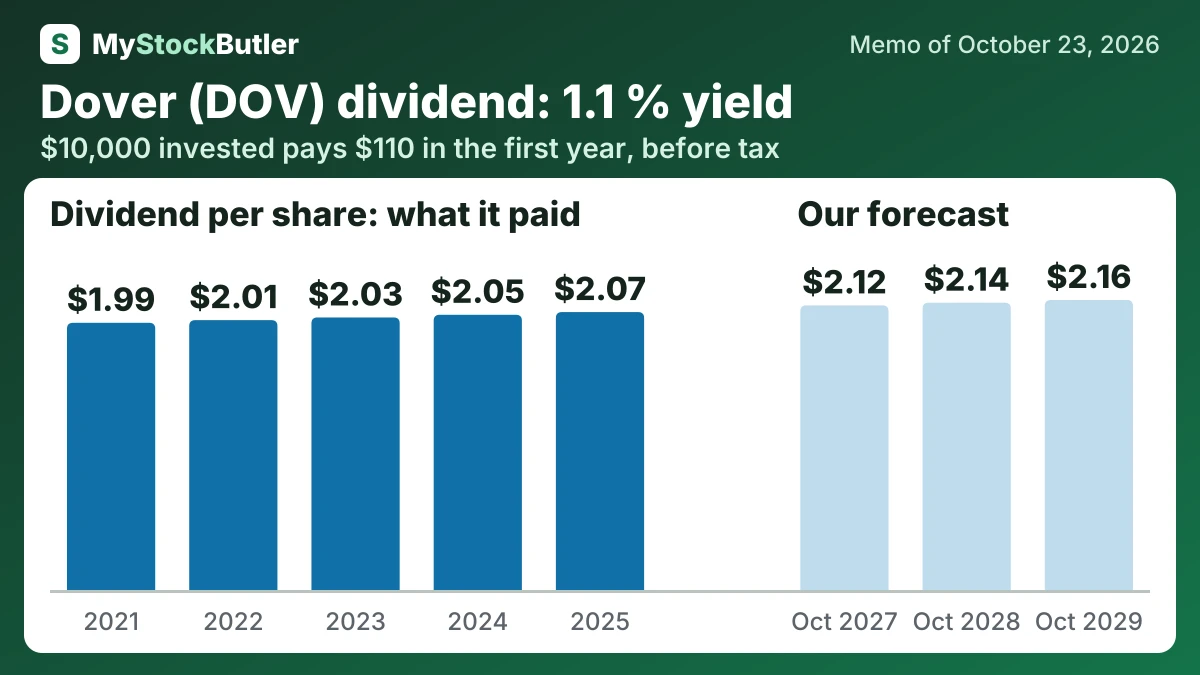
MyStockButler's October 2026 analysis: Dover paid a $2.07 dividend in 2025. Dover generated $1.12 billion of free cash flow in 2025, and dividends were covered more than three times by first-nine-month 2026 free cash flow.
How much does Dover pay in dividends over time?
Reported continuing-operations net income was $1,399,968 thousand in 2024. It fell to $1,097,429 thousand in 2025 as disposal gains disappeared. Adjusted continuing earnings were $1,150,250 thousand in 2024 and rose to $1,324,486 thousand in 2025. Organic growth was 1.6%, the key number for portfolio-led growth. In 2025, Dover paid a $2.07 dividend and recorded $3.92 of share buybacks; buybacks alone do not prove attractive purchase prices.
| 2025 | 2024 | 2023 | 2022 | 2021 | |
|---|---|---|---|---|---|
| Book value per share | 54.92 | 50.68 | |||
| Book value per share, growth | 8.4% | ||||
| − Dividends paid, per share | 2.07 | 2.05 | 2.03 | 2.01 | 1.99 |
| − Share buybacks, per share | 3.92 | 3.61 | 0.00 | 4.07 | 0.15 |
What this means. Share buybacks per share is the company’s total spending to repurchase its own shares divided by the number of shares, not cash paid directly to every shareholder.
How much would Dover's dividend pay you?
$10,000 invested in Dover at its 1.1% dividend yield (our report of October 23, 2026) pays $110.00 in the first year, before tax. If its dividend per share keeps changing 1.0% a year, as it did from 2021 to 2025, and the dividends are reinvested, year 10 pays $133.17, with $1,211.74 received in all.
Before tax. Past dividend growth is not a promise. Information only, not investment advice.
Does Dover's dividend get covered by its cash?
Dover generated $1.12 billion of free cash flow in 2025, equal to 84.4% of adjusted continuing earnings. That was encouraging despite higher capital spending. But free cash flow excludes acquisition payments, so it does not measure the full cost of an acquisition-led strategy.
The balance sheet provides room but not a complete investment case. September net debt was approximately 0.8 times trailing adjusted corporate EBITDA, and the company reported 35.7-times interest coverage under its debt agreement. Its current ratio was approximately 1.95, but divestiture proceeds can temporarily improve leverage and liquidity. Dividends were covered more than three times by first-nine-month 2026 free cash flow, leaving the larger question of how much cash remains for acquisitions and growth.
| 2025 | 2024 | 2023 | 2022 | 2021 | |
|---|---|---|---|---|---|
| − Dividends paid | 283,007 | 283,117 | 284,297 | 287,551 | 286,896 |
| − Share buybacks | 540,700 | 500,000 | 0 | 585,000 | 21,637 |
| Acquisitions | 663,270 | 635,269 | 533,623 | 312,855 |
What this means. The 2021 acquisitions number is missing because the report excludes purchases made by businesses that Dover later sold.
What could change Dover's dividend?
Dividends rise from $2.12 per share to $2.16 in the base case. The bear case holds at $2.10. The bull case reaches $2.22. Annual dividends were $2.07 in 2025. The board raised the quarterly rate to $0.525 in August 2026. That history supports modest increases, while debt, working capital and investment justify a freeze in the bear case.
| October 2027 | October 2028 | October 2029 | |
|---|---|---|---|
| Net asset value | 8,151 (7,896 / 8,206) | 8,746 (7,746 / 8,916) | 9,431 (7,936 / 9,766) |
| Shares (millions) | 132 (133 / 131) | 130 (132 / 129) | 128 (132 / 126) |
| Dividends per share | 2.12 (2.10 / 2.14) | 2.14 (2.10 / 2.18) | 2.16 (2.10 / 2.22) |
| Price to net asset value | 3.40 (2.70 / 3.80) | 3.50 (2.50 / 4.10) | 3.60 (2.40 / 4.40) |
What this means. A price to net asset value of 3.40 means investors pay 3.40 dollars for each 1 dollar of what the company owns after debts.
What is Dover's dividend yield at today's price?
At $195.49 a share on October 23, 2026, Dover’s market value is $26.0 billion. Adding the company’s $3.3 billion of debt and subtracting $1.7 billion of cash produces $1.6 billion of net debt and an enterprise value of about $27.6 billion. Enterprise value estimates the cost of owning the operating business for both shareholders and lenders: like buying a house, the buyer considers the property’s value, the mortgage and the cash available to repay it.