Cboe dividend
MyStockButler's November 2026 analysis: Cboe pays a raised dividend of $0.86 per share in the September 2026 quarter, and its five-year record shows increases every year. Cboe's free cash flow exceeded income allocated to common shareholders in 2025, even after subtracting stock compensation.
How much does Cboe pay per share over its history?
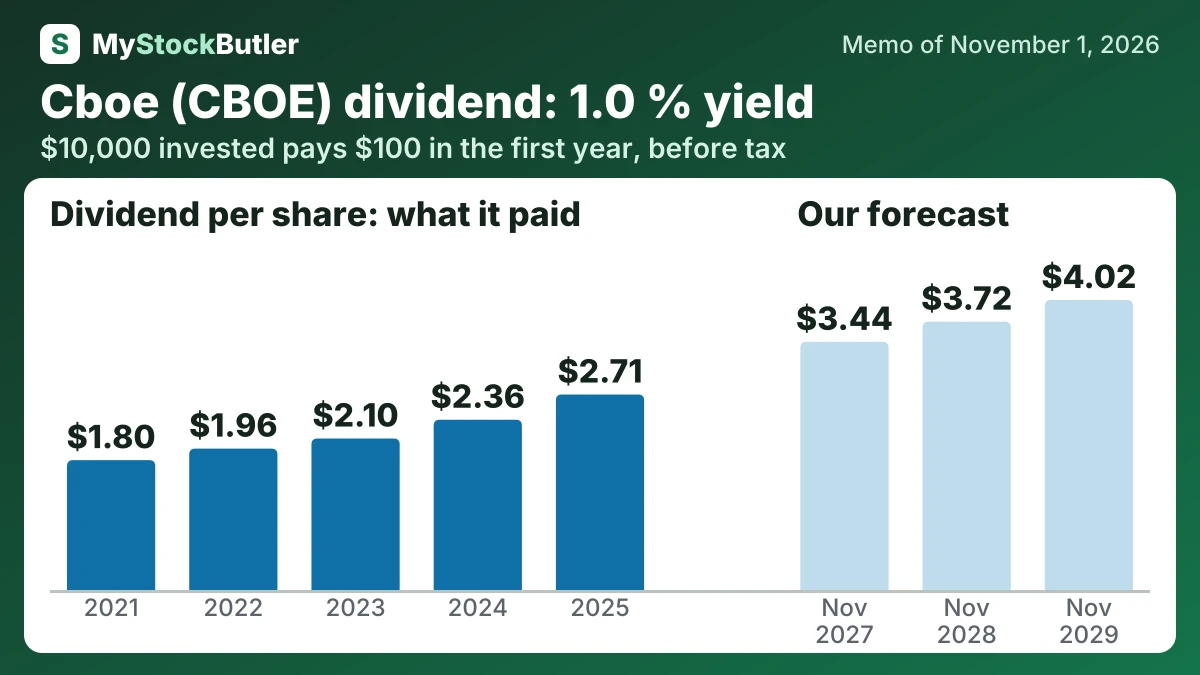
Dividends in the base case rise from $3.44 to $3.72 and then $4.02 per share. The current quarterly rate annualizes to $3.44, while the five-year record shows increases every year. The bear case holds $3.44 throughout. The bull case reaches $4.51 by 2029, supported by strong cash generation, including $1.631 billion of real free cash flow in 2025.
| 2025 | 2024 | 2023 | 2022 | 2021 | |
|---|---|---|---|---|---|
| Net income | 1,094.8 | 761.0 | 757.5 | 234.1 | 527.3 |
| EPS, diluted | 10.42 | 7.21 | 7.13 | 2.19 | 4.92 |
| Dividend per share | 2.70 | 2.36 | 2.10 | 1.96 | 1.80 |
How much would Cboe's dividend pay you?
$10,000 invested in Cboe at its 1.0% dividend yield (our report of November 1, 2026) pays $100.00 in the first year, before tax. If its dividend per share keeps changing 10.8% a year, as it did from 2021 to 2025, and the dividends are reinvested, year 10 pays $288.56, with $1,781.18 received in all.
Before tax. Past dividend growth is not a promise. Information only, not investment advice.
Does Cboe's cash cover its dividend?
Cboe also returned cash through dividends and buybacks. A dividend pays every shareholder per share; a buyback purchases shares, increasing the remaining shareholders’ proportional ownership, although the result depends on the price paid. In the September 2026 quarter, Cboe paid a raised dividend of $0.86 per share and repurchased $56.1 million of stock.
Free cash flow means operating cash flow less capital spending. “Real” free cash flow goes further by subtracting stock compensation. Stock pay is not a cash payment when recorded, but it can dilute shareholders or require cash spending to offset dilution. In 2025, free cash flow exceeded income allocated to common shareholders, even after that adjustment.
| 2025 | 2024 | 2023 | 2022 | 2021 | |
|---|---|---|---|---|---|
| Free cash flow | 1,681.6 | 1,039.7 | 1,030.6 | 591.3 | 545.8 |
| − Dividends paid | 284.3 | 249.4 | 223.5 | 209.4 | 193.3 |
| − Share buybacks | 66.7 | 204.8 | 83.9 | 100.9 | 81.3 |
| = Free cash flow not paid out | 1,330.6 | 585.5 | 723.2 | 281.0 | 271.2 |
| Paid out, % of free cash flow | 20.9% | 43.7% | 29.8% | 52.5% | 50.3% |
What this means. The cash rose by total may not match the change in cash and short-term investments because it includes restricted clearing cash and customer deposits that the balance sheet leaves out.
What could change Cboe's dividend?
The forecast would move toward the bear case in 2027–2028 if SPX and 0DTE activity cools. In the latest quarter, 0DTE represented 65% of SPX activity, so weaker demand would directly challenge the earnings path.
From 2027 onward, further multi-listed share loss combined with higher S&P royalties would pressure net revenue and margins. Disappointing extended-hours adoption or continuing CAT costs would add another earnings drag through 2029.
| November 2027 | November 2028 | November 2029 | |
|---|---|---|---|
| Earnings | 1,593 (1,360 / 1,722) | 1,709 (1,328 / 2,024) | 1,807 (1,334 / 2,320) |
| Dividends per share | 3.44 (3.44 / 3.60) | 3.72 (3.44 / 4.03) | 4.02 (3.44 / 4.51) |
| Price to earnings | 22.00 (18.00 / 25.00) | 21.00 (17.00 / 26.00) | 20.00 (16.00 / 27.00) |