Snap-on dividend: cash coverage and yield
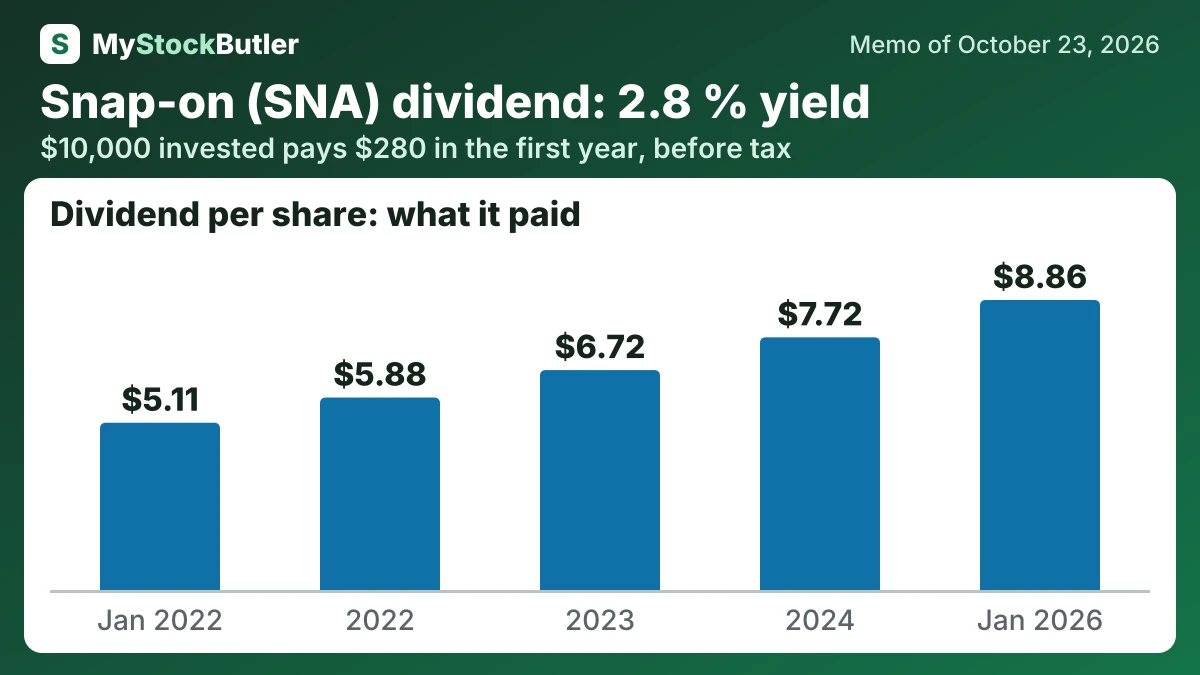
MyStockButler's October 2026 analysis: Snap-on paid $8.86 per share in fiscal 2025. Its real free cash flow per share was $14.22 against the $8.86 dividend, so the dividend was covered by that measure.
How much does Snap-on pay in dividends?
Revenue growth slowed from 16.7% in 2021 to 0.9% in fiscal 2025. The earnings turn has not arrived: diluted EPS was $19.19 in fiscal 2025, down from $19.51 in 2024. Snap-on’s real free cash flow fell to 14.6% of revenue from 17.5% in 2024. Real free cash flow per share was $14.22 against an $8.86 dividend.
Dividends now take first claim on cash. In November 2025, the board raised the quarterly dividend 14.0% to $2.44 a share. In April 2026, it authorized another $500 million of repurchases. An authorization is permission to spend, not proof that the spending occurred, and buybacks create value only if the shares are purchased at sensible prices.
| Jan 2026 | 2024 | 2023 | 2022 | Jan 2022 | |
|---|---|---|---|---|---|
| EPS, diluted | 19.19 | 19.51 | 18.76 | 16.82 | 14.92 |
| Real free cash flow per share | 14.22 | 16.70 | 15.50 | 6.89 | 12.32 |
| − Dividends paid, per share | 8.86 | 7.72 | 6.72 | 5.88 | 5.11 |
What this means. The company reports more cash per share because its count does not subtract shares given to employees as pay.
How much would Snap-on's dividend pay you?
$10,000 invested in Snap-on at its 2.8% dividend yield (our report of October 23, 2026) pays $280.00 in the first year, before tax. If its dividend per share keeps changing 14.8% a year, as it did from Jan 2022 to Jan 2026, and the dividends are reinvested, year 10 pays $1,518.00, with $7,233.71 received in all.
Before tax. Past dividend growth is not a promise. Information only, not investment advice.
Does Snap-on's dividend fit its free cash flow?
Free cash flow is the cash left after operating needs and capital spending. Across the five periods ending in January 2026, Snap-on generated roughly $3.7 billion of free cash flow without Financial Services and paid roughly $3.4 billion to shareholders. One year can exceed 100% of free cash flow because the company can draw on accumulated cash, but repeated excess distributions would eventually reduce flexibility.
Excluding Financial Services, fiscal 2025 operating cash flow was $857.3 million. After $75.0 million of capital spending, free cash flow was $782.3 million. Deducting $28.9 million of stock compensation produces an analytical “real free cash flow”: the deduction recognises value transferred to employees and the possible need to repurchase shares to prevent dilution.
| Jan 2026 | 2024 | 2023 | 2022 | Jan 2022 | |
|---|---|---|---|---|---|
| Free cash flow | 782.3 | 922.0 | 880.4 | 407.4 | 719.0 |
| − Dividends paid | 462.2 | 406.4 | 355.6 | 313.1 | 275.8 |
| − Share buybacks | 328.6 | 290.0 | 294.7 | 198.1 | 431.3 |
| Paid to shareholders | 790.8 | 696.4 | 650.3 | 511.2 | 707.1 |
| Paid out, % of free cash flow | 101.1% | 75.5% | 73.9% | 125.5% | 98.3% |
What could change Snap-on's dividend?
The dividend input begins with the current $2.44 quarterly rate, or $9.76 annualized. The base case uses $10.54, $11.08, and $11.64 per share as quarterly increases resume at a slower pace than the recent five-year growth rate.
What is Snap-on's dividend yield at its share price?
| Today (Oct 23, 2026) | |
|---|---|
| Share price | 352.83 |
| Free cash flow yield (calculated) | 4.3% |
| Real free cash flow yield (calculated) | 4.1% |
| Dividend yield (calculated) | 2.8% |
What this means. The earnings and sales include the financial services business, but the cash and debt used for some measures do not, so those measures mix different parts of the company.