Skydance Corporation stock forecast 2027–2029
MyStockButler's October 2026 analysis: Skydance Corporation's weighted forecast is $1.10 in October 2027 and $4.94 in October 2029. It hinges on whether savings and operating gains become cash after interest, programming and integration costs.
Where could Skydance Corporation's shares be in each forecast year?
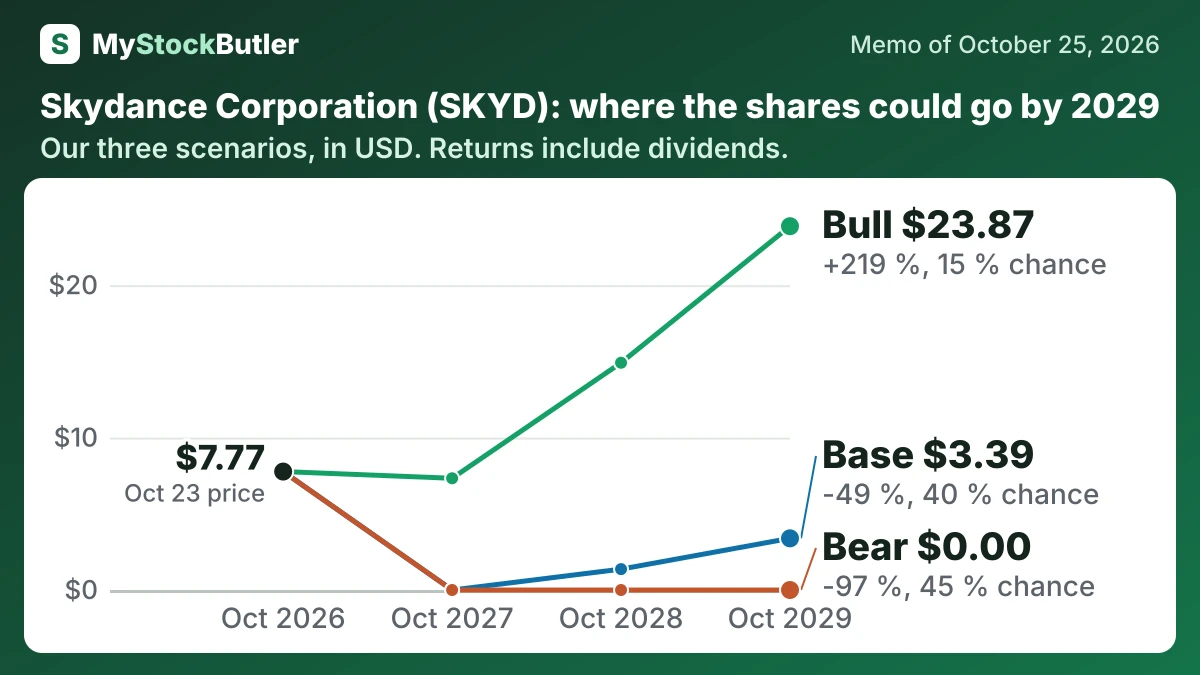
The weighted value is $1.10 in October 2027, a loss of 83% including dividends, and $4.94 in October 2029, a loss of 30% including dividends. Bear, base and bull probabilities are 45%, 40% and 15%. November 9, 2026 results test standalone guidance. In 2027, savings must exceed implementation costs while streaming customers stay and pay more. Debt repayment must be visible before the 2028 and 2029 note maturities. The investment turns only when cash, not promises, reduces leverage.
| Case | Probability | October 2027 | October 2028 | October 2029 |
|---|---|---|---|---|
| Bear | 45 % | 0.00 (-97 %) | 0.00 (-97 %) | 0.00 (-97 %) |
| Base | 40 % | 0.00 (-97 %) | 1.37 (-77 %) | 3.39 (-49 %) |
| Bull | 15 % | 7.33 (-3 %) | 14.91 (+98 %) | 23.87 (+219 %) |
| Weighted | 100 % | 1.10 (-83 %) | 2.79 (-60 %) | 4.94 (-30 %) |
What this means. The weighted value is the probability-based average of all three cases, so it can be below today's price even though the bull case is much higher.
What has to go right or wrong for Skydance Corporation?
Normal operating profit rises gradually in the base case, from $8,500 million in October 2027 to $9,000 million in October 2029. The starting point uses a 2027 estimate of $66.1 billion of combined revenue and $13.7 billion of adjusted EBITDA, less estimated depreciation and amortization. The bear case falls from $6,300 million to $5,500 million as television erosion and delayed savings overwhelm integration benefits. The bull case rises from $9,500 million to $11,500 million as streaming, studios and synergies outperform. The estimate remains judgmental because no post-close operating history exists.
| October 2027 | October 2028 | October 2029 | |
|---|---|---|---|
| Normal operating profit | 8,500 (6,300 / 9,500) | 8,800 (5,800 / 10,500) | 9,000 (5,500 / 11,500) |
| Shares (millions) | 5,059 (5,070 / 5,045) | 5,093 (5,115 / 5,029) | 5,127 (5,160 / 4,943) |
| Dividends per share | 0.20 (0.20 / 0.20) | 0.20 (0.00 / 0.30) | 0.20 (0.00 / 0.40) |
| Enterprise value to normal operating profit | 9.00 (7.00 / 12.00) | 9.50 (6.00 / 14.00) | 10.00 (5.00 / 16.00) |
| Net debt | 79,103 (81,000 / 77,000) | 76,603 (82,500 / 72,000) | 72,603 (84,500 / 66,000) |
How much cash does Skydance Corporation really make?
Stock compensation makes the economic surplus thinner. Deducting $273 million of 2025 stock pay leaves $80 million of real free cash flow, or 0.3% of revenue. That is not another cash payment during the year, but it represents value shareholders must absorb.
| 2025 | 2024 | 2023 | 2022 | 2021 | |
|---|---|---|---|---|---|
| Cash from operations | 649 | 752 | 384 | -142 | 835 |
| − Capital spending | 296 | 263 | 328 | 358 | 354 |
| = Free cash flow | 353 | 489 | 56 | -500 | 481 |
| − Stock pay | 273 | 245 | 177 | 172 | 192 |
| = Real free cash flow | 80 | 244 | -121 | -672 | 289 |
| Real free cash flow, % of revenue | 0.3% | 0.8% | -0.4% | -2.2% | 1.0% |
What this means. The company's own free cash flow is the same as ours; our real free cash flow is lower because shares given to employees as pay reduce existing shareholders' ownership even though no cash leaves the company.
What does an investor pay for Skydance Corporation today?
Market value is the shareholders’ claim on the business. A P/E compares that price with earnings per share, but the earnings estimate must include the enlarged share count and the interest bill created by the Warner Bros. Discovery acquisition.
Free-cash-flow yield measures cash left after operating and investment spending against market value. A rental property makes the distinction clear: rent is revenue, profit is what remains after accounting expenses, but free cash flow is what remains after repairs. “Real” free cash flow is not a universal term, so its deductions must be known before the lower figure can be trusted. Dividends measure distributions, not permanent funding capacity.