IP dividend: payout and cash coverage
MyStockButler's October 2026 analysis: IP's base dividend is $1.85 per share, unchanged from 2022 through 2025, but recent free cash flow has not covered it. In the first nine months of 2026, IP paid $735 million in dividends while free cash flow was negative $180 million.
How much does IP pay per share over time?
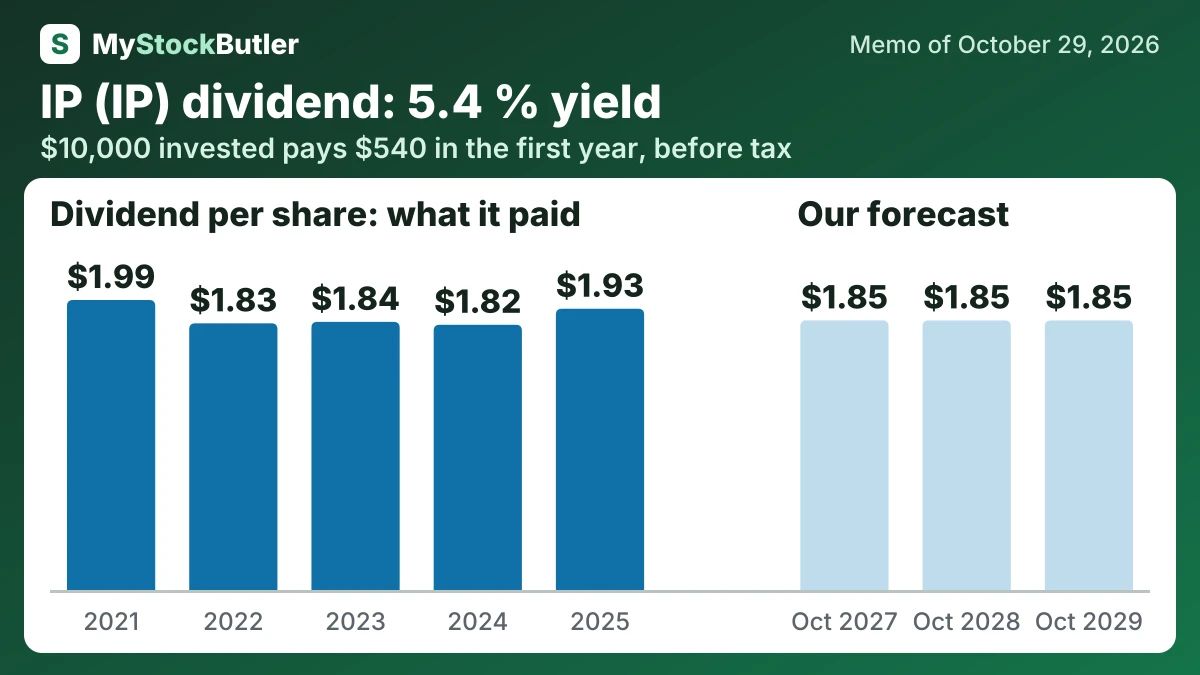
The base dividend stays at $1.85 per share throughout. That matches the unchanged rate from 2022 through 2025, although recent free cash flow was negative and capital spending was heavy. The bear case cuts dividends to $0.93, then $0.46, then zero as cash pressure persists. The bull case keeps $1.85 initially and raises it to $2.00 and $2.20 as coverage improves.
How much would IP's dividend pay you?
$10,000 invested in IP at its 5.4% dividend yield (our report of October 29, 2026) pays $540.00 in the first year, before tax. If its dividend per share keeps changing −0.8% a year, as it did from 2021 to 2025, and the dividends are reinvested, year 10 pays $798.06, with $6,630.91 received in all.
Before tax. Past dividend growth is not a promise. Information only, not investment advice.
Does IP's cash cover its dividend?
Dividend yield states what the annual payout represents at today’s price, not whether cash covers it. In the first nine months of 2026, IP paid $735 million in dividends while free cash flow was negative $180 million. A household can pay a bill from savings or a credit card when income falls short; a company can do the same, but sustained dividends require cash generation across good and bad years.
In 2025, operating activities generated $1.7 billion of cash. Capital spending was $1.9 billion, so free cash flow was negative $159 million.
| 2025 | 2024 | 2023 | 2022 | 2021 | |
|---|---|---|---|---|---|
| Free cash flow | -159 | 757 | 692 | 1,217 | 1,464 |
| − Dividends paid | 977 | 643 | 642 | 673 | 780 |
| − Share buybacks | 0 | 0 | 197 | 1,300 | 810.9 |
| = Free cash flow not paid out | 114 | ||||
| = Paid out more than the free cash flow | 1,136 | 147 | 756 | 126.9 |
What could change IP's dividend?
The view moves toward the bear case in 2027 if shipments weaken or price pass-through is delayed. The effect would carry into 2028 if demand remains soft. Continuing EMEA losses or separation costs during 2027 and 2028 would further reduce margins, cash flow and debt capacity.
The bull case becomes more credible during 2027 and 2028 if stronger shipments and price increases lift margins. By 2028, verified recurring savings should appear in full-year cash earnings. A well-executed European sale or separation during 2027–2029 would clarify costs and reduce uncertainty, allowing valuation and buybacks to rise.
| October 2027 | October 2028 | October 2029 | |
|---|---|---|---|
| Normal operating profit | 1,300 (600 / 1,700) | 1,600 (600 / 2,100) | 1,900 (900 / 2,400) |
| Dividends per share | 1.85 (0.93 / 1.85) | 1.85 (0.46 / 2.00) | 1.85 (0.00 / 2.20) |
| Net debt | 12,342 (12,757 / 11,942) | 13,308 (14,102 / 13,033) | 14,106 (15,033 / 14,265) |
What is IP's dividend yield today?
| Today (Oct 29, 2026) | |
|---|---|
| Share price | 34.48 |
| Free cash flow yield (calculated) | -0.9% |
| Real free cash flow yield (calculated) | -1.4% |
| Dividend yield (calculated) | 5.4% |
What this means. The company pays a dividend of 5.4 percent even though its recent free cash flow was negative, which means the dividend may not be covered by cash generated by the business.