Huntington stock forecast 2027–2029
MyStockButler's October 2026 analysis: Huntington's weighted forecast is $15.51 in October 2027, $16.76 in October 2028 and $18.56 in October 2029, from today's $15.66. It hinges on acquisition savings, stronger returns and controlled credit.
Where could Huntington's shares be by 2029?
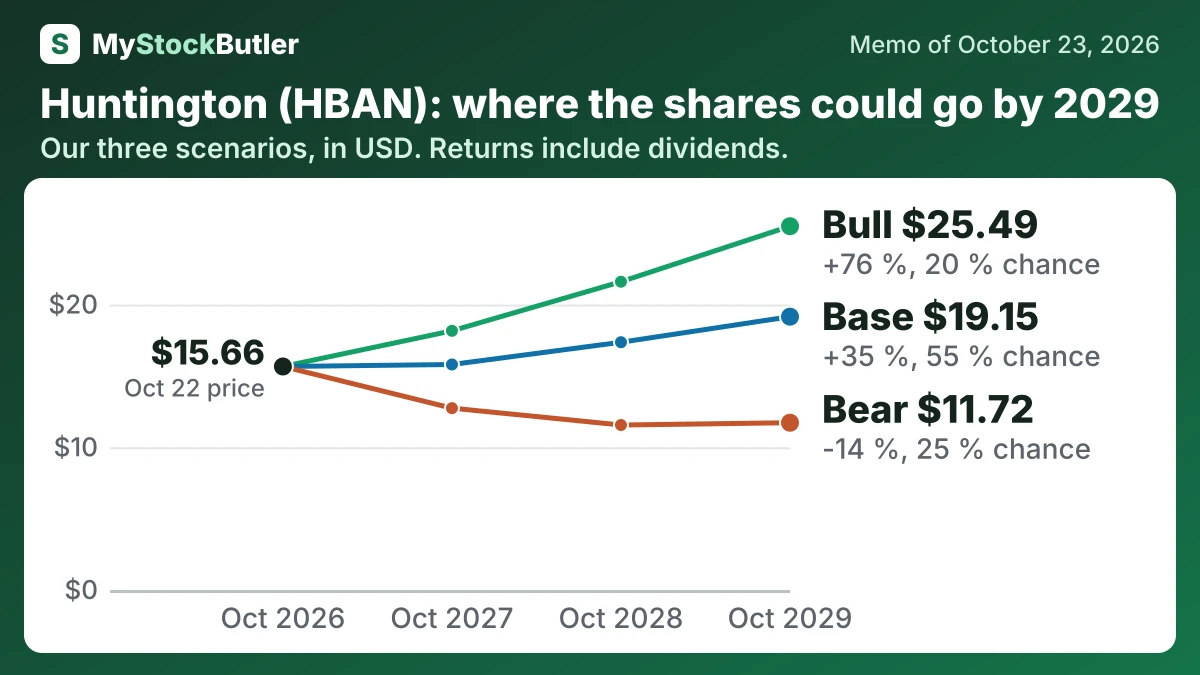
The forecast gives Huntington Bancshares modest near-term upside, improving as earnings, buybacks and book value accumulate. The probability-weighted share price is $15.51 in October 2027, $16.76 in October 2028 and $18.56 in October 2029, equivalent to returns including dividends of 3%, 15% and 31% from today’s $15.66. By October 2029, the range runs from $11.72 in the bear case to $25.49 in the bull case.
| Case | Probability | October 2027 | October 2028 | October 2029 |
|---|---|---|---|---|
| Bear | 25 % | 12.74 (-15 %) | 11.56 (-19 %) | 11.72 (-14 %) |
| Base | 55 % | 15.80 (+5 %) | 17.36 (+19 %) | 19.15 (+35 %) |
| Bull | 20 % | 18.16 (+20 %) | 21.60 (+46 %) | 25.49 (+76 %) |
| Weighted | 100 % | 15.51 (+3 %) | 16.76 (+15 %) | 18.56 (+31 %) |
What this means. The weighted row is a probability-based average of the bear, base, and bull cases, not a guaranteed share price.
What has to go right for Huntington's forecast, and what could go wrong?
The bear case requires deposit competition to keep margins weak, commercial and vehicle losses to rise, Cadence savings to arrive late and supervision costs to increase. Huntington protects capital by reducing buybacks, while investors apply a discount to book. The case gives $12.74 in October 2027 and $11.72 in October 2029, or a 14% loss including dividends. Its 25% probability reflects rising credit indicators and acquisition risk, tempered by capital and liquidity disclosures.
The bull case requires faster funding-cost relief, delivered Cadence savings, durable new-market relationships and controlled credit. Fee growth and stronger returns support larger repurchases and a higher valuation. The case gives $18.16 in October 2027 and $25.49 in October 2029, a 76% return including dividends. Its 20% probability reflects the demanding need for all these conditions to succeed together.
How much does Huntington earn and give back per share?
Base dividends are $0.62, $0.64 and $0.66 per share. The first value matches the current annual pace after the latest $0.155 quarterly declaration, while later increases reflect moderate earnings growth and a payout around the mid-30% range. The bear case holds dividends at $0.60 after a modest cut; the bull case reaches $0.64, $0.68 and $0.72. Huntington’s dividend has remained near $0.62 for four years, so stability is better supported than rapid growth.
| 2025 | 2024 | 2023 | 2022 | 2021 | |
|---|---|---|---|---|---|
| EPS, diluted | 1.39 | 1.22 | 1.24 | 1.45 | 0.90 |
| − Dividends declared ÷ average diluted shares | 0.62 | 0.62 | 0.62 | 0.62 | 0.64 |
| − Share buybacks, per share | 0.00 | 0.00 | 0.00 | 0.00 | 0.51 |
| = Kept, per share | 0.76 | 0.60 | 0.62 | 0.83 | |
| Book value per share | 13.78 | 12.21 | 11.71 | 10.79 | 11.91 |
What this means. In 2021, the company paid out $0.25 more per share than it earned because dividends and share buybacks together exceeded its profit.
What does an investor pay for Huntington today?
The P/E ratio compares a share price with the company’s recent annual profit. A forward P/E uses an estimate of future profit, so it is a forecast rather than a result. Like a rental property, the same asset appears cheaper if expected rent rises, even though its price has not changed. Huntington’s lower forward multiple is attractive only if the forecast earnings arrive and can be repeated.
| Today (Oct 23, 2026) | |
|---|---|
| Share price | 15.66 |
| Market value (calculated) | 31,560.96 |
| P/E, last 12 months (calculated) | 12.9x |
| P/E, next 12 months (calculated) | 11.8x |
| Price to book (calculated) | 1.1x |
| Price to tangible book (calculated) | 1.7x |
What this means. The next-12-month price-to-earnings number uses analysts’ predicted profit, not profit the company has already earned, so it could be wrong.