Equifax dividend
MyStockButler's October 2026 analysis: Equifax pays a $0.56 quarterly rate, and its free cash flow covered the dividend. Dividends plus buybacks absorbed more than free cash flow.
How much does Equifax pay in dividends?
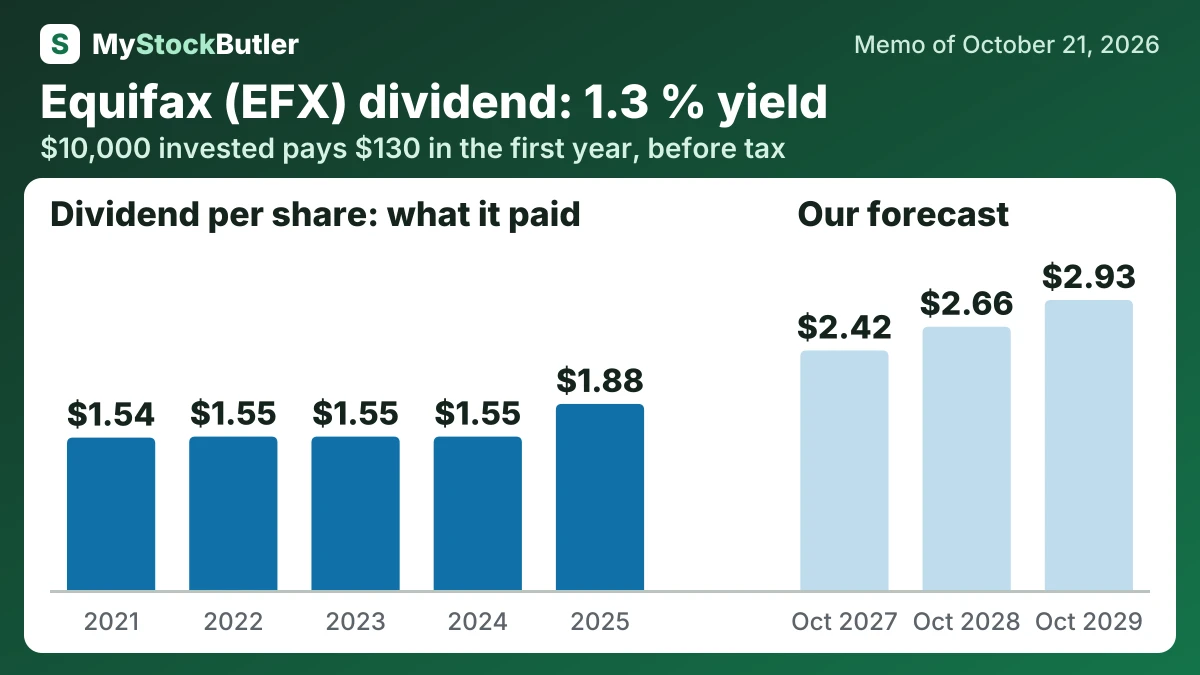
The dividend path starts from the $0.56 quarterly rate. The base gives $2.42, $2.66 and $2.93 per share because cash generation permits moderate increases. The bear gives $2.24, $2.24 and $2.35 because the company pauses first. The bull gives $2.44, $2.73 and $3.06 because earnings and savings support repeated increases. That range reflects a record of increases but no multi-year payout promise.
| October 2027 | October 2028 | October 2029 | |
|---|---|---|---|
| Earnings | 1,161 (1,028 / 1,181) | 1,247 (1,043 / 1,335) | 1,327 (1,051 / 1,496) |
| Shares (millions) | 114 (116 / 114) | 112 (115 / 110) | 111 (114 / 107) |
| Dividends per share | 2.42 (2.24 / 2.44) | 2.66 (2.24 / 2.73) | 2.93 (2.35 / 3.06) |
| Price to earnings | 20.00 (17.00 / 24.00) | 19.00 (15.00 / 25.00) | 18.00 (14.00 / 26.00) |
What this means. The price to earnings number shows how many dollars investors pay for each dollar the company earns.
How much would Equifax's dividend pay you?
$10,000 invested in Equifax at its 1.3% dividend yield (our report of October 21, 2026) pays $130.00 in the first year, before tax. If its dividend per share keeps changing 5.1% a year, as it did from 2021 to 2025, and the dividends are reinvested, year 10 pays $234.92, with $1,770.60 received in all.
Before tax. Past dividend growth is not a promise. Information only, not investment advice.
Is Equifax's dividend covered by its cash?
Equifax first used the recovery to reduce debt. Net debt fell to $4,840.6 million while buybacks remained zero. The policy then changed: buybacks reached $927.5 million, and dividends reached $232.8 million. Together, those payouts absorbed 102.3% of free cash flow, and net debt ended at $4,912.5 million.
| 2025 | 2024 | 2023 | 2022 | 2021 | |
|---|---|---|---|---|---|
| Free cash flow | 1,134.3 | 813.0 | 515.5 | 132.6 | 865.8 |
| − Dividends paid | 232.8 | 193.2 | 191.8 | 191.1 | 190.0 |
| − Share buybacks | 927.5 | 0 | 0 | 0 | 69.9 |
| = Free cash flow not paid out | 615.2 | 278.1 | 599.4 | ||
| Paid out, % of free cash flow | 102.3% | 23.8% | 37.2% | 144.1% | 30.0% |
What this means. The company paid shareholders more than the cash it generated in 2025 and 2022, so it had to use savings or borrow money to cover the difference.
What could change Equifax's dividend?
On October 20, 2026, management guided FY 2026 revenue to $6,646–$6,676 million after cutting its revenue outlook. It guided adjusted EPS to $8.45–$8.55. Management promises at least $1 billion of annual free cash flow and 100% cash conversion. Capital expenditure is guided at 7.5% of revenue.
Through 2028, earnings growth, VantageScore adoption and realized AI savings would determine whether margins and cash conversion improve. Persistent technology or legal costs would instead reduce free cash flow and buybacks.
What is Equifax's dividend yield today against its price?
At $176.54 a share on October 21, 2026, shareholders valued Equifax’s equity at $20,658.2 million. Enterprise value adds debt and subtracts cash because a buyer of the operating business also takes responsibility for its borrowings. On September 30, 2026, Equifax had $5.233 billion of debt and $193 million of cash. Like buying a house with a mortgage, the equity price is not the whole cost.
| Today (Oct 21, 2026) | |
|---|---|
| Share price | 176.54 |
| Free cash flow yield (calculated) | 5.5% |
| Dividend yield (calculated) | 1.3% |
What this means. The next 12 months price-to-earnings number uses analysts' expected profits, so it is an estimate rather than a result the company has already earned.