Equifax stock forecast 2027–2029
MyStockButler's October 2026 analysis: Equifax's weighted forecast points to $194.39 for October 2027. Equifax's forecast hinges on turning data networks and diversified demand into durable cash despite mortgage weakness.
Where could Equifax's shares be by 2029?
The weighted forecast points to modest upside, but the possible outcomes widen sharply by 2029. For October 2027, it gives $194.39, or 11% including dividends. For October 2028, it gives $202.06 and 17%. For October 2029, it gives $211.76 and 24%.
At the last date, the bear-to-bull range is $128.84 to $362.16. Today's price is $176.54. The bear carries 30%. The base carries 55%. The bull carries 15%.
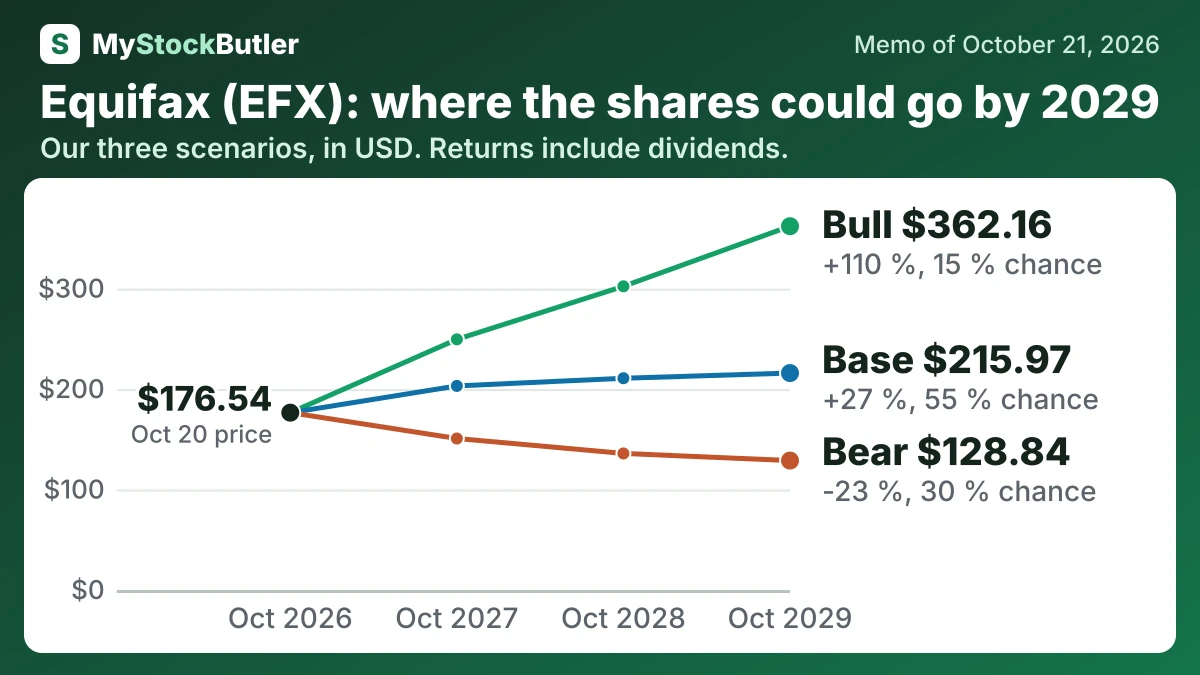
| Case | Probability | October 2027 | October 2028 | October 2029 |
|---|---|---|---|---|
| Bear | 30 % | 150.79 (-13 %) | 135.93 (-20 %) | 128.84 (-23 %) |
| Base | 55 % | 203.15 (+16 %) | 210.79 (+22 %) | 215.97 (+27 %) |
| Bull | 15 % | 249.51 (+43 %) | 302.31 (+74 %) | 362.16 (+110 %) |
| Weighted | 100 % | 194.39 (+11 %) | 202.06 (+17 %) | 211.76 (+24 %) |
What this means. The weighted row is the average value after giving more importance to the base case because it is more likely.
What must go right or wrong for Equifax's forecast?
The base balances mortgage weakness against diversified-market growth, The Work Number's 223M active records, and possible AI savings. The first estimate also broadly matches the supplied analyst earnings view. The bear case gives $1,028M, $1,043M and $1,051M as weak mortgage pricing holds margins near 15%. The bull gives $1,181M, $1,335M and $1,496M as mortgage activity stabilizes and new products improve margins. Management's 2026 revenue guidance cut and its expected mortgage-originations decline support the downside risk.
The bull case requires mortgage activity to stabilize, diversified markets to outperform, VantageScore adoption to reduce royalty leakage and AI savings to exceed ongoing costs. Repeat use of newer products then supports stronger cash generation, debt reduction and buybacks. The shares reach $249.51 first and $362.16 last, but the probability is only 15% because the Vitality Index and savings target do not yet prove durable incremental profit.
How much cash does Equifax really make?
Free cash flow means cash from operations after capital spending. The recovery came partly from lower capital expenditure and partly from working capital moving from a cash drain to a cash release. Working capital includes unpaid customer invoices, so a release can improve cash without increasing recurring profit. That timing benefit cannot expand indefinitely.
| 2025 | 2024 | 2023 | 2022 | 2021 | |
|---|---|---|---|---|---|
| Cash from operations | 1,615.7 | 1,324.5 | 1,116.8 | 757.1 | 1,334.8 |
| − Capital spending | 481.4 | 511.5 | 601.3 | 624.5 | 469.0 |
| = Free cash flow | 1,134.3 | 813.0 | 515.5 | 132.6 | 865.8 |
| − Stock pay | 78.4 | 81.6 | 71.8 | 62.6 | 54.9 |
| = Real free cash flow | 1,055.9 | 731.4 | 443.7 | 70.0 | 810.9 |
What does an investor pay for Equifax today?
| Today (Oct 21, 2026) | |
|---|---|
| Share price | 176.54 |
| Market value (calculated) | 20,658.2 |
| Enterprise value (calculated) | 25,672.0 |
| P/E, last 12 months (calculated) | 28.5x |
| Free cash flow yield (calculated) | 5.5% |
| Real free cash flow yield (calculated) | 5.1% |
What this means. The next 12 months price-to-earnings number uses analysts' expected profits, so it is an estimate rather than a result the company has already earned.