Clorox stock forecast 2027–2029
MyStockButler's October 2026 analysis: The weighted forecast puts Clorox at $85.87 in October 2027 and $106.84 in October 2029, with 55% assigned to the base case. It hinges on demand, margins and cash improving while GOJO integrates successfully.
Where could Clorox's shares be in each forecast year?
The weighted price is $85.87 in October 2027, a 5% total return. It is $106.84 in October 2029, a 40% total return. Bear probability is 25%; base probability is 55%. Bull probability is 20%.
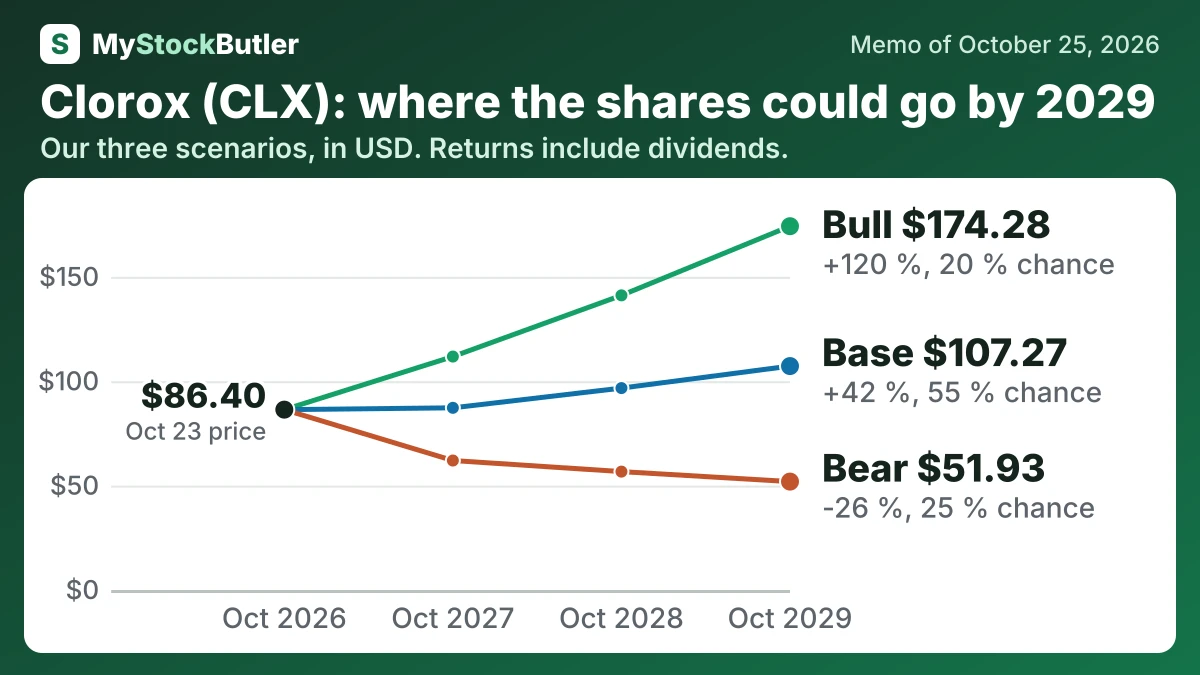
| Case | Probability | October 2027 | October 2028 | October 2029 |
|---|---|---|---|---|
| Bear | 25 % | 62.02 (-22 %) | 56.71 (-24 %) | 51.93 (-26 %) |
| Base | 55 % | 87.27 (+7 %) | 96.73 (+24 %) | 107.27 (+42 %) |
| Bull | 20 % | 111.83 (+35 %) | 141.15 (+75 %) | 174.28 (+120 %) |
| Weighted | 100 % | 85.87 (+5 %) | 95.61 (+22 %) | 106.84 (+40 %) |
What this means. The weighted row is the average value after giving each possible outcome the probability shown above it.
What has to go right or wrong for Clorox?
Its story is a mostly mechanical FY2027 rebound: GOJO and easier ERP comparisons lift sales, but weak legacy volume, litter, inflation and integration costs restrain margins. Debt service and dividends absorb cash, so shares rise and the P/E contracts. The probability remains below base because Clorox has established brands and early GOJO earnings potential.
Here, Purell’s installed dispenser base drives repeat refills, the $50 million savings target becomes real, and Glad, Home Care and Hidden Valley recover share. Higher cash generation accelerates debt repayment and buybacks, supporting a 22x P/E. The probability stays limited because GOJO is recent, savings are not fully earned and legacy volume remains weak.
How much cash does Clorox really make?
Stock compensation is noncash today but gives employees a claim on shareholder value. Deducting it produces a stricter analytical measure of free cash flow. Clorox is cash-generative, but the headline depends on transaction payments, working capital and tax timing.
| Jun 2026 | Jun 2025 | Jun 2024 | Jun 2023 | Jun 2022 | |
|---|---|---|---|---|---|
| Cash from operations | 612 | 981 | 695 | 1,158 | 786 |
| − Capital spending | 207 | 220 | 212 | 228 | 251 |
| = Free cash flow | 405 | 761 | 483 | 930 | 535 |
| − Stock pay | 48 | 81 | 74 | 73 | 52 |
| = Real free cash flow | 357 | 680 | 409 | 857 | 483 |
| Real free cash flow, % of revenue | 5.3% | 9.6% | 5.8% | 11.6% | 6.8% |
What this means. The company says free cash flow was 881 million because it leaves out a 476 million payment to the Glad venture, while we count that payment because the cash really left the company.
What does an investor pay for Clorox today?
Free cash flow is the cash left after operating the business and replacing necessary equipment. Clorox paid $476 million in March 2026 for P&G’s remaining interest in Glad, and that payment reduced operating cash flow. Adding it back produced adjusted free cash flow of $881 million, which helps assess recurring operations but does not return the money to Clorox’s bank account. The dividend therefore needs to be tested against cash after investment and debt service.
| Today (Oct 25, 2026) | |
|---|---|
| Share price | 86.40 |
| Market value (calculated) | 10,449.06 |
| Enterprise value (calculated) | 15,452.06 |
| P/E, last 12 months (calculated) | 18.0x |
| P/E, next 12 months (calculated) | 15.2x |
| Real free cash flow yield (calculated) | 3.4% |
What this means. The price to book figure means investors are paying about 116 dollars for every 1 dollar of the company’s recorded net assets.