AES dividend: cash cover and outlook
MyStockButler's October 2026 analysis: AES declared $0.17595 per share in October, payable in November. AES's operating cash did not cover capital spending in 2025, so free cash flow was negative.
How much does AES pay in dividends?
An investor who buys at the offer price and receives the same amount at completion earns no capital appreciation from the transaction itself. Dividends are separate: AES declared $0.17595 per share in October, payable in November, but an investor holding only until closing receives only the dividends for which that investor qualifies. The merger agreement’s outside date is June 1, 2027, subject to specified extensions.
| 2025 | 2024 | |
|---|---|---|
| EPS, diluted | 1.31 | |
| Free cash flow per share | -2.27 | |
| − Dividends paid, per share | 0.70 | |
| − Share buybacks, per share | 0.00 |
What this means. The company's own free cash flow per share is positive because it counts only cash left at the parent company and leaves out spending by its subsidiaries; our count includes that spending and is negative.
Does AES's cash cover its dividend?
Operating cash did not cover capital spending in 2025, so free cash flow was negative. That can be rational when the spending builds plants expected to earn for decades. It becomes more concerning when maintenance spending, environmental obligations and expansion are mixed together, because the accounts do not provide a complete absolute figure for upkeep.
Parent free cash flow already deducts specified parent interest and overhead, while common dividends consumed about $501 million in 2025. The remaining cash must compete with debt repayment, investment and equity contributions. An approximately $2 billion equity requirement over 2026–2030 makes the funding question central: can AES complete its pipeline without relying on delayed asset sales or stronger-than-expected operating receipts?
| 2025 | 2024 | |
|---|---|---|
| Free cash flow | -1,623 | |
| − Dividends paid | 501 | |
| − Share buybacks | 0 | |
| = Paid out more than the free cash flow | 3,036 | |
| Paid to shareholders | 501 | |
| Paid out, % of free cash flow | not meaningful |
What this means. The company paid shareholders cash even though its business used more cash than it generated, so it had to use savings or borrow money.
What could change AES's dividend?
Liquidity shows why group resources cannot be treated as the parent’s dividend budget. At June 30, only $43 million of AES’s $1.8 billion in unrestricted cash was held at the parent and qualified holding companies. AES has said that standalone growth could require reducing or eliminating the dividend, issuing substantial new equity, or both.
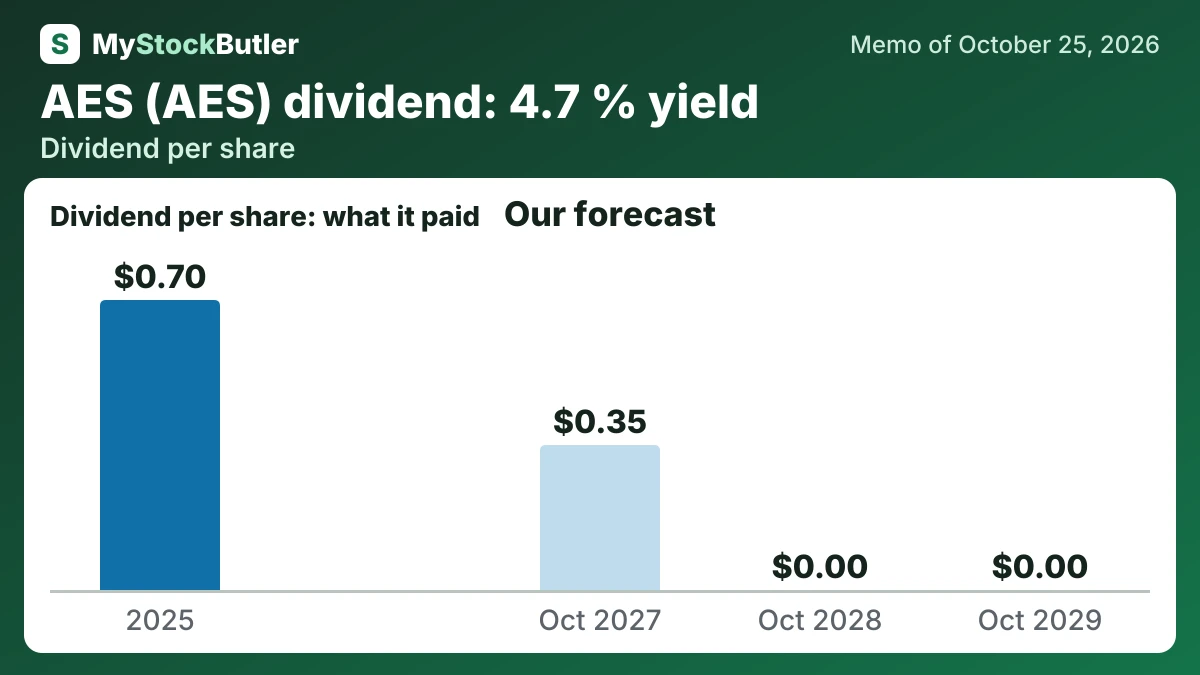
The base and bear cases pay $0.35 per share in October 2027, then nothing. The base assumes only two quarterly payments before closing, while the bear assumes a 50% cut from the latest annualized rate. The bull pays $0.70 in 2027 and 2028, then $0.75 in 2029, requiring the deal to fail and cash generation to improve.
| October 2027 | October 2028 | October 2029 | |
|---|---|---|---|
| EBITDA | 3,400 (3,100 / 3,600) | 3,550 (3,000 / 3,900) | 3,700 (3,100 / 4,250) |
| Shares (millions) | 713 (742 / 713) | 713 (774 / 713) | 713 (802 / 713) |
| Dividends per share | 0.35 (0.35 / 0.70) | 0.00 (0.00 / 0.70) | 0.00 (0.00 / 0.75) |
| Net debt | 32,264 (33,564 / 30,764) | 33,764 (35,564 / 30,664) | 34,964 (37,564 / 30,564) |