PPG dividend
MyStockButler's October 2026 analysis: PPG's forecast has dividends rising from $2.99 per share to $3.23 by 2029. In 2025, PPG paid $628 million in dividends, while dividends and buybacks together exceeded free cash flow by 22.5%.
How much does PPG pay in dividends?
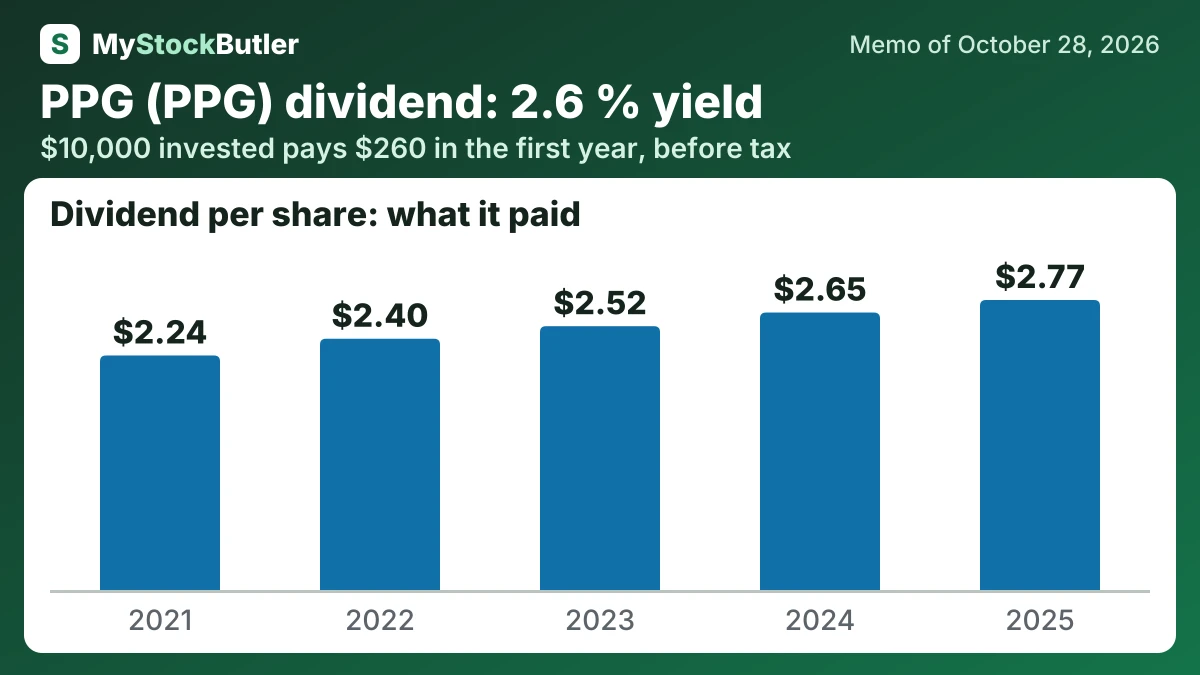
Base dividends rise from $2.99 per share to $3.23 by 2029. The forecast repeats the latest quarterly increase pattern. The bear case holds the annual payment at $2.96, while the bull case reaches $3.41 through larger raises. PPG has increased its dividend for 55 consecutive years, and the 2025 payout was about 37% of adjusted EPS, supporting modest growth but not an aggressive assumption.
| 2025 | 2024 | 2023 | 2022 | 2021 | |
|---|---|---|---|---|---|
| − Dividends paid, per share | 2.77 | 2.65 | 2.52 | 2.40 | 2.24 |
| − Share buybacks, per share | 3.48 | 3.20 | 0.36 | 0.80 | 0.88 |
| = FCF not paid out, per share | 4.52 |
What this means. Real free cash flow per share is lower because it subtracts the value of shares given to employees as pay.
How much would PPG's dividend pay you?
$10,000 invested in PPG at its 2.6% dividend yield (our report of October 28, 2026) pays $260.00 in the first year, before tax. If its dividend per share keeps changing 5.5% a year, as it did from 2021 to 2025, and the dividends are reinvested, year 10 pays $558.85, with $3,888.02 received in all.
Before tax. Past dividend growth is not a promise. Information only, not investment advice.
Is PPG's dividend covered by its cash?
After that purchase, shareholder returns became a more prominent use of cash. In 2025, PPG paid $628 million in dividends and $790 million to repurchase shares. Together, those distributions exceeded free cash flow by 22.5%. Buybacks can increase earnings per remaining share, but their value depends on the price PPG paid and what else it could have done with the money.
PPG covered the difference with existing resources and borrowing. Refinancing means not every borrowed dollar funded a buyback, but net debt still increased, leaving less capacity for debt reduction or future investment. The cash record therefore points to a trade-off: PPG funded the business while also paying owners more than recent internally generated cash covered. Its portfolio changes now determine whether that pressure produced a leaner company.
| 2025 | 2024 | 2023 | 2022 | 2021 | |
|---|---|---|---|---|---|
| Free cash flow | 1,158 | 670 | 1,778 | 514 | |
| − Dividends paid | 628 | 622 | 598 | 570 | 536 |
| − Share buybacks | 790 | 752 | 86 | 190 | 210 |
| = Free cash flow not paid out | 1,073 | ||||
| = Paid out more than the free cash flow | 283 | 729 | 259 | ||
| Paid out, % of free cash flow | 122.5% | 205.1% | 38.5% | 147.9% |
What this means. The company's own net debt is slightly different from our calculation because it rounds its figures to the nearest hundred million dollars.
What could change PPG's dividend?
In 2026, management guides adjusted EPS to $7.90–$8.10; Q4 organic sales growth is expected in the low single digits. Capital spending is guided at $650 million–$700 million. Restructuring promises $50 million of annual savings, with $80 million–$100 million of cash outlays.
What is PPG's dividend yield today?
At $113.37 a share, PPG is priced as a profitable coatings business with a substantial lender claim alongside the shareholder claim.
| Today (Oct 28, 2026) | |
|---|---|
| Share price | 113.37 |
| Free cash flow yield (calculated) | 4.6% |
| Dividend yield (calculated) | 2.6% |
What this means. Enterprise value is higher than market value because it includes the company's debt after subtracting its cash and short-term investments.