Lockheed Martin stock forecast 2027–2029
MyStockButler's October 2026 analysis: The weighted scenario is $602.14 by October 2027 and $683.77 by October 2029, with the bear case at 28% probability, base at 53%, and bull at 19%. It hinges on whether Lockheed Martin converts funded demand into cash without repeating fixed-price losses.
Where could Lockheed Martin's shares be by 2029?
Weighted price is $602.14 by October 2027, a +5% return including dividends. It reaches $683.77 by October 2029, a +24% return including dividends. The bear case has 28% probability, the base case 53%, and the bull case 19%.
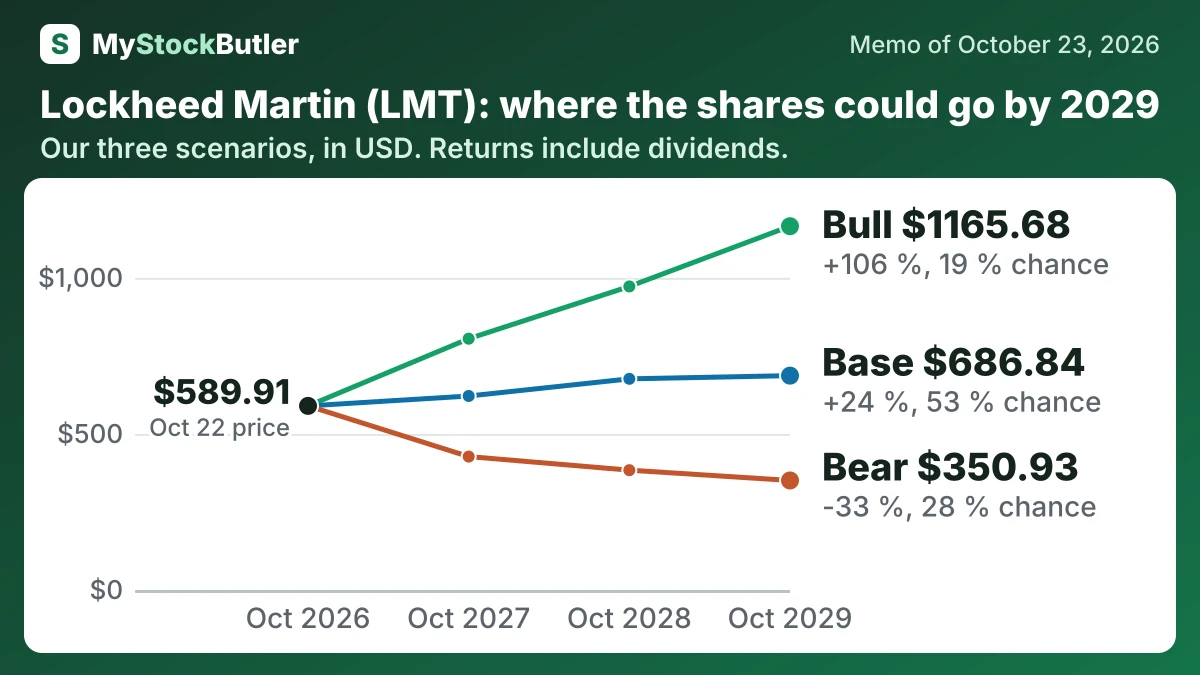
| Case | Probability | October 2027 | October 2028 | October 2029 |
|---|---|---|---|---|
| Bear | 28 % | 427.45 (-25 %) | 383.91 (-30 %) | 350.93 (-33 %) |
| Base | 53 % | 621.64 (+8 %) | 676.62 (+20 %) | 686.84 (+24 %) |
| Bull | 19 % | 805.17 (+39 %) | 972.63 (+70 %) | 1165.68 (+106 %) |
| Weighted | 100 % | 602.14 (+5 %) | 650.90 (+15 %) | 683.77 (+24 %) |
What this means. The weighted row is the average value after giving more weight to cases that are more likely, not a promise that the shares will reach that price.
What has to go right or wrong for Lockheed Martin?
The October 22, 2026 F-35 framework covers 850 U.S. aircraft. Congressional appropriations and final contracts determine whether it becomes executable work. Year-end 2026 results test the raised guidance. In 2027–2028, accepted missile deliveries, supplier capacity, and margins matter; through 2029, F-35 funding and recurring fixed-price losses matter most.
How much cash does Lockheed Martin really make?
In 2025, operating cash flow was $8,557 million. After $1,649 million of capital spending, free cash flow was $6,908 million. Capital spending is a real claim on cash even though accounting spreads much of its cost across future years.
Stock compensation is different: the cash-flow statement adds it back because issuing shares does not use cash at the moment of expense recognition. Deducting 2025’s $304 million of stock pay gives analytical “real free cash flow” of $6,604 million. It is not Lockheed’s own measure, but it shows what remains after compensating employees with shares.
| 2025 | 2024 | 2023 | 2022 | 2021 | |
|---|---|---|---|---|---|
| Cash from operations | 8,557 | 6,972 | 7,920 | 7,802 | 9,221 |
| − Capital spending | 1,649 | 1,685 | 1,691 | 1,670 | 1,522 |
| = Free cash flow | 6,908 | 5,287 | 6,229 | 6,132 | 7,699 |
| − Stock pay | 304 | 277 | 265 | 238 | 227 |
| = Real free cash flow | 6,604 | 5,010 | 5,964 | 5,894 | 7,472 |
| Real free cash flow, % of revenue | 8.8% | 7.1% | 8.8% | 8.9% | 11.1% |
What this means. The company's own free cash flow matches our count, but our real free cash flow is lower because we subtract shares given to employees as pay, which gives away part of the company.
What does an investor pay for Lockheed Martin today?
A share is a small claim on the profits of the company behind the F-35 fighter and major missile systems. The stock-market value belongs to common shareholders. Enterprise value measures the operating business for all capital providers, so it adds debt and subtracts cash. Lockheed’s enterprise value is therefore higher than its market value by $14.538 billion: that is a financing bridge, not extra value belonging to shareholders.
| Today (Oct 23, 2026) | |
|---|---|
| Share price | 589.91 |
| Market value (calculated) | 136,145.77 |
| Enterprise value (calculated) | 150,683.77 |
| P/E, last 12 months (calculated) | 21.0x |
| P/E, next 12 months (calculated) | 18.0x |
| Real free cash flow yield (calculated) | 4.9% |
What this means. Enterprise value is higher than market value because it adds the company's debt and subtracts its cash, showing what it would cost to buy the whole business.