Jack Henry stock forecast 2027–2029
MyStockButler's October 2026 analysis: Jack Henry’s weighted case is $175.91 in October 2029, with 53% probability assigned to the base case. It hinges on conversion pace, recurring revenue and costs for staffing, cybersecurity, AI infrastructure and data-center consolidation.
Where could Jack Henry’s shares be by 2029?
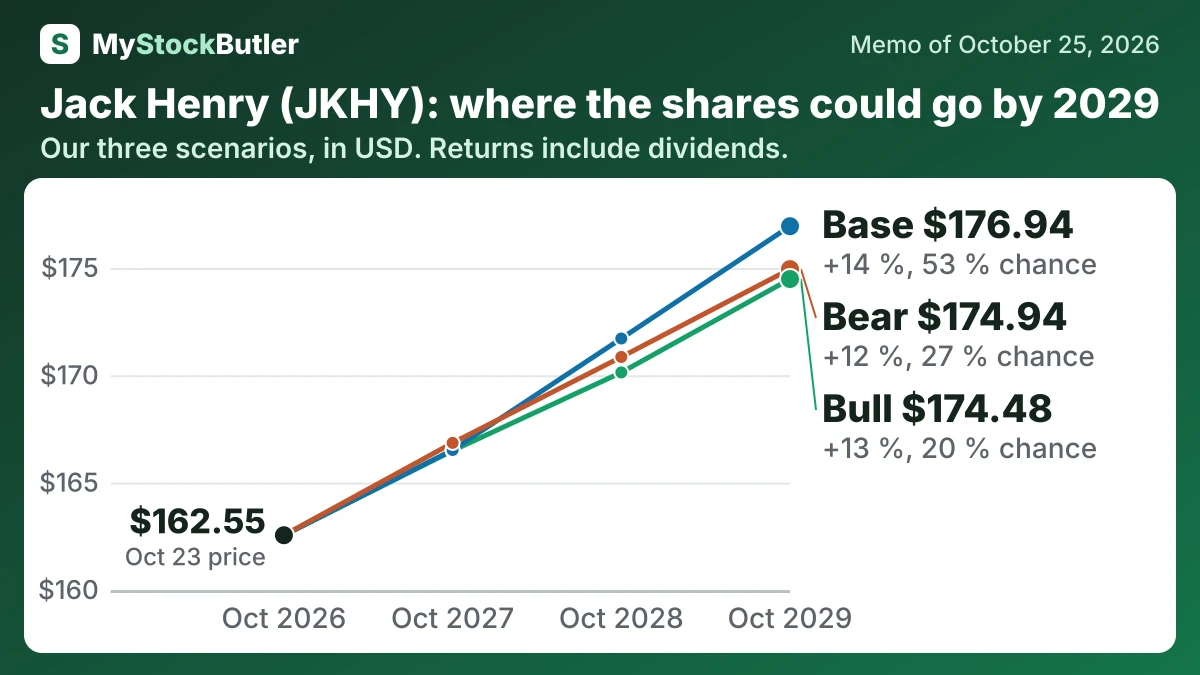
The weighted value is $166.60 in October 2027, a 4% return including dividends, and $175.91 in October 2029, a 13% return. The cases assign 27% probability to the bear case, 53% to the base case and 20% to the bull case.
| Case | Probability | October 2027 | October 2028 | October 2029 |
|---|---|---|---|---|
| Bear | 27 % | 166.85 (+4 %) | 170.85 (+8 %) | 174.94 (+12 %) |
| Base | 53 % | 166.52 (+4 %) | 171.71 (+9 %) | 176.94 (+14 %) |
| Bull | 20 % | 166.49 (+4 %) | 170.13 (+8 %) | 174.48 (+13 %) |
| Weighted | 100 % | 166.60 (+4 %) | 171.16 (+8 %) | 175.91 (+13 %) |
What has to go right or wrong for Jack Henry?
Conversion pace, recurring revenue and costs for staffing, cybersecurity, AI infrastructure and data-center consolidation will determine whether growth reaches margins and cash. The first checkpoint is the fiscal 2027 first-quarter call on November 4, 2026, with completed conversions and signed-work timing central to the test. Cash must fund investment and dividends; discretionary buybacks are the flexible part of capital returns.
How much cash does Jack Henry really make?
Free cash flow means cash left after the investment definition chosen by the analyst. Jack Henry’s broader measure also deducts capitalized development and internal-use software, producing $539.3 million. That measure included $32.8 million of asset-sale proceeds. Removing them leaves $506.5 million, or 100.7% of reported net income.
Stock compensation creates a further question because issuing shares is an economic cost even though it is not a cash payment. Working capital creates timing effects too: customer receivables consume cash, while advance payments provide it. Tax rules enacted on July 4, 2025 also reduced FY2026 cash taxes. The cash benefit is real, but it should not be projected indefinitely.
| Jun 2026 | Jun 2025 | Jun 2024 | Jun 2023 | Jun 2022 | |
|---|---|---|---|---|---|
| Cash from operations | 761,960 | 641,504 | 568,041 | 381,559 | 504,631 |
| − Capital spending | 67,103 | 53,358 | 58,118 | 39,179 | 34,659 |
| = Free cash flow | 694,857 | 588,146 | 509,923 | 342,380 | 469,972 |
| − Stock pay | 32,460 | 28,392 | 28,873 | 28,611 | 24,780 |
| = Real free cash flow | 662,397 | 559,754 | 481,050 | 313,769 | 445,192 |
| Free cash flow, % of revenue | 27.3% | 24.8% | 23.0% | 16.5% | 24.2% |
| Real free cash flow, % of revenue | 26.0% | 23.6% | 21.7% | 15.1% | 22.9% |
What this means. The company's free cash flow is lower because it also subtracts money spent on software, while our count subtracts only money spent on property and equipment.
What do investors pay for Jack Henry today?
P/E is the share price divided by earnings per share. The trailing figure describes what investors pay for the last year’s profit; the forward figure uses expected profit, so the gap between them assumes earnings will rise. Profit is not cash, however, because Jack Henry must keep spending on software and infrastructure. In FY26, it spent $184.2 million on ongoing product development.
| Today (Oct 24, 2026) | |
|---|---|
| Share price | 162.55 |
| P/E, last 12 months (calculated) | 23.3x |
| P/E, next 12 months (calculated) | 22.1x |
| Free cash flow yield (calculated) | 6.1% |
| Real free cash flow yield (calculated) | 5.8% |
What this means. The enterprise value uses debt and cash from June 30, so it may not show what the company owes or holds today.