FirstEnergy dividend: cash coverage and yield
MyStockButler's October 2026 analysis: FirstEnergy paid $1.016 billion in dividends in 2025, with no share buybacks. Its free cash flow was negative $1.005 billion, so operating cash did not cover the dividend.
How much does FirstEnergy pay in dividends?
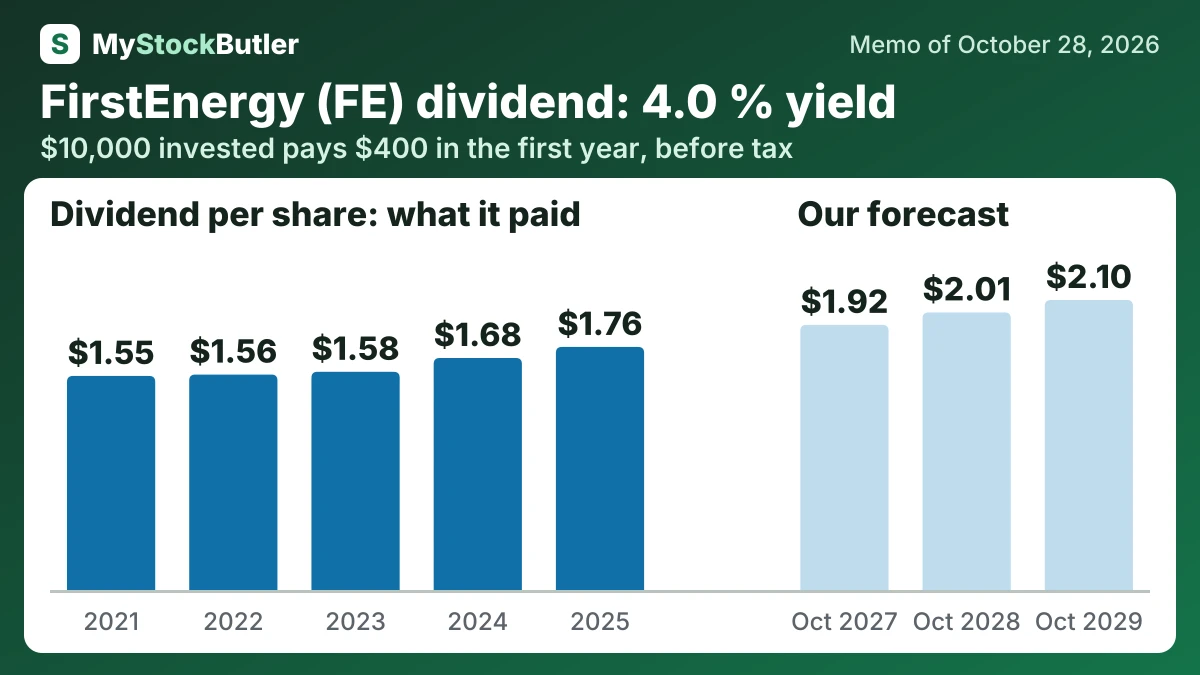
Dividends grow from $1.92 per share to $2.10 in the base case. This continues the announced 4.5% increase and stays within the stated 60%–70% Core EPS payout target. The bear case pauses at $1.86 because negative free cash flow and rising debt compete with distributions. The bull case reaches $2.19 as stronger earnings support 6% annual increases.
| 2025 | 2024 | 2023 | 2022 | 2021 | |
|---|---|---|---|---|---|
| − Dividends paid, per share | 1.76 | 1.68 | 1.58 | 1.56 | 1.55 |
| − Share buybacks, per share | 0.00 | 0.00 | 0.00 | 0.00 | 0.00 |
| = Paid out more than FCF, per share | 3.67 | 3.80 | 5.13 | 1.88 | 0.96 |
What this means. Real free cash flow is lower than free cash flow because we subtract the value of shares given to employees as pay, even though that pay is not an immediate cash payment.
How much would FirstEnergy's dividend pay you?
$10,000 invested in FirstEnergy at its 4.0% dividend yield (our report of October 28, 2026) pays $400.00 in the first year, before tax. If its dividend per share keeps changing 3.2% a year, as it did from 2021 to 2025, and the dividends are reinvested, year 10 pays $795.02, with $5,728.52 received in all.
Before tax. Past dividend growth is not a promise. Information only, not investment advice.
Does FirstEnergy's cash cover its dividend?
FirstEnergy’s capital investment rose from $3.747 billion in 2023 to $5.556 billion in 2025. Free cash flow was negative every year from 2022 through 2025; in 2025 it was negative $1.005 billion. Dividends were $1.016 billion, and payments to minority owners were $100 million. The company made no share buybacks during those five years. Net debt rose from $22.392 billion at the end of 2021 to $26.499 billion at the end of 2025. Some borrowing refinanced old obligations, but financing still helped support investment and payouts.
| 2025 | 2024 | 2023 | 2022 | 2021 | |
|---|---|---|---|---|---|
| Free cash flow | -1,005 | -1,139 | -1,969 | -165 | 324 |
| − Paid to minority owners | 100 | 86 | 72 | 21 | 0 |
| − Dividends paid | 1,016 | 970 | 906 | 891 | 849 |
| − Share buybacks | 0 | 0 | 0 | 0 | 0 |
| = Paid out more than the free cash flow | 2,121 | 2,195 | 2,947 | 1,077 | 525 |
What this means. The company paid dividends even when its free cash flow was negative, so it had to use savings or borrow more money.
What could change FirstEnergy's dividend?
Management guides to 2026 Core EPS of $2.62–$2.82 and targets 6%–8% annual Core EPS growth through 2030. Its plan calls for $36 billion of investment and 10.4% annual rate-base growth. It targets a 60%–70% dividend payout. FFO/debt should be about 14%, measuring cash generated from operations against total debt.
The view would move toward bull if large-load connections and transmission projects arrive on schedule during 2028–2029. Faster formula-rate updates, successful construction and controlled equity issuance would improve earnings visibility, credit support and dividend capacity.
| October 2027 | October 2028 | October 2029 | |
|---|---|---|---|
| Earnings | 1,600 (1,350 / 1,750) | 1,800 (1,400 / 2,050) | 2,000 (1,500 / 2,350) |
| Shares (millions) | 585 (587 / 582) | 591 (596 / 585) | 597 (604 / 588) |
| Dividends per share | 1.92 (1.86 / 1.95) | 2.01 (1.86 / 2.07) | 2.10 (1.86 / 2.19) |