Evergy dividend
MyStockButler's October 2026 analysis: Evergy’s current quarterly rate is $0.695, or $2.78 annualized. In 2025, operating cash was $2.05 billion and capital spending was $2.80 billion, leaving negative free cash flow of $751.7 million.
How much does Evergy pay per share?
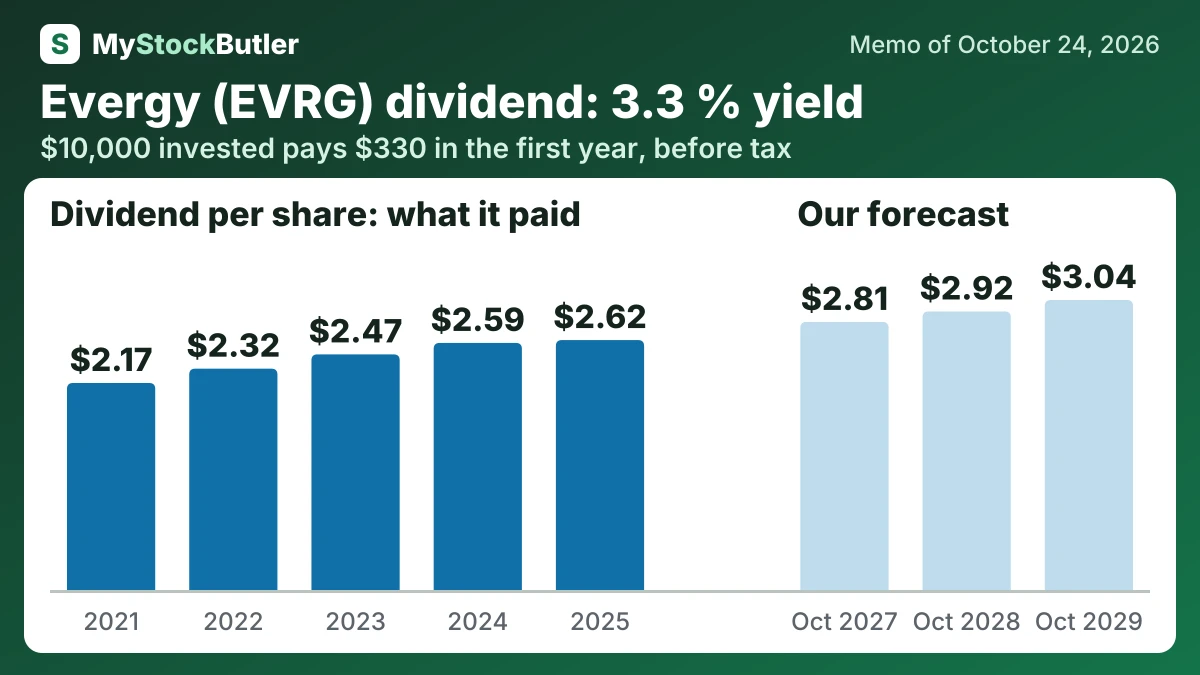
Dividends rise more slowly than earnings. The current quarterly rate is $0.695, or $2.78 annualized. The base case reaches $2.81 in the first period, then $2.92 and $3.04, reflecting roughly 4% annual growth. The bear case holds the payout at $2.78 because negative free cash flow and funding needs could prompt a pause. The bull case begins at $2.84 and reaches $3.18 as earnings and demand outperform.
| October 2027 | October 2028 | October 2029 | |
|---|---|---|---|
| Earnings | 1,095 (1,008 / 1,140) | 1,207 (1,058 / 1,288) | 1,331 (1,111 / 1,455) |
| Shares (millions) | 253 (256 / 250) | 262 (267 / 257) | 270 (278 / 264) |
| Dividends per share | 2.81 (2.78 / 2.84) | 2.92 (2.78 / 3.00) | 3.04 (2.78 / 3.18) |
| Price to earnings | 20.50 (17.50 / 22.00) | 20.00 (16.00 / 23.00) | 19.50 (15.00 / 23.50) |
How much would Evergy's dividend pay you?
$10,000 invested in Evergy at its 3.3% dividend yield (our report of October 24, 2026) pays $330.00 in the first year, before tax. If its dividend per share keeps changing 4.8% a year, as it did from 2021 to 2025, and the dividends are reinvested, year 10 pays $718.52, with $4,967.32 received in all.
Before tax. Past dividend growth is not a promise. Information only, not investment advice.
Is Evergy’s dividend covered by its cash?
In 2025, operating cash was $2.05 billion and capital spending was $2.80 billion. The result was negative free cash flow of $751.7 million. The deficit widened mainly because investment spending accelerated, not because cash collections collapsed.
| 2025 | 2024 | 2023 | 2022 | 2021 | |
|---|---|---|---|---|---|
| Free cash flow | -751.7 | -352.9 | -353.8 | -364.6 | -620.8 |
| − Dividends paid | 613.1 | 596.7 | 569.6 | 534.8 | 497.9 |
| − Share buybacks | 0 | 0 | 0 | 0 | 0 |
| = Paid out more than the free cash flow | 1,364.8 | 949.6 | 923.4 | 899.4 | 1,118.7 |
What this means. The company paid dividends even though its free cash flow was negative, so it had to use savings or borrow money to pay shareholders.
What could change Evergy’s dividend?
The bear case becomes more likely in 2027–2028 if large-load energization slips or actual usage trails signed capacity. Through 2027–2029, delayed rate recovery, cost overruns, or conditions imposed by regulators would weaken earnings conversion. More borrowing or equity issuance would further reduce per-share growth.
What is Evergy’s dividend yield today?
At $84.43 on October 23, 2026, Evergy’s market value is about $19.5 billion and its enterprise value is about $35.9 billion. Market value measures the portion owned by common shareholders. Enterprise value treats the company as a whole operating business, including claims from lenders and other financing providers, less cash. The roughly $16.5 billion gap mainly reflects those financing claims, not a separately verified net-debt balance.
The 3.3% dividend yield offers income while investors wait, but a ten-year Treasury yielded 4.96% on October 22. Evergy’s dividend may grow, but shareholders bear business risk. Its negative free-cash-flow yield also matters: during the first half of 2026, operations generated $711.1 million while property and equipment spending reached $1,811.8 million. The shortfall helps explain the $21.6 billion investment plan, including $3.3 billion of planned common-equity financing.
| Today (Oct 23, 2026) | |
|---|---|
| Share price | 84.43 |
| P/E, last 12 months (calculated) | 21.4x |
| Dividend yield (calculated) | 3.3% |
What this means. The negative free cash flow yield means the company spent more cash than it generated recently, even though it still pays a dividend.