Brown–Forman dividend: cash coverage and yield
MyStockButler's October 2026 analysis: Brown–Forman’s current annualized dividend is $0.924 per share. Brown–Forman’s free cash flow improved in fiscal 2026 because working-capital needs and capital spending declined, but the company still distributed almost all that cash.
How much does Brown–Forman pay in dividends?
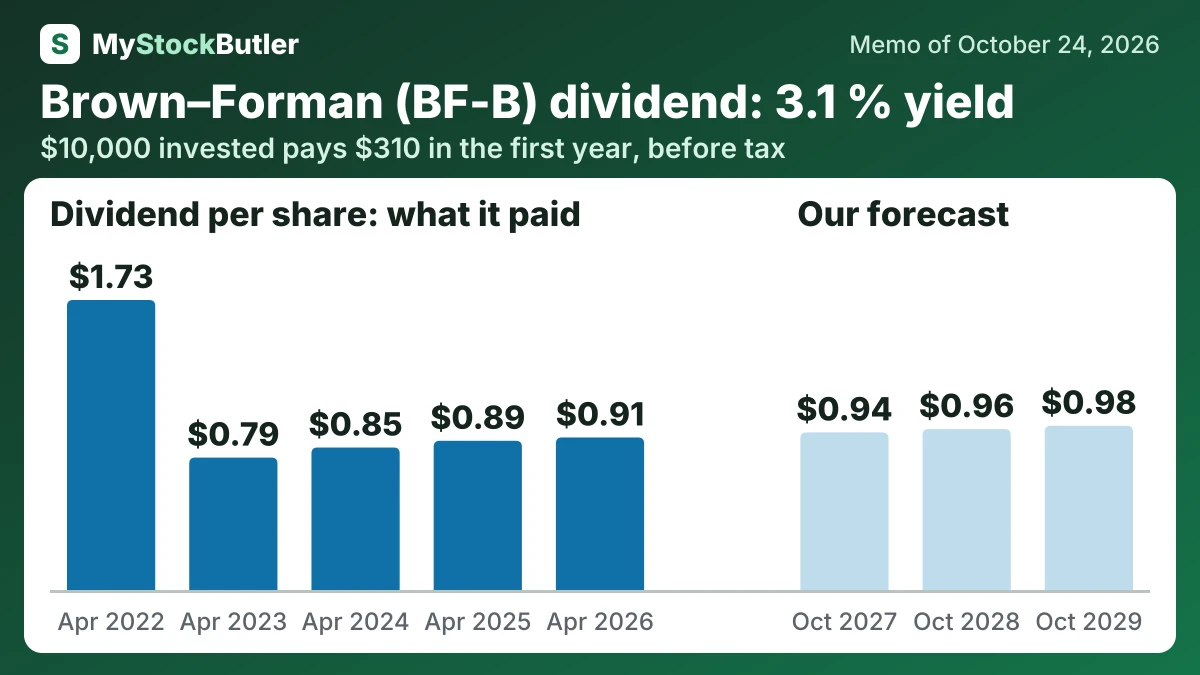
The base moves from the current annualized $0.924 to $0.936, $0.960 and $0.984. The bear holds $0.924 throughout, reflecting lower operating income and debt pressure. The bull reaches $1.080 by 2029 if cash flow improves. Brown–Forman has raised its regular dividend for 42 consecutive years, but fiscal 2027 guidance calls for organic operating income to decline by 3%–5%.
| Apr 2026 | Apr 2025 | Apr 2024 | Apr 2023 | Apr 2022 | |
|---|---|---|---|---|---|
| EPS, diluted | 1.53 | 1.84 | 2.14 | 1.63 | 1.74 |
| − Dividends paid, per share | 0.91 | 0.89 | 0.85 | 0.79 | 1.73 |
| − Share buybacks, per share | 0.86 | 0.00 | 0.84 | 0.00 | 0.00 |
What this means. The company's free cash flow per share is higher than our real free cash flow per share because we subtract the value of shares given to employees as pay, which reduces what each existing share really gets.
How much would Brown–Forman's dividend pay you?
$10,000 invested in Brown–Forman at its 3.1% dividend yield (our report of October 24, 2026) pays $310.00 in the first year, before tax. If its dividend per share keeps changing −14.8% a year, as it did from Apr 2022 to Apr 2026, and the dividends are reinvested, year 10 pays $85.56, with $1,798.07 received in all.
Before tax. Past dividend growth is not a promise. Information only, not investment advice.
Does Brown–Forman’s cash cover its dividend?
Asset sales then helped repair the balance sheet. Brown–Forman paused repurchases in fiscal 2025, sold its Duckhorn investment and repaid debt. In fiscal 2026, free cash flow improved even as earnings fell because working-capital needs and capital spending declined. The company still distributed almost all that cash while reducing borrowings, which meant that its cash balance also fell.
Free cash flow subtracts capital spending from operating cash. It improved because Brown–Forman spent less on long-lived assets as well as because working capital improved. The accompanying “real free cash flow” measure subtracts stock compensation. That is an economic adjustment for paying employees with ownership, not an additional cash payment or the company’s own definition.
| Apr 2026 | Apr 2025 | Apr 2024 | Apr 2023 | Apr 2022 | |
|---|---|---|---|---|---|
| Free cash flow | 893 | 431 | 419 | 457 | 798 |
| − Dividends paid | 427 | 420 | 404 | 378 | 831 |
| − Share buybacks | 400 | 0 | 400 | 0 | 0 |
| = Free cash flow not paid out | 66 | 11 | 79 | ||
| Paid out, % of free cash flow | 92.6% | 97.4% | 191.9% | 82.7% | 104.1% |
What this means. In years when payouts exceed 100% of free cash flow, the company paid shareholders more cash than the business generated, using savings or new borrowing to cover the gap.
What could change Brown–Forman’s dividend?
Through fiscal 2029, higher-cost inventory and refinancing would pressure margins and cash flow. Conversely, stronger volume and production utilization would support buybacks, dividends and a higher P/E.
| October 2027 | October 2028 | October 2029 | |
|---|---|---|---|
| Earnings | 790 (751 / 820) | 817 (699 / 899) | 855 (680 / 986) |
| Shares (millions) | 457 (460 / 447) | 455 (460 / 435) | 453 (461 / 422) |
| Dividends per share | 0.94 (0.92 / 0.96) | 0.96 (0.92 / 1.02) | 0.98 (0.92 / 1.08) |
| Price to earnings | 17.00 (14.00 / 21.00) | 16.00 (13.00 / 22.00) | 16.00 (12.00 / 23.00) |
What this means. The company is expected to earn much more than it pays out as dividends, so shareholders should not expect to receive all of its earnings as cash.
What is Brown–Forman’s dividend yield today?
Cash flow gives a better view, but it has its own timing problem. Brown–Forman’s free cash flow yield was 6.6%, while fiscal 2026 inventories absorbed $22 million of cash. Whiskey is filled into barrels and often aged for three years or more, so cash can leave long before a sale arrives. Lower capital spending or slower inventory growth can improve one year’s cash flow without permanently raising profits. Dividends therefore compete with advertising, barrels, warehouses and debt repayment.