Brown–Forman stock forecast 2027–2029
MyStockButler's October 2026 analysis: Brown–Forman’s weighted scenario is $28.48 in October 2027, a 0% return, and $29.35 in October 2029, a 10% return, including dividends. It hinges on repeat demand for New Mix and Jack Daniel’s, healthier depletions and stronger consumer takeaway.
Where could Brown–Forman’s shares be by October 2029?
The weighted forecast is $28.48 in October 2027, a 0% return, and $29.35 in October 2029, a 10% return, including dividends. It assigns 35% probability to the bear case, 50% to the base case and 15% to the bull case.
By October 2029, the bear case reaches $17.71, while the bull case reaches $53.70. The forecast therefore assigns meaningful downside even though the central outcome is close to today’s price.
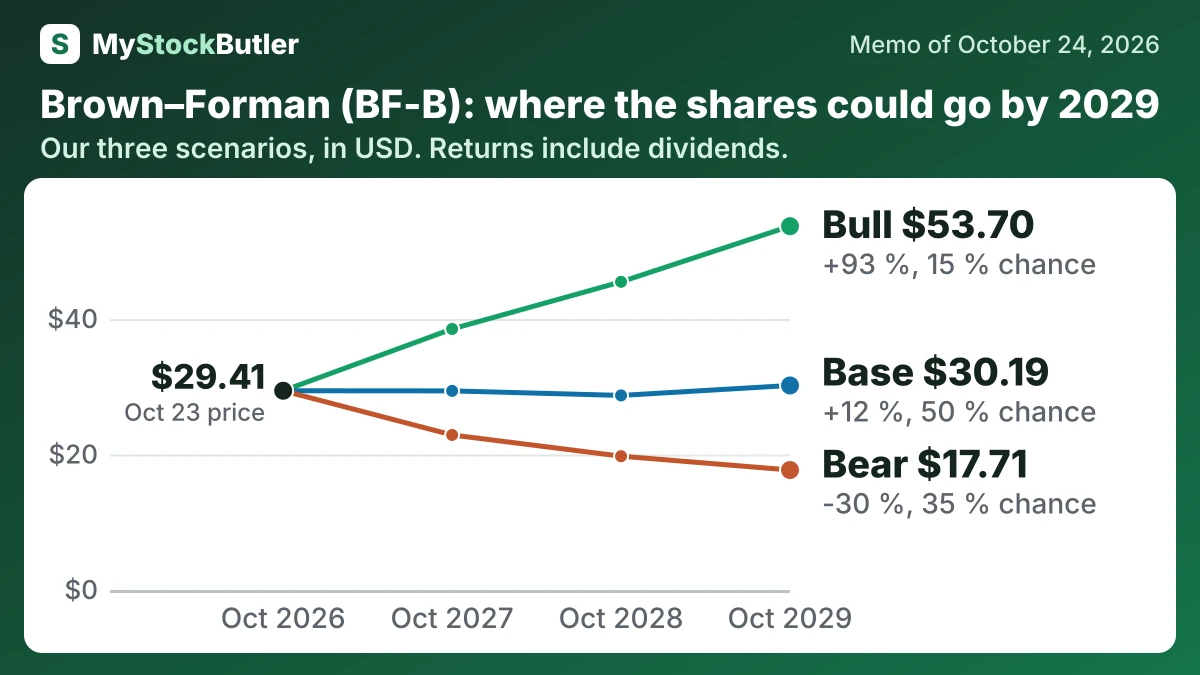
| Case | Probability | October 2027 | October 2028 | October 2029 |
|---|---|---|---|---|
| Bear | 35 % | 22.88 (-19 %) | 19.75 (-27 %) | 17.71 (-30 %) |
| Base | 50 % | 29.39 (+3 %) | 28.72 (+4 %) | 30.19 (+12 %) |
| Bull | 15 % | 38.53 (+34 %) | 45.49 (+61 %) | 53.70 (+93 %) |
| Weighted | 100 % | 28.48 (+0 %) | 28.10 (+2 %) | 29.35 (+10 %) |
What this means. The weighted row is the probability-based average of all three cases, not a prediction that the share price will definitely reach that value.
What has to go right or wrong for Brown–Forman?
Base earnings are $790m in October 2027. They rise to $817m in October 2028 and $855m in October 2029. The path reflects revenue of $3,950m and a 20.0% margin initially, followed by modest improvement. It is close to the next-twelve-month consensus earnings cross-check of about $799m. The bear case falls to $751m and then $699m, ending at $680m as demand, price/mix and refinancing pressure persist. The bull case reaches $820m, $899m and $986m if New Mix, Jack Daniel’s innovation, distribution and operating leverage work together.
| October 2027 | October 2028 | October 2029 | |
|---|---|---|---|
| Earnings | 790 (751 / 820) | 817 (699 / 899) | 855 (680 / 986) |
| Shares (millions) | 457 (460 / 447) | 455 (460 / 435) | 453 (461 / 422) |
| Dividends per share | 0.94 (0.92 / 0.96) | 0.96 (0.92 / 1.02) | 0.98 (0.92 / 1.08) |
| Price to earnings | 17.00 (14.00 / 21.00) | 16.00 (13.00 / 22.00) | 16.00 (12.00 / 23.00) |
What this means. The company is expected to earn much more than it pays out as dividends, so shareholders should not expect to receive all of its earnings as cash.
How much cash does Brown–Forman really make?
Free cash flow subtracts capital spending from operating cash. It improved because Brown–Forman spent less on long-lived assets as well as because working capital improved. The accompanying “real free cash flow” measure subtracts stock compensation. That is an economic adjustment for paying employees with ownership, not an additional cash payment or the company’s own definition.
| Apr 2026 | Apr 2025 | Apr 2024 | Apr 2023 | Apr 2022 | |
|---|---|---|---|---|---|
| Cash from operations | 1,000 | 598 | 647 | 640 | 936 |
| − Capital spending | 107 | 167 | 228 | 183 | 138 |
| = Free cash flow | 893 | 431 | 419 | 457 | 798 |
| − Stock pay | 32 | 28 | 25 | 18 | 15 |
| = Real free cash flow | 861 | 403 | 394 | 439 | 783 |
What this means. Stock pay is deducted even though it uses no cash because giving employees shares gives away part of the company.
What does an investor pay for Brown–Forman today?
Cash flow gives a better view, but it has its own timing problem. Brown–Forman’s free cash flow yield was 6.6%, while fiscal 2026 inventories absorbed $22 million of cash. Whiskey is filled into barrels and often aged for three years or more, so cash can leave long before a sale arrives. Lower capital spending or slower inventory growth can improve one year’s cash flow without permanently raising profits. Dividends therefore compete with advertising, barrels, warehouses and debt repayment.