BAE Systems earnings
MyStockButler's October 2026 analysis: BAE Systems reported higher revenue, operating profit, net income and diluted EPS in the six months to June. The next release should show whether July’s upgraded outlook survived the spending of customer advances.
What has BAE Systems guided for 2026?
In July 2026, BAE lifted its constant-currency sales-growth target to 8.0%–10.0% and its underlying EBIT-growth target to 10.0%–12.0%. It lifted underlying EPS growth to 11.0%–13.0%. “Underlying” profit removes specified accounting charges and unusual items to show the repeatable business trend; statutory profit is the formal accounting result. In 2025, underlying EPS was 75.2p, while statutory basic EPS was 68.8p. Constant currency removes exchange-rate effects, so the comparison focuses on operations.
Management raised its 2024–2026 cumulative cash target to £6,700m, while leaving later overlapping targets unchanged. That suggests confidence in near-term receipts, but also a risk that early cash leaves less to collect later. The table sets out the full guidance, including operating, cash and finance measures.
| Period | Low | High | Given on | |
|---|---|---|---|---|
| Sales | Year to Dec 2026 | 8.0% | 10.0% | Jul 30, 2026 |
| Underlying EBIT | Year to Dec 2026 | 10.0% | 12.0% | Jul 30, 2026 |
| Underlying EPS | Year to Dec 2026 | 11.0% | 13.0% | Jul 30, 2026 |
| Free cash flow target | Year to Dec 2026 | 2,000 | Jul 30, 2026 | |
| Underlying net finance costs | Year to Dec 2026 | 340 | 340 | Jul 30, 2026 |
| Cumulative free cash flow 2024-2026 | 2024–2026 | 6,700 | Jul 30, 2026 |
Did BAE Systems keep its past promises?
BAE also exceeded its 2025 guidance. It forecast sales growth of 8%–10% and underlying earnings-per-share growth of 8%–10%, then delivered 10% and 12% on a constant-currency basis. Meeting guidance supports management’s credibility, but the board must still ask whether the original targets were demanding enough.
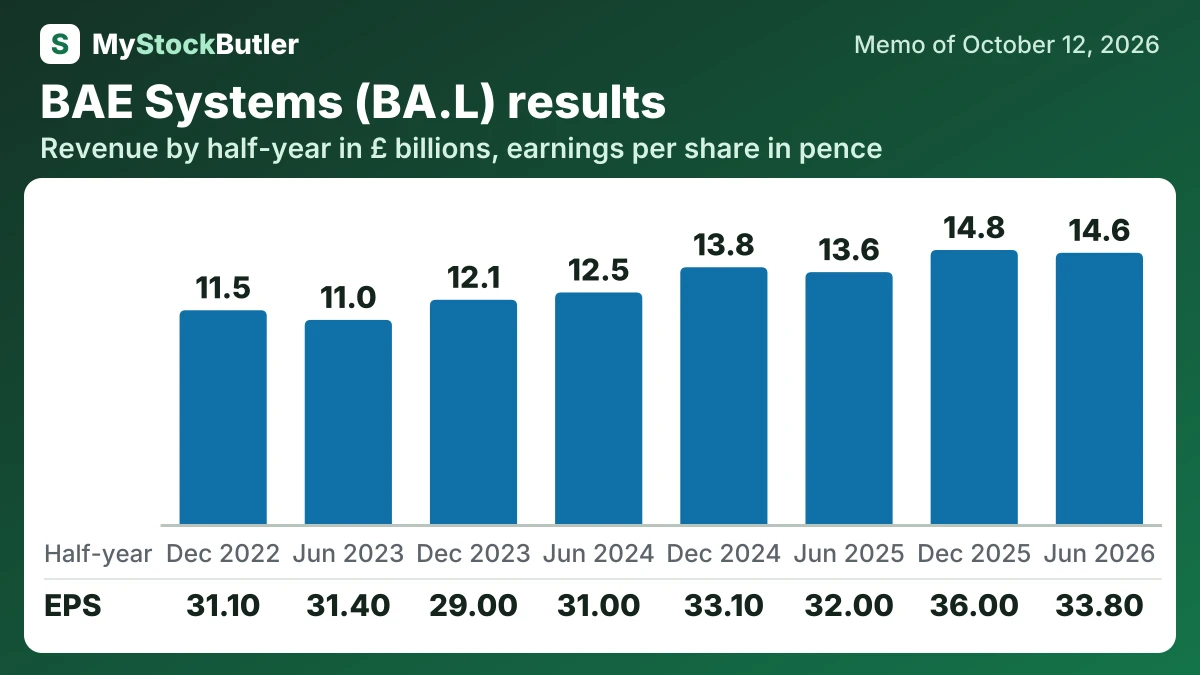
What do BAE Systems’ last eight reported periods show?
Revenue and operating profit both increased in the six months to June, with operating profit growing faster than revenue. Net income and diluted EPS also rose, but financing and tax absorbed part of the operating improvement.
| 6 months to Jun 2026 | 6 months to Dec 2025 | 6 months to Jun 2025 | 6 months to Dec 2024 | 6 months to Jun 2024 | 6 months to Dec 2023 | 6 months to Jun 2023 | 6 months to Dec 2022 | |
|---|---|---|---|---|---|---|---|---|
| Revenue | 14,615 | 14,765 | 13,571 | 13,835 | 12,477 | 12,081 | 10,997 | 11,519 |
| Operating income | 1,504 | 1,598 | 1,327 | 1,389 | 1,296 | 1,340 | 1,233 | 1,356 |
| Net income | 1,020 | 1,093 | 969 | 1,008 | 948 | 892 | 965 | 976 |
| EPS, diluted | 33.80 | 36.00 | 32.00 | 33.10 | 31.00 | 29.00 | 31.40 | 31.10 |
| Cash from operations | 2,243 | 3,358 | 74 | 3,168 | 757 | 2,276 | 1,484 | 2,346 |
| = Free cash flow | 1,428 | 2,392 | -762 | 2,074 | -45 | 1,340 | 815 | 1,693 |
What should you watch in BAE Systems’ next release?
The clearest checkpoint is the 2026 full-year report, indicated for February 2027. It should show whether July’s upgraded outlook survived the spending of customer advances. The interim dividend is due on 2 December 2026, and BAE plans to move from five reporting segments to four from 1 January 2027, requiring recast comparisons.