Axon stock forecast 2027–2029
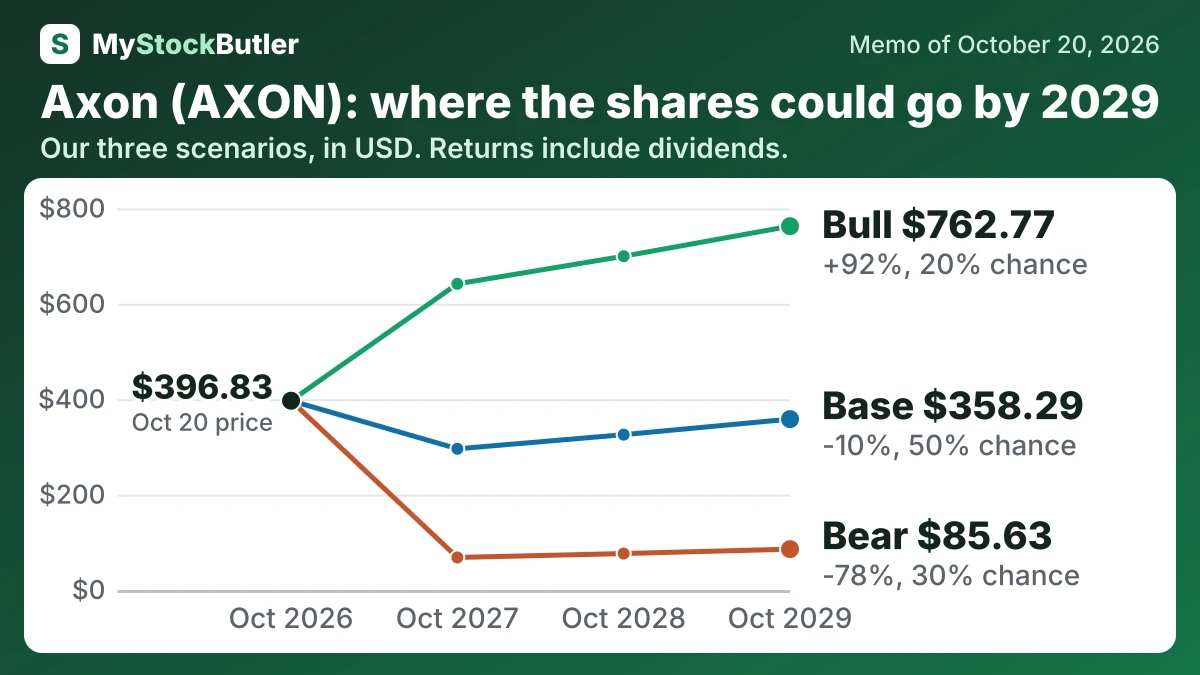
MyStockButler's October 2026 analysis: Axon's weighted forecast points to $357.39 in October 2029, a 10% loss. It hinges on growth becoming durable reported profit and cash per share.
Where could Axon's shares be by October 2029?
The October 2029 outcomes range from $85.63 in the bear case to $762.77 in the bull case. The bear probability is 30%. The base case is most likely at 50%. The bull case carries 20%.
| Case | Probability | October 2027 | October 2028 | October 2029 |
|---|---|---|---|---|
| Bear | 30% | 68.25 (-83%) | 76.46 (-81%) | 85.63 (-78%) |
| Base | 50% | 296.07 (-25%) | 325.74 (-18%) | 358.29 (-10%) |
| Bull | 20% | 641.93 (+62%) | 699.83 (+76%) | 762.77 (+92%) |
| Weighted | 100% | 296.90 (-25%) | 325.77 (-18%) | 357.39 (-10%) |
What could make Axon reach the bull case, and what could push Axon toward the bear case?
The bear case gives EBIT of $662 million. It assumes revenue of $6,620 million and a 10% margin as procurement slows and cash conversion remains weak. The bull case gives $2,280 million, based on $9,500 million of revenue and a 24% margin if software adoption and integration accelerate. Axon’s $6 billion 2028 revenue target and 126% NRR support the upside, but negative EBIT in 2025 and large stock compensation support the wider range.
The bear case requires slower agency deployments, weak bookings conversion, costly integration and persistent stock compensation pressure.
| FY2030 | |
|---|---|
| Operating profit (EBIT) | 1,494 (662 / 2,280) |
| Shares (millions) | 88.60 (92.70 / 86.40) |
| Exit multiple (enterprise value to operating profit (ebit)) | 22.00 (15.00 / 30.00) |
| Net debt | -2,711 (839 / -4,661) |
How much cash does Axon really make after stock pay?
Stock compensation is noncash when expensed, but it gives employees an ownership claim. Existing shareholders therefore bear an economic cost through dilution or the cash required to offset it. Subtracting stock pay from free cash flow is not a GAAP measure; it asks how much cash would remain if compensation did not create new owners. Only 2022 was positive on that measure.
| 2025 | 2024 | 2023 | 2022 | 2021 | |
|---|---|---|---|---|---|
| = Free cash flow | 75,081 | 329,527 | 129,628 | 179,559 | 74,608 |
| − Stock pay | 634,231 | 382,604 | 131,358 | 106,176 | 303,331 |
| = Real free cash flow | -559,150 | -53,077 | -1,730 | 73,383 | -228,723 |
| Free cash flow, % of revenue | 2.7% | 15.8% | 8.3% | 15.1% | 8.6% |
| Real free cash flow, % of revenue | -20.1% | -2.5% | -0.1% | 6.2% | -26.5% |
What this means. The company's free cash flow is slightly lower than ours in 2023, 2022, and 2021 because it subtracts money spent on intangible assets, while our count leaves that spending out.
What does an investor pay for Axon today?
Adjusted EBITDA is not cash. It is a profit-like measure that removes interest, taxes, depreciation, amortization, stock compensation, and selected other items. Free cash flow is closer to money available after operations and equipment purchases. Axon reported $242 million of adjusted EBITDA but a $1 million free-cash outflow in the second quarter of 2026. It also recorded $634.2 million of stock-based compensation in 2025. Employees may receive shares instead of cash, but existing owners then hold a smaller percentage of the company.