STERIS stock forecast 2027–2029
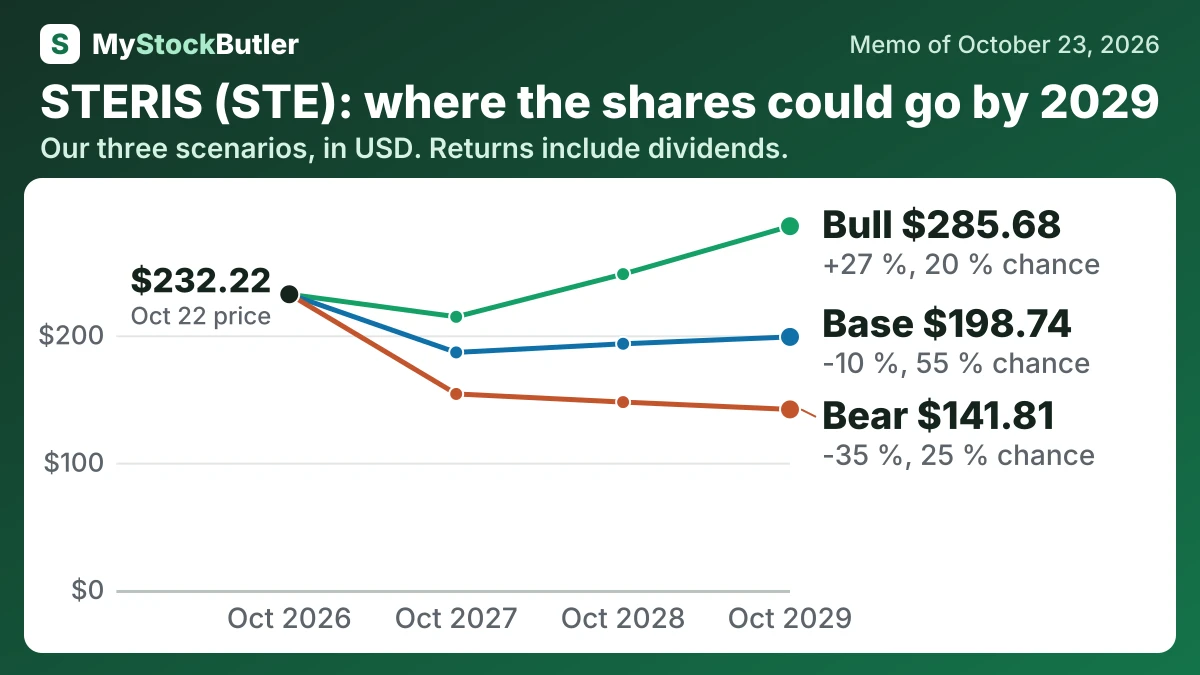
MyStockButler's October 2026 analysis: The weighted forecast points to $184.00 in October 2027 (-20%) and $201.90 in October 2029 (-9%), with dividends included. It hinges on repeat demand, AST recovery and whether new capacity earns its cost.
Where could STERIS's shares be by 2029?
The weighted forecast points to $184.00 in October 2027 (-20%) and $201.90 in October 2029 (-9%), with dividends included; it hinges on repeat demand, AST recovery and whether new capacity earns its cost. Management guides for fiscal 2027 to 6.0%–7.0% constant-currency organic revenue growth and $11.10–$11.30 adjusted EPS. It also guides to $800 million of free cash flow after $450 million of capital spending. About $75 million is for North Carolina.
The forecast assigns 25% probability to the bear case, 55% to the base case and 20% to the bull case. Collections, inventory, capital spending and buybacks will matter around the September-quarter results on November 4, 2026, with the call on November 5. North Carolina’s largest planned installment is in FY2028; distribution opening, manufacturing start and old-site costs ending will test the build. As of October 22, 2026, Xodus remained pending, and its debt financing adds execution risk. The center’s expected return on invested capital is above 10% within three to five years of opening.
| Case | Probability | October 2027 | October 2028 | October 2029 |
|---|---|---|---|---|
| Bear | 25 % | 153.95 (-33 %) | 147.54 (-34 %) | 141.81 (-35 %) |
| Base | 55 % | 186.57 (-18 %) | 193.35 (-14 %) | 198.74 (-10 %) |
| Bull | 20 % | 214.51 (-6 %) | 248.06 (+9 %) | 285.68 (+27 %) |
| Weighted | 100 % | 184.00 (-20 %) | 192.84 (-14 %) | 201.90 (-9 %) |
What this means. The weighted row is a probability-based average of the three cases, so it can show a loss even though the bull case shows a gain.
What has to go right for STERIS, and what could go wrong?
The base case follows management’s 6.0%–7.0% organic-growth outlook and recent Healthcare strength. Service grew 11.8% and consumables grew 7.2% in FY2026, while June growth remained stronger in those businesses than in equipment. The bear case assumes AST destocking, higher depreciation and labor costs persist. The bull case requires AST utilization, productivity and new capacity to recover.
The bear story is persistent AST weakness, margin pressure and constrained cash flow. Customers continue reducing inventories, while depreciation, labor costs and capacity limits reduce returns. North Carolina spending and Xodus financing arrive before their benefits, so investors accept a lower multiple.
How much cash does STERIS really make?
STERIS converts a substantial share of earnings into cash, even while funding a capital-intensive network.
| Mar 2026 | Mar 2025 | Mar 2024 | Mar 2023 | Mar 2022 | |
|---|---|---|---|---|---|
| Cash from operations | 1,341.4 | ||||
| − Capital spending | 369.0 | 369.7 | 351.2 | 352.499 | 282.837 |
| = Free cash flow | 972.4 | ||||
| − Stock pay | 61.7 | ||||
| = Real free cash flow | 910.7 | ||||
| Real free cash flow, % of revenue | 15.3% |
What does an investor pay for STERIS today?
| Today (Oct 22, 2026) | |
|---|---|
| Share price | 232.22 |
| Market value (calculated) | 22,641.5 |
| Enterprise value (calculated) | 24,052.8 |
| P/E, last 12 months (calculated) | 28.4x |
| P/E, next 12 months (calculated) | 20.7x |
| Real free cash flow yield (calculated) | 4.0% |
What this means. Enterprise value is higher than market value because it also includes the company’s debt after subtracting its cash and short-term investments.