Smiths dividend
MyStockButler's October 2026 analysis: Smiths paid £0.485 per share in FY2026, with the base forecast rising to £0.5112 per share. Cash after capital spending and stock pay was £196m, while dividend coverage depends on continuing free cash flow.
How much does Smiths pay its shareholders?
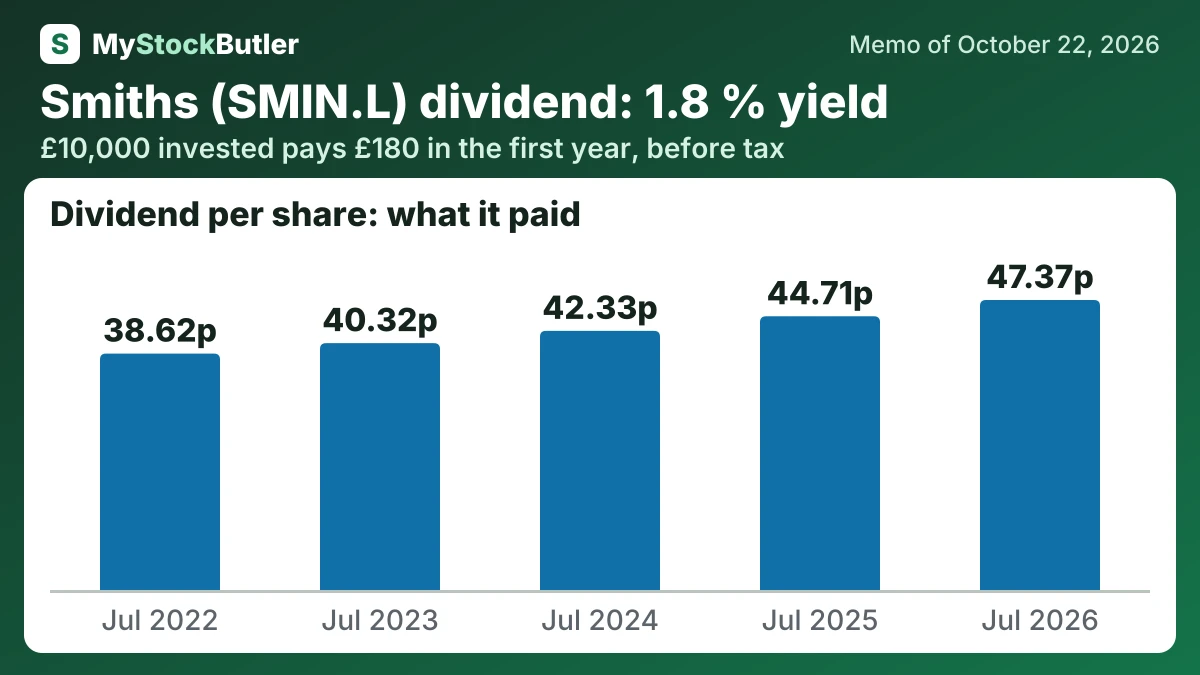
The base dividend rises from £0.5112 per share to £0.5388 and £0.5679. This applies the recent 5.4% growth rate to the FY2026 dividend of £0.485. The bear case holds the first forecast dividend at £0.485 and then grows it at 2%, while the bull case assumes 7% annual growth. The range reflects Smiths’ progressive policy, but also its guidance for cash conversion only in the low 90%s.
| October 2027 | October 2028 | October 2029 | |
|---|---|---|---|
| Net asset value | 1,252 (1,152 / 1,292) | 1,432 (1,217 / 1,537) | 1,627 (1,297 / 1,827) |
| Shares (millions) | 244 (252 / 236) | 238 (244 / 237) | 239 (245 / 238) |
| Dividends per share | 0.51 (0.48 / 0.52) | 0.54 (0.49 / 0.56) | 0.57 (0.50 / 0.59) |
| Price to net asset value | 2.90 (2.40 / 3.30) | 3.00 (2.30 / 3.50) | 3.10 (2.20 / 3.70) |
What this means. A price to net asset value of 2.90 means investors are paying £2.90 for each £1 of the company's net assets.
How much would Smiths's dividend pay you?
£10,000 invested in Smiths at its 1.8% dividend yield (our report of October 22, 2026) pays £180.00 in the first year, before tax. If its dividend per share keeps changing 5.2% a year, as it did from Jul 2022 to Jul 2026, and the dividends are reinvested, year 10 pays £347.46, with £2,539.50 received in all.
Before tax. Past dividend growth is not a promise. Information only, not investment advice.
Is Smiths' dividend covered by its cash?
Cash from operations fell to £254m in FY2026 from £292m in FY2025. Capital spending fell to £39m from £51m, which cushioned the decline. After capital spending and stock pay, cash on the specified owner-cost basis was £196m in FY2026, against £224m in FY2025. Stock pay is not an immediate cash payment, but it transfers value to employees through shares, so treating it as an economic cost is sensible.
Cash conversion is not the same as cash available to shareholders. Continuing headline operating cash conversion was 96% in FY2026, but reported free cash flow was £256m after more deductions. The £3,245m of disposal proceeds was a one-off payment, not recurring customer cash, so dividend coverage depends on continuing free cash flow.
| Jul 2026 | Jul 2025 | Jul 2024 | Jul 2023 | Jul 2022 | |
|---|---|---|---|---|---|
| − Paid to minority owners | 0 | 0 | 0 | 0 | 0 |
| − Dividends paid | 149 | 152 | 147 | 143 | 150 |
| − Share buybacks | 839 | 303 | 70 | 207 | 511 |
| − Acquisitions | 170 | 121 | 65 | 0 | |
| + Businesses and assets sold | 3,253 | 0 | 0 | 2 | 1,334 |
| − Investments bought | 1 | 0 |
What this means. Our net cash is higher because our count leaves out lease liabilities and derivatives used to manage borrowing, which the company's own count includes.
What could change Smiths' dividend?
Smiths’ weighted forecast points to a loss: John Crane and Flex-Tek must convert demand into durable profit and cash. Management guides to around 4.0% organic revenue growth and a 21.0% headline operating margin in FY2027. It expects headline operating cash conversion in the low 90%s, with a 1.0% FX headwind.
What is Smiths' dividend yield today?
Revenue rose in FY2026, but reported operating margin fell from the prior year, and acquisitions contributed more to growth than Smiths’ existing businesses. Diluted EPS fell while dividend per share rose. Valuation is 54.3x trailing P/E versus 23.6x next-twelve-month P/E. The 11.1% buyback yield is far above the 1.8% dividend yield, but the buyback is funded from disposal proceeds.
| Today (Oct 22, 2026) | |
|---|---|
| Share price | 2676.00 |
| Market value (calculated) | 7,529.30 |
| P/E, last 12 months (calculated) | 54.3x |
| P/E, next 12 months (calculated) | 23.6x |
| Dividend yield (calculated) | 1.8% |
What this means. The business value is lower than its stock market value because the company has more cash and short-term investments than debt.