Smiths stock forecast 2027–2029
MyStockButler's October 2026 analysis: Smiths’ weighted price is 1,420.26p in October 2027. It hinges on Smiths broadly delivering around 4% organic growth, a 21% headline margin and cash conversion in the low 90%s.
Where could Smiths’ shares be by 2029?
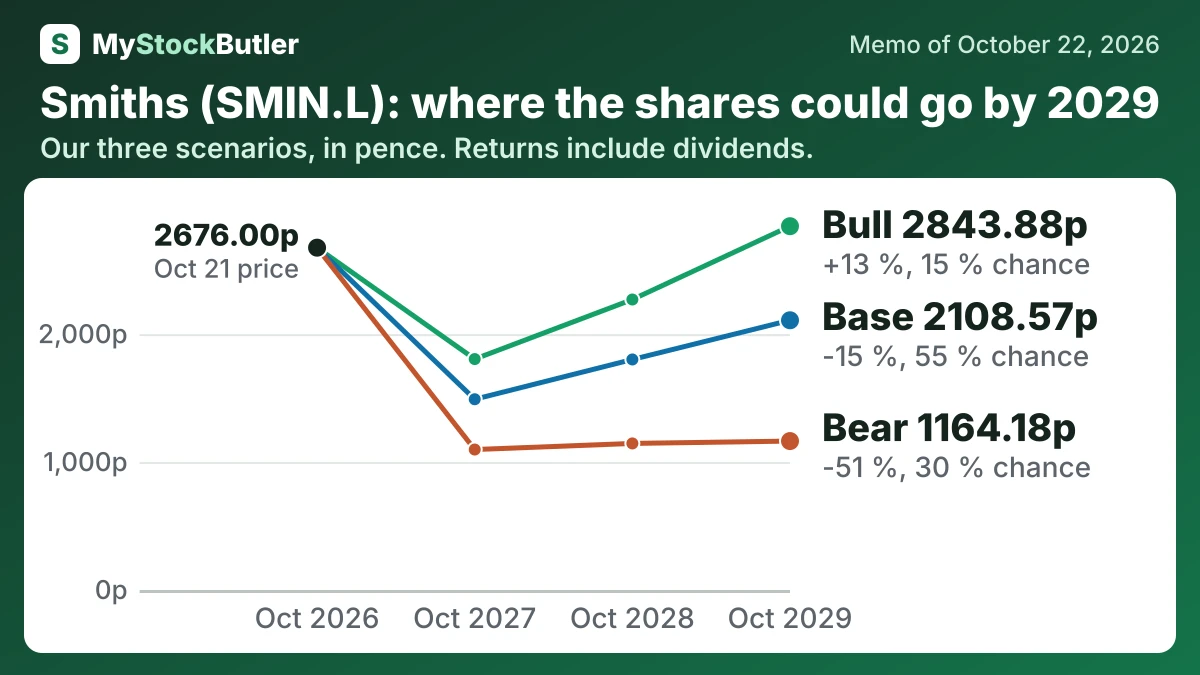
The weighted price is 1,420.26p in October 2027. That represents a 45% loss including dividends. It rises to 1,675.45p in October 2028, still a 34% loss, and reaches 1,935.55p in October 2029, a 22% loss.
| Case | Probability | October 2027 | October 2028 | October 2029 |
|---|---|---|---|---|
| Bear | 30 % | 1098.01 (-57 %) | 1145.76 (-54 %) | 1164.18 (-51 %) |
| Base | 55 % | 1491.09 (-42 %) | 1802.01 (-29 %) | 2108.57 (-15 %) |
| Bull | 15 % | 1805.08 (-31 %) | 2270.79 (-11 %) | 2843.88 (+13 %) |
| Weighted | 100 % | 1420.26 (-45 %) | 1675.45 (-34 %) | 1935.55 (-22 %) |
What this means. The weighted row is the probability-based average of the bear, base, and bull outcomes, not a separate forecast.
What has to go right or wrong for Smiths?
The bear case requires US construction weakness and thermal destocking to persist, while Middle East disruption delays John Crane work. Lower sales weaken margins and cash conversion, and investors cut the multiple. The buyback supports the share count but cannot repair operating earnings. This produces 1,098.01p in October 2027 and 1,164.18p in October 2029, with a 30% probability.
The base case assumes Smiths broadly delivers its FY2027 guidance: around 4% organic growth, a 21% headline margin and cash conversion in the low 90%s. Construction improves gradually, aerospace remains supportive and John Crane’s aftermarket holds up. The price reaches 1,491.09p first and 2,108.57p last, with a 55% probability. Even this outcome remains a 15% loss including dividends.
The bull case needs faster construction recovery, stronger aerospace and DRC demand, profitable John Crane deliveries and fading Middle East disruption. Growth reaches the medium-term range, margins approach 23% and cash supports both investment and buybacks. The price reaches 1,805.08p and then 2,843.88p, with a 15% probability because several uncertain conditions must improve together.
How much cash does Smiths really make?
Cash from operations fell to £254m in FY2026 from £292m in FY2025. Capital spending fell to £39m from £51m, which cushioned the decline. After capital spending and stock pay, cash on the specified owner-cost basis was £196m in FY2026, against £224m in FY2025. Stock pay is not an immediate cash payment, but it transfers value to employees through shares, so treating it as an economic cost is sensible.
| Jul 2026 | Jul 2025 | |
|---|---|---|
| Cash from operations | 254 | 292 |
| − Capital spending | 39 | 51 |
| − Additional interest deduction (interest already included in cash from operations) | 0 | 0 |
| − Stock pay | 19 | 17 |
What this means. Stock pay is subtracted even though no cash leaves the business because giving employees shares reduces existing investors’ ownership.
What does an investor pay for Smiths today?
| Today (Oct 22, 2026) | |
|---|---|
| Share price | 2676.00 |
| Market value (calculated) | 7,529.30 |
| Enterprise value (calculated) | 5,673.30 |
| P/E, last 12 months (calculated) | 54.3x |
| P/E, next 12 months (calculated) | 23.6x |
| Dividend yield (calculated) | 1.8% |
What this means. The business value is lower than its stock market value because the company has more cash and short-term investments than debt.