Qnity dividend
MyStockButler's October 2026 analysis: Qnity pays $0.14 per share in the base case, matching the total dividend declared for 2025. Qnity generated $968 million of real free cash flow in 2025, so the dividend was backed by substantial cash that year, while future coverage remains a test.
How much does Qnity pay per share?
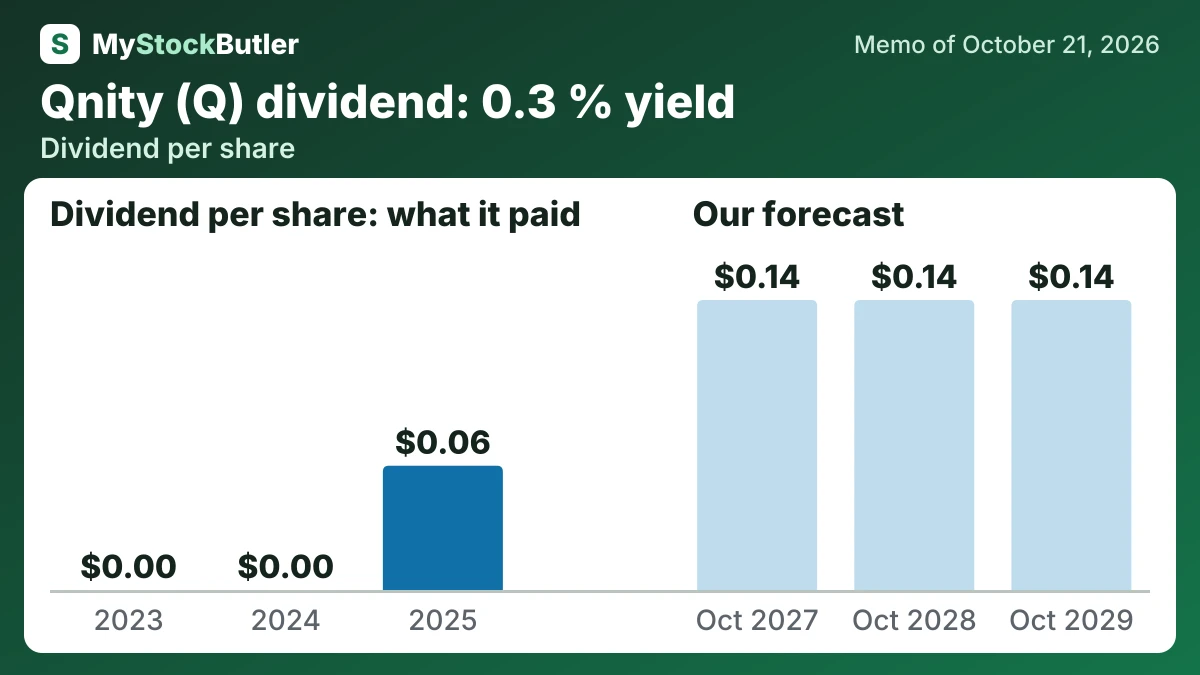
The base dividend stays at $0.14 per share, matching the total dividend declared for 2025. The bear case suspends it after the first period because net debt and working-capital needs could take priority. The bull case reaches $0.28 after two 40% increases, supported by stronger cash generation, but there is no disclosed payout target.
| 2025 | 2024 | 2023 | 2022 | 2021 | |
|---|---|---|---|---|---|
| Revenue | 4,754 | 4,335 | 4,035 | 4,755 | |
| Net income | 692 | 693 | 507 | 774 | |
| EPS, diluted | 3.30 | 3.31 | |||
| Dividend per share | 0.14 | 0.00 | 0.00 | 0.00 | 0.00 |
What this means. The 2022–2024 profits may look higher because these separated-company figures leave out interest on its own debt and some head-office costs.
Does Qnity's cash cover its dividend?
That is what made 2025 unusually strong. Cash from operations reached $1,273 million. Of this, $214 million came from working-capital release, far more than the $14 million recorded in 2024. Capital spending was $285 million, leaving free cash flow of $988 million. After deducting $20 million of stock compensation, real free cash flow was $968 million.
Qnity began paying dividends and later authorized share repurchases. An authorization is permission to spend, not a promise to do so. The choice among investment, debt reduction, dividends, and buybacks is now management’s responsibility.
| 2025 | 2024 | 2023 | 2022 | 2021 | |
|---|---|---|---|---|---|
| Free cash flow | 988 | 861 | 651 | 951 | |
| − Dividends paid | 13 | 0 | 0 | 0 | 0 |
| − Share buybacks | 0 | 0 | 0 | 0 | 0 |
| = Free cash flow not paid out | 954 | 844 | 633 | 934 | |
| Paid to shareholders | 13 | 0 | 0 | 0 | 0 |
| Paid out, % of free cash flow | 1.3% | 0.0% | 0.0% | 0.0% |
What this means. In 2025, the company borrowed 4,100 million but still owed more than it held in cash because 4,306 million went out through other uses.
What could change Qnity's dividend?
Net debt falls from $2,871M to $1,429M in the base case. That path reflects the $600M–$700M adjusted free-cash-flow outlook, tempered by interest, capital spending, working capital, dividends and buybacks. The bear case remains at $2,399M because free cash flow weakens and buybacks stop. The bull case reaches $434M because cash generation is repeatedly strong.
| October 2027 | October 2028 | October 2029 | |
|---|---|---|---|
| Normal operating profit | 1,350 (1,120 / 1,420) | 1,410 (1,050 / 1,570) | 1,470 (1,120 / 1,730) |
| Shares (millions) | 209 (210 / 209) | 209 (210 / 208) | 209 (211 / 208) |
| Dividends per share | 0.14 (0.14 / 0.14) | 0.14 (0.00 / 0.20) | 0.14 (0.00 / 0.28) |
| Enterprise value to normal operating profit | 20.00 (16.00 / 23.00) | 20.00 (14.00 / 25.00) | 19.00 (13.00 / 26.00) |
| Net debt | 2,871 (2,749 / 2,327) | 2,125 (2,649 / 1,405) | 1,429 (2,399 / 434) |
What is Qnity's dividend yield at today's price?
The reported free cash flow yield is 3.9%, with a real free cash flow yield of 3.8%; the adjustment behind the latter still needs definition. The small dividend supplies little of the return, so the important question is whether normalized cash remains after interest, necessary investment, and separation costs.