Ingersoll Rand dividend
MyStockButler's October 2026 analysis: Ingersoll Rand's dividend remains $0.08 per share in every scenario and has been flat since 2022. Ingersoll Rand's free cash flow covered the $8 million paid in dividends in Q2 2026, while the business also spent on buybacks and acquisitions.
How much does Ingersoll Rand pay per share?
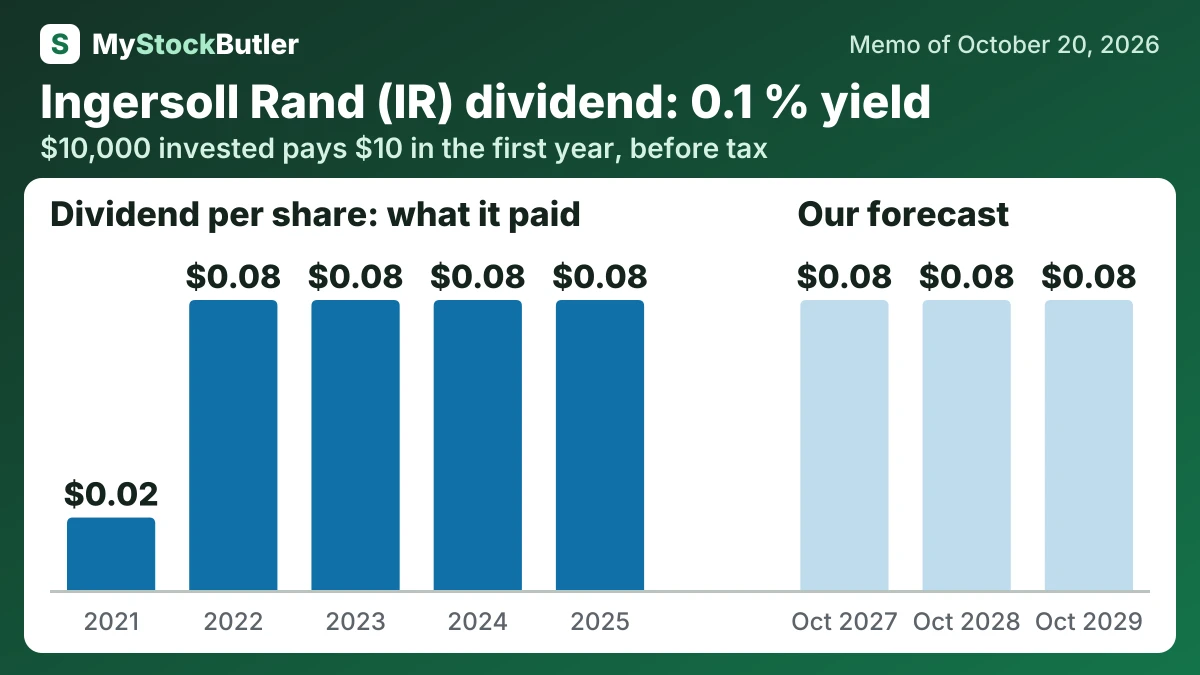
The dividend remains $0.08 per share in every scenario. The latest quarterly declaration was $0.02, and the annual dividend has been flat since 2022. Stronger cash flow could support an increase, but IR has favored buybacks and acquisitions and has provided no growth target.
| 2025 | 2024 | 2023 | 2022 | 2021 | |
|---|---|---|---|---|---|
| EPS, diluted | 1.45 | 2.06 | 1.90 | 1.44 | 1.24 |
| Real free cash flow per share | 2.91 | 2.92 | 2.98 | 1.69 | 1.13 |
| − Dividends paid, per share | 0.08 | 0.08 | 0.08 | 0.08 | 0.02 |
| − Share buybacks, per share | 2.51 | 0.61 | 0.61 | 0.63 | 1.73 |
| = FCF not paid out, per share | 0.43 | 2.35 | 2.40 | 1.16 |
What this means. The company's own free cash flow per share is higher because it does not subtract shares given to employees as pay; we subtract them because they reduce each investor's share of the business.
How much would Ingersoll Rand's dividend pay you?
$10,000 invested in Ingersoll Rand at its 0.1% dividend yield (our report of October 20, 2026) pays $10.00 in the first year, before tax. If its dividend per share keeps changing 41.4% a year, as it did from 2021 to 2025, and the dividends are reinvested, year 10 pays $238.34, with $771.68 received in all.
Before tax. Past dividend growth is not a promise. Information only, not investment advice.
Does Ingersoll Rand's dividend get covered by cash?
Free cash flow is the necessary follow-up. IR generated $269 million of free cash flow in Q2 2026 and deployed $110 million to acquisitions. Because its free-cash-flow measure subtracts capital spending but not acquisitions, it shows operating cash after maintenance, not cash left after expansion. IR also repurchased $240 million of shares and paid $8 million in dividends in Q2 2026. The stock is therefore principally a reinvestment story.
| 2025 | 2024 | 2023 | 2022 | 2021 | |
|---|---|---|---|---|---|
| Free cash flow | 1,220.1 | 1,247.6 | 1,272.0 | 770.8 | 563.7 |
| − Dividends paid | 31.8 | 32.3 | 32.4 | 32.4 | 8.2 |
| − Share buybacks | 1,007.4 | 250.0 | 249.6 | 257.3 | 730.6 |
| = Free cash flow not paid out | 173.8 | 958.3 | 983.4 | 476.2 | |
| − Acquisitions | 525.0 | 2,958.7 | 963.0 | 246.8 | 974.8 |
| Paid out, % of free cash flow | 85.2% | 22.6% | 22.2% | 37.6% | 131.1% |
What this means. In 2021, the company paid shareholders more cash than it made, so it had to use savings or borrow money to cover the difference.
What could change Ingersoll Rand's dividend?
The first checkpoint is 2026 guidance: revenue growth is expected at 4.5%–6.5%, with organic growth of 1.0%–3.0%. A miss would move the forecast toward the bear case; a result above the range would support the bull case.
| October 2027 | October 2028 | October 2029 | |
|---|---|---|---|
| Normal operating profit | 1,296 (1,200 / 1,394) | 1,369 (1,167 / 1,531) | 1,452 (1,134 / 1,683) |
| Dividends per share | 0.08 (0.08 / 0.08) | 0.08 (0.08 / 0.08) | 0.08 (0.08 / 0.08) |
| Net debt | 2,690 (2,690 / 2,624) | 2,071 (2,121 / 1,856) | 1,452 (1,552 / 887) |
What is Ingersoll Rand's dividend yield today?
The 32.0x trailing P/E and 19.9x forward P/E make earnings recovery central. The 4.0% free cash flow yield falls to 3.9% after stock-based pay. The 0.1% dividend yield leaves shareholder returns chiefly dependent on reinvestment and buybacks. The weighted price is $62.46 in October 2027, a 19% loss, including dividends. It is $68.04 in October 2029, a 12% loss, including dividends. The forecast assigns 30% probability to the bear case and 50% to base. The bull case receives 20%.