Expand stock forecast 2027–2029
MyStockButler's October 2026 analysis: The weighted forecast is $68.00 in October 2027, $80.38 in October 2028 and $97.56 in October 2029, versus today’s $94.62. It hinges on durable cash after drilling, workable gas prices and successful Twin Eagle integration.
Where could Expand’s shares be by 2029?
The weighted forecast implies downside through 2028, followed by a modest gain by October 2029. The shares are estimated at $68.00 in October 2027, $80.38 in October 2028 and $97.56 in October 2029, excluding dividends, versus today’s $94.62. That means returns of negative 26%, negative 10% and positive 10%.
The range is wide because gas prices, cash generation and valuation can move together. By October 2029, the bear case gives $29.87 and the bull case gives $187.48. The base case carries the highest probability at 52%, against 28% for the bear case and 20% for the bull case.
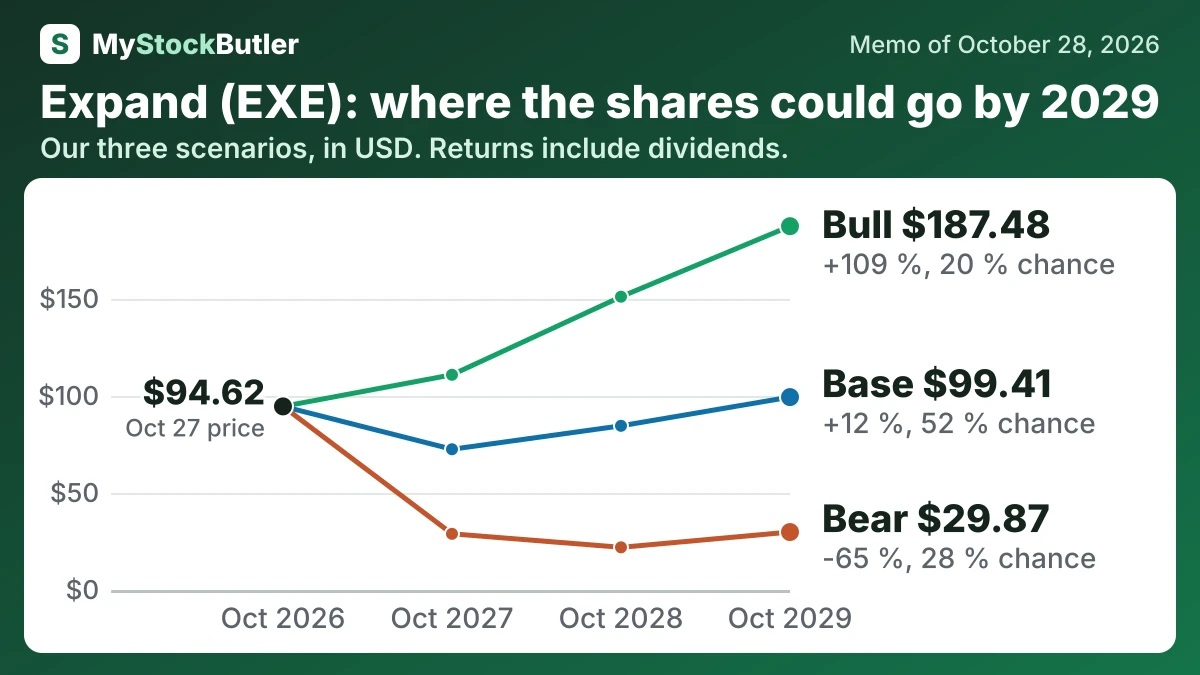
| Case | Probability | October 2027 | October 2028 | October 2029 |
|---|---|---|---|---|
| Bear | 28 % | 28.95 (-68 %) | 21.99 (-74 %) | 29.87 (-65 %) |
| Base | 52 % | 72.53 (-21 %) | 84.61 (-6 %) | 99.41 (+12 %) |
| Bull | 20 % | 110.91 (+20 %) | 151.14 (+66 %) | 187.48 (+109 %) |
| Weighted | 100 % | 68.00 (-26 %) | 80.38 (-10 %) | 97.56 (+10 %) |
What has to go right or wrong for Expand?
EBITDA is the central operating variable. The base case rises from $5.294 billion in October 2027 to $5.654 billion in October 2029. It assumes production near management’s 7,450–7,550 MMcfe/d guidance, modest margin improvement and marketing EBITDA rising from $230 million. The bear case falls to $3.358 billion in 2028 as weaker prices, Appalachian discounts and fixed transport costs squeeze margins. The bull case reaches $7.620 billion in 2029 as LNG and power demand, Haynesville efficiency and Twin Eagle reinforce one another. Gas prices have been highly volatile, but production met or exceeded guidance in all eight reviewed quarters.
How much cash does Expand really make?
Operating cash flow is cash generated by the business; free cash flow subtracts capital spending. In 2025, operating cash flow was $4.575 billion and capital spending was $2.736 billion. That left $1.839 billion of free cash flow. Deducting $46 million of stock-based pay produced this memo’s “real” free cash flow of $1.793 billion, an owner-focused adjustment for the cost of paying employees in shares.
| 2025 | 2024 | 2023 | 2022 | 2021 | |
|---|---|---|---|---|---|
| Cash from operations | 4,575 | 1,565 | 2,380 | 4,125 | 1,809 |
| − Capital spending | 2,736 | 1,557 | 1,829 | 1,823 | 669 |
| = Free cash flow | 1,839 | 8 | 551 | 2,302 | 1,140 |
| − Stock pay | 46 | 38 | 33 | 22 | 9 |
| = Real free cash flow | 1,793 | -30 | 518 | 2,280 | 1,131 |
What this means. The company says free cash flow is cash left over, but we subtract stock pay because giving employees shares reduces what existing shareholders own, even though no cash leaves today.
What does an investor pay for Expand today?
At $94.62 a share on October 28, 2026, Expand is valued as both an equity investment and a debt-financed operating business.
| Today (Oct 28, 2026) | |
|---|---|
| Share price | 94.62 |
| Market value (calculated) | 21,853.18 |
| Enterprise value (calculated) | 26,453.18 |
| P/E, last 12 months (calculated) | 8.2x |
| P/E, next 12 months (calculated) | 11.7x |
| Free cash flow yield (calculated) | 8.4% |
What this means. The enterprise value is higher than the market value because it includes the company's debt as well as its stock value, after subtracting its cash.