VINCI dividend: cash coverage and yield
MyStockButler's October 2026 analysis: VINCI's dividend rises by €0.25 a year in the base case to €5.75 per share, after Five consecutive increases. In 2025, €11.886 billion of cash from operations left €7.437 billion after capital spending and employee stock compensation, so the cash measure covered the dividend in aggregate.
How much does VINCI pay in dividends?
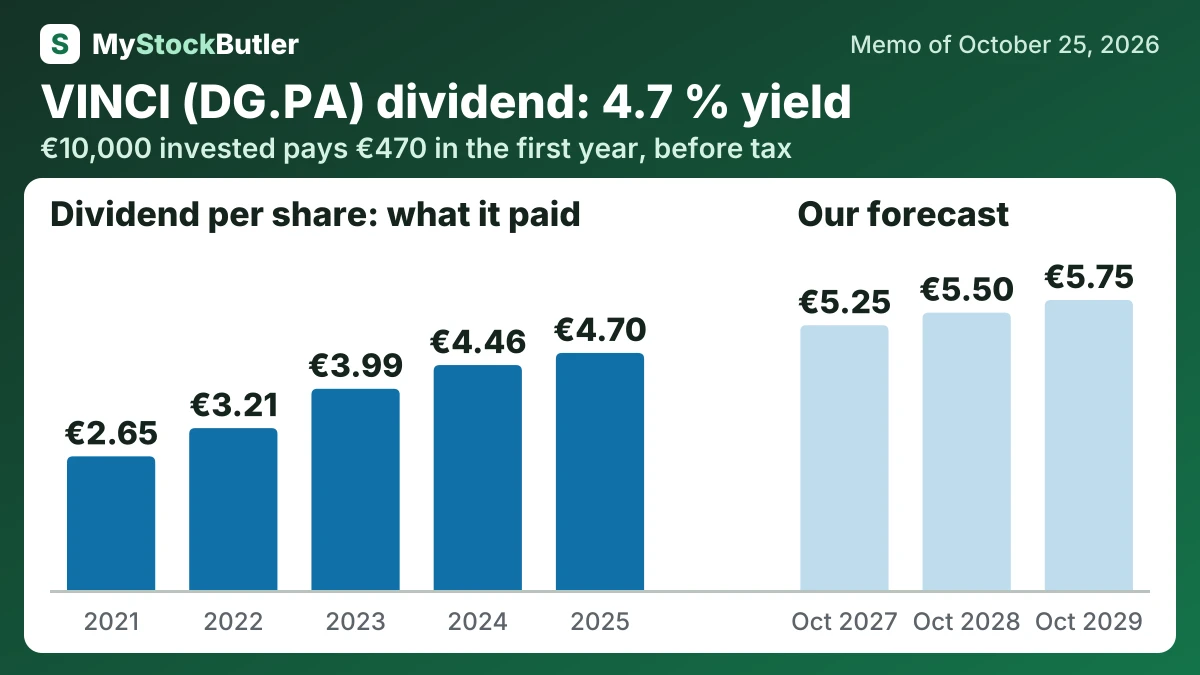
Dividends rise by €0.25 a year in the base case, reaching €5.75. The bear case cuts the payment to €4.50, while the bull case reaches €6.50. Five consecutive increases support continued growth, but traffic weakness, investment and the tax charge argue against rapid increases. The current analyst EPS reference is €9.94698, leaving the base dividend below that level.
| 2025 | 2024 | 2023 | 2022 | 2021 | |
|---|---|---|---|---|---|
| EPS, diluted | 8.65 | 8.43 | 8.18 | 7.47 | 4.51 |
| Real free cash flow per share | 13.12 | 13.23 | 12.61 | 10.08 | 9.85 |
| − Dividends paid, per share | 4.70 | 4.46 | 3.99 | 3.21 | 2.65 |
What this means. The company’s own free cash flow per share is lower because it uses a different formula that includes other investments and asset-sale proceeds.
How much would VINCI's dividend pay you?
€10,000 invested in VINCI at its 4.7% dividend yield (our report of October 25, 2026) pays €470.00 in the first year, before tax. If its dividend per share keeps changing 15.4% a year, as it did from 2021 to 2025, and the dividends are reinvested, year 10 pays €3,665.82, with €15,151.88 received in all.
Before tax. Past dividend growth is not a promise. Information only, not investment advice.
Is VINCI's dividend covered by its cash?
VINCI used its cash generation to support dividends, acquisitions and investment, while minority owners and lenders claimed part of the money first. A minority owner is an outside investor in a subsidiary that VINCI controls: the subsidiary’s accounts enter the group totals, but not all its cash belongs to VINCI shareholders.
Share repurchases require the same discipline. VINCI bought €1.7 billion of its shares in the first nine months of 2026 and launched a further programme capped at €270 million on 1 October. Repurchases can increase each remaining shareholder’s claim, but VINCI can also use repurchased shares for employee plans. The lasting benefit therefore depends on the net change in shares outstanding, not the gross amount bought. The cash funded a broad expansion, but the next question is whether the new assets earn enough.
Cash from operations was €11.886 billion in 2025. After capital spending, the accompanying calculation left €8.004 billion; after employee stock compensation, it left €7.437 billion. VINCI’s own measure was different because its bridge treats concession investment, disposals, leases and growth spending differently. Neither label is meaningful until its deductions are understood.
| 2025 | 2024 | 2023 | 2022 | 2021 | |
|---|---|---|---|---|---|
| Free cash flow | 8,004 | 8,091 | 7,610 | 6,105 | 5,961 |
| − Dividends paid | 2,665 | 2,570 | 2,293 | 1,830 | 1,528 |
| − Acquisitions | 1,091 | 4,719 | 507 | 1,991 | 3,936 |
| − Debt repaid | 4,315 | 1,993 | 2,179 | 3,653 | 2,195 |
| Cash and short-term investments | 18,498 | 16,094 | 16,172 | 13,333 | 11,265 |
What this means. The company's own net debt is higher because it includes debt-related contracts and financial accounts that our simpler calculation leaves out.
What could change VINCI's dividend?
| October 2027 | October 2028 | October 2029 | |
|---|---|---|---|
| Net asset value | 32,130 (29,930 / 33,170) | 34,180 (30,530 / 35,770) | 36,480 (31,130 / 38,670) |
| Shares (millions) | 549 (554 / 544) | 546 (556 / 536) | 544 (559 / 529) |
| Dividends per share | 5.25 (5.00 / 5.50) | 5.50 (4.75 / 6.00) | 5.75 (4.50 / 6.50) |
| Price to net asset value | 1.85 (1.55 / 2.10) | 1.90 (1.50 / 2.20) | 1.95 (1.45 / 2.30) |
What is VINCI's dividend yield today?
The headline free-cash-flow yield is 13.6%, while the separately stated real free-cash-flow yield is 12.7%. A yield is not a promised distribution: VINCI can direct cash to dividends, buybacks, acquisitions or debt reduction. Its value depends on what remains after those competing demands.