Cognizant dividend: cash coverage and yield
MyStockButler's October 2026 analysis: Cognizant's latest annual dividend run rate is $1.32 per share. Cognizant's 2025 free cash flow supported that dividend, while buybacks and other uses also drew on cash.
How much does Cognizant pay per share over the years shown?
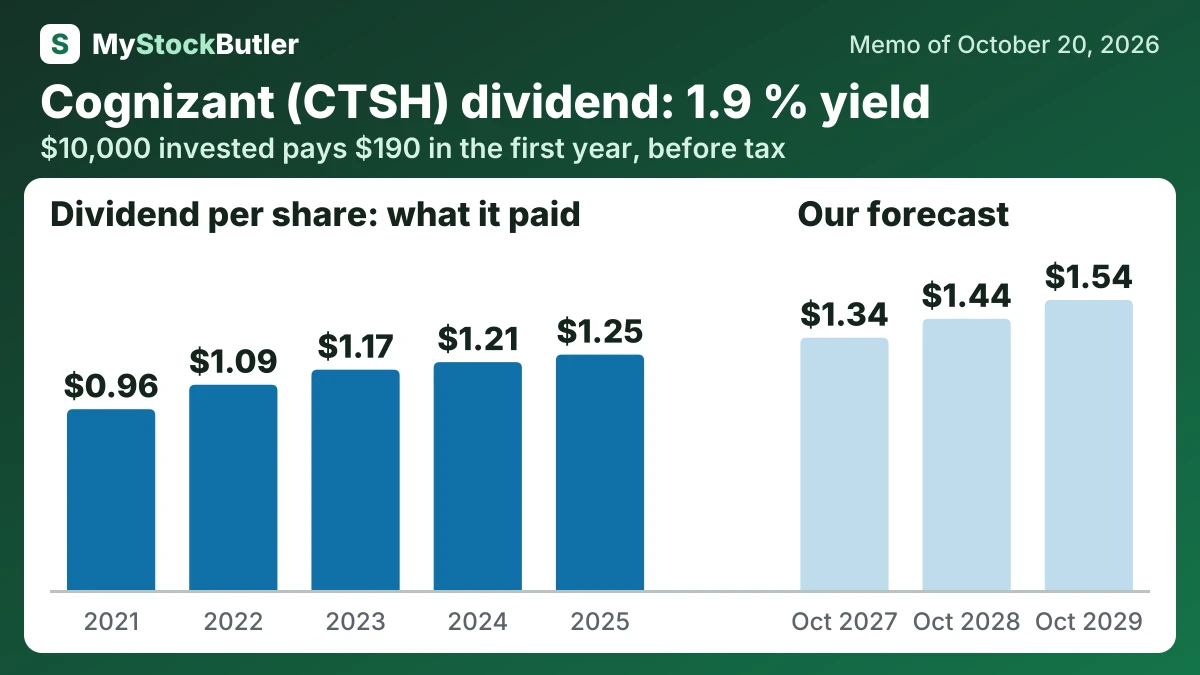
The base dividend rises from $1.34 per share to $1.44 and then $1.54. That is a measured increase from the latest $1.32 annual run rate, supported by 2025 free cash flow but restrained by borrowing and investment needs. The bear case reaches $1.30 and then pauses, while the bull case reaches $1.38, $1.56 and $1.76 if cash generation strengthens.
| October 2027 | October 2028 | October 2029 | |
|---|---|---|---|
| Earnings | 2,800 (2,600 / 3,030) | 2,950 (2,580 / 3,350) | 3,150 (2,580 / 3,700) |
| Shares (millions) | 430 (434 / 424) | 414 (424 / 402) | 400 (415 / 383) |
| Dividends per share | 1.34 (1.30 / 1.38) | 1.44 (1.30 / 1.56) | 1.54 (1.30 / 1.76) |
| Price to earnings | 12.00 (10.00 / 13.00) | 12.00 (9.00 / 14.00) | 12.00 (9.00 / 15.00) |
How much would Cognizant's dividend pay you?
$10,000 invested in Cognizant at its 1.9% dividend yield (our report of October 20, 2026) pays $190.00 in the first year, before tax. If its dividend per share keeps changing 6.8% a year, as it did from 2021 to 2025, and the dividends are reinvested, year 10 pays $430.08, with $2,928.74 received in all.
Before tax. Past dividend growth is not a promise. Information only, not investment advice.
Is Cognizant's dividend covered by its cash?
Free cash flow is operating cash less capital spending. Capital spending was $288 million in 2025. Conventional free cash flow was therefore $2,595 million, or 12.3% of revenue. The measure is useful, but it excludes acquisition spending and treats training, selling and much technology development as operating costs.
Book value also needs interpretation because internally developed skills and relationships are only partly recorded, while acquisitions create goodwill. Free cash flow is cash from operations after property and equipment purchases; Cognizant’s own measure also adds property-sale proceeds. It can fund dividends, repurchases, acquisitions or debt repayment, so cash generated is not the same as cash distributed.
| 2025 | 2024 | 2023 | 2022 | 2021 | |
|---|---|---|---|---|---|
| Free cash flow | 2,595 | 1,827 | 2,013 | 2,236 | 2,216 |
| − Dividends paid | 610 | 600 | 591 | 564 | 509 |
| − Share buybacks | 1,320 | 540 | 998 | 1,348 | 692 |
| = Free cash flow not paid out | 665 | 687 | 424 | 324 | 1,015 |
| Paid out, % of free cash flow | 74.4% | 62.4% | 78.9% | 85.5% | 54.2% |
What this means. The company's own net cash is higher because it does not count finance lease debt, while our calculation does.
What could change Cognizant's dividend?
The first 2027 test is whether bookings convert into revenue faster than expected. Faster conversion would move the forecast toward the bull case; renewed weakness would support the bear case.
During 2027 and 2028, collections will determine whether buybacks and investment remain affordable. Weak cash conversion would reduce share-count progress and confidence in the multiple.
What is Cognizant's dividend yield today against its price?
| Today (Oct 20, 2026) | |
|---|---|
| Share price | 68.06 |
| Market value (calculated) | 30,657.23 |
| Free cash flow yield (calculated) | 8.5% |
| Dividend yield (calculated) | 1.9% |
What this means. Enterprise value is higher than market value because it includes the company's debt after subtracting its cash, showing the cost of buying the whole business.