Bunzl stock forecast 2027–2029
MyStockButler's October 2026 analysis: Bunzl's probability-weighted share price is 3061.39p in October 2027. It hinges on durable cash generation and disciplined acquisitions.
Where could Bunzl's shares be by 2029?
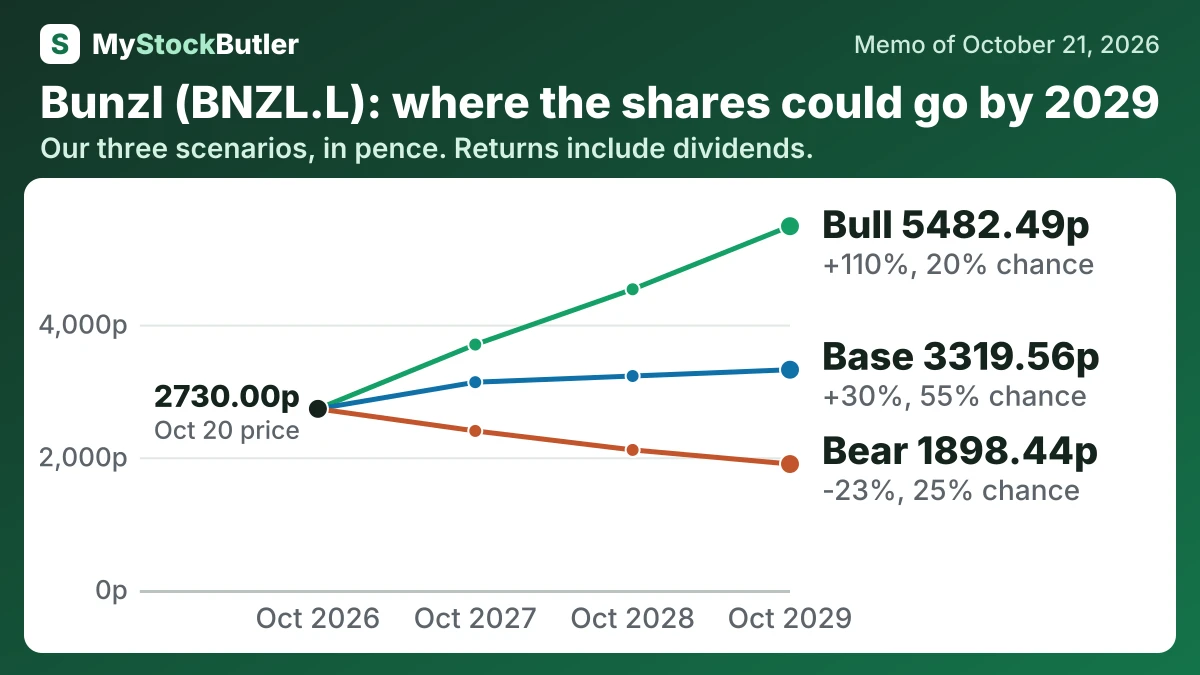
The probability-weighted share price is 3061.39p in October 2027, giving a 15% return from 2730p after including dividends. It reaches 3207.73p in October 2028, a 23% return, and 3396.87p in October 2029, a 33% return. By the last date, the bear case is 1898.44p and the bull case is 5482.49p, against today’s 2730p. The forecast assigns 25% to bear, 55% to base and 20% to bull.
| Case | Probability | October 2027 | October 2028 | October 2029 |
|---|---|---|---|---|
| Bear | 25% | 2397.00 (-10%) | 2110.81 (-18%) | 1898.44 (-23%) |
| Base | 55% | 3131.66 (+17%) | 3224.75 (+24%) | 3319.56 (+30%) |
| Bull | 20% | 3698.63 (+38%) | 4532.09 (+72%) | 5482.49 (+110%) |
| Weighted | 100% | 3061.39 (+15%) | 3207.73 (+23%) | 3396.87 (+33%) |
What this means. The weighted row is the average estimated share value after giving more influence to the cases considered more likely.
What has to go right for Bunzl's base case, and what could go wrong?
The bear case falls from £525m to £498m and then £486m. It assumes stalled revenue, fading lower-cost inventory benefits and weaker execution, consistent with the fall in adjusted net income from £649.9m in 2024 to £581.9m in 2025. The bull case rises from £630m to £681m and then £736m. It requires 4% revenue growth and margins improving from 5.0% to 5.4%, supported by service recovery, warehouse productivity and successful bolt-ons.
How much cash does Bunzl really make?
Cash then pays for equipment and software, leases on warehouses and vehicles, and interest on borrowing. Lease payments matter because a distributor can appear light on capital spending while renting much of its operating system. The memo’s stricter free-cash-flow calculation therefore gives a more demanding view of shareholder cash than Bunzl’s own measure.
| 2025 | 2024 | 2023 | 2022 | 2021 | |
|---|---|---|---|---|---|
| Cash from operations | 913.0 | 910.9 | 904.0 | 951.6 | 733.1 |
| − Capital spending | 71.5 | 54.4 | 58.3 | 46.7 | 32.7 |
| − Lease payments | 232.7 | 216.7 | 188.0 | 175.1 | 158.9 |
| − Interest paid | 127.3 | 126.6 | 107.6 | 61.9 | 43.5 |
| = Free cash flow | 481.5 | 513.2 | 550.1 | 667.9 | 498.0 |
| = Real free cash flow | 478.0 | 496.0 | 534.7 | 653.8 | 485.3 |
What this means. The company's own free cash flow is higher because it leaves out some cash costs and payments that our count includes, so its number is not the cash truly left for shareholders.
What does Bunzl's share price pay for earnings and cash?
The price-to-earnings ratio, or P/E, divides the share price by earnings per share. Statutory EPS follows accounting rules, while adjusted EPS removes costs management classifies as exceptional or acquisition-related. Bunzl reported 2025 statutory EPS of 141.5p and adjusted EPS of 179.3p. Amortisation of acquired customer relationships may not be a new cash payment, but it records part of what Bunzl paid for the business.
| Today (Oct 21, 2026) | |
|---|---|
| Share price | 2,730.00 |
| Market value (calculated) | 8,624.7 |
| Enterprise value (calculated) | 9,995.4 |
| P/E, last 12 months (calculated) | 18.1x |
| P/E, next 12 months (calculated) | 14.6x |
| Free cash flow yield (calculated) | 5.6% |
What this means. The next 12 months price-to-earnings number uses analysts’ expected profit, not profit the company has already earned.