Franklin stock forecast 2027–2029
MyStockButler's October 2026 analysis: Franklin's probability-weighted value is $40.32 in October 2027. It hinges on Western Asset stopping its outflows and alternatives converting commitments into deployed, fee-paying assets.
Where could Franklin's shares be by October 2029?
The probability-weighted value is $40.32 in October 2027, a 34% total return including dividends. It rises to $46.45 in October 2028, a 58% return. By October 2029, it reaches $53.35, an 85% return.
The 2029 outcomes range from $17.70 to $101.33. Today’s reference price is $31.06. The weighting is 30% bear, 50% base and 20% bull.
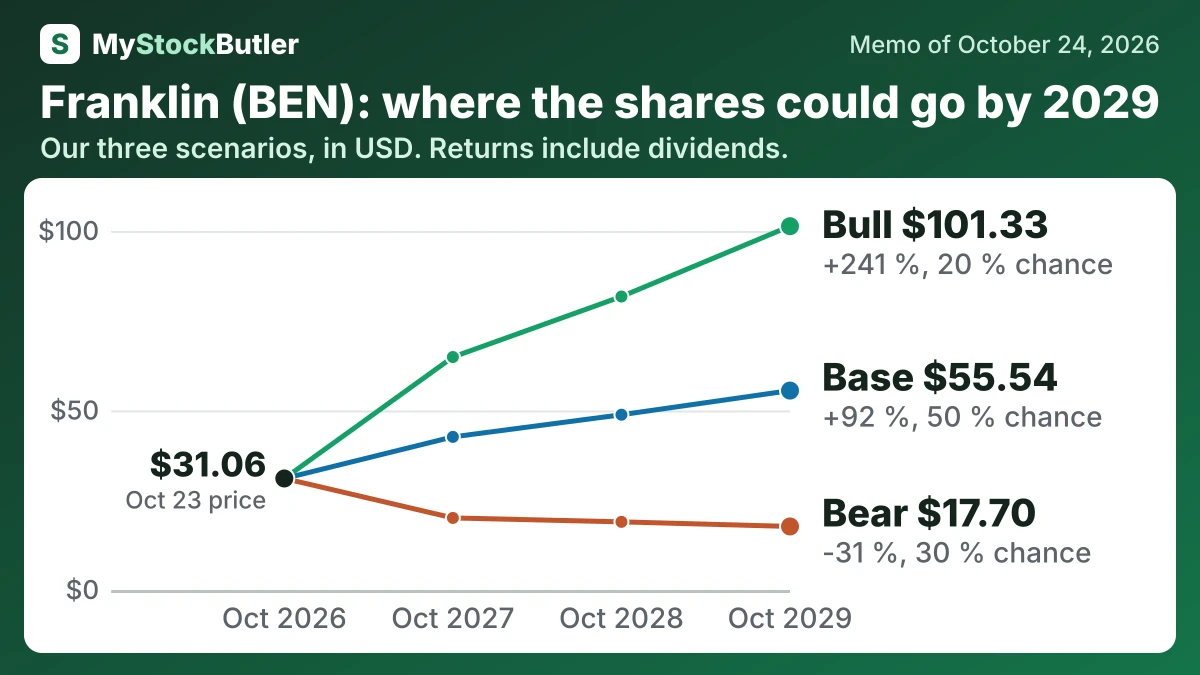
| Case | Probability | October 2027 | October 2028 | October 2029 |
|---|---|---|---|---|
| Bear | 30 % | 20.07 (-31 %) | 18.98 (-31 %) | 17.70 (-31 %) |
| Base | 50 % | 42.65 (+42 %) | 48.82 (+66 %) | 55.54 (+92 %) |
| Bull | 20 % | 64.89 (+113 %) | 81.74 (+172 %) | 101.33 (+241 %) |
| Weighted | 100 % | 40.32 (+34 %) | 46.45 (+58 %) | 53.35 (+85 %) |
What this means. The weighted row is a probability-based average of the bear, base, and bull cases, not a promise that the shares will reach that price.
What has to go right for Franklin's base case?
The base assumes positive external flows, gradual alternatives conversion and savings that improve margins without fully reaching management’s operating target. External flows turned positive through June 2026, while management expected an adjusted operating margin near 30%. The bear reflects Western Asset’s $1.1 billion quarterly outflow and lower fee yield. The bull requires Western to stabilize and alternatives to convert quickly into fee-paying assets.
How much cash does Franklin really make?
Franklin’s operating cash exceeds net income partly because impairments and amortization reduce accounting profit without using cash in the same period. After capital spending, the company still produced substantial free cash flow in FY2025. That makes the reported earnings weakness less alarming in the short run, but it does not settle the longer-term question.
Stock compensation changes the interpretation. Paying employees with shares preserves cash today but gives them part of the company. Existing shareholders then face dilution, or Franklin must repurchase shares to offset it. The cash-flow statement adds back stock pay, but an economic analysis treats that transfer of ownership as a cost.
| Sep 2025 | Sep 2024 | Sep 2023 | Sep 2022 | Sep 2021 | |
|---|---|---|---|---|---|
| Cash from operations | 1,066.1 | 971.3 | 1,089.2 | 1,956.7 | 1,245.4 |
| − Capital spending | 154.5 | 177.1 | 148.8 | 90.3 | 79.3 |
| = Free cash flow | 911.6 | 794.2 | 940.4 | 1,866.4 | 1,166.1 |
| − Stock pay | 214.8 | 246.1 | 182.6 | 208.2 | 171.9 |
| = Real free cash flow | 696.8 | 548.1 | 757.8 | 1,658.2 | 994.2 |
What this means. Cash from operations includes money moving through investment products, so it may look like the business itself generated or used more cash than it really did.
What does an investor pay for Franklin today?
| Today (Oct 24, 2026) | |
|---|---|
| Share price | 31.06 |
| Market value (calculated) | 15,780.9 |
| P/E, last 12 months (calculated) | 21.1x |
| P/E, next 12 months (calculated) | 9.8x |
| Free cash flow yield (calculated) | 5.8% |
| Dividend yield (calculated) | 4.2% |
What this means. Enterprise value is higher than market value because it also includes the company's debt and subtracts its cash.