Airtel Africa dividend
MyStockButler's October 2026 analysis: Airtel Africa pays 7.1 cents per share in FY26, after five consecutive annual increases. Cash from operations reached $3,195m, and after $753m of capital spending, $204m of lease payments and $839m of interest paid, $1,399m remained before further considerations, so the dividend is covered on that bridge but not free of other claims.
How much does Airtel Africa pay per share?
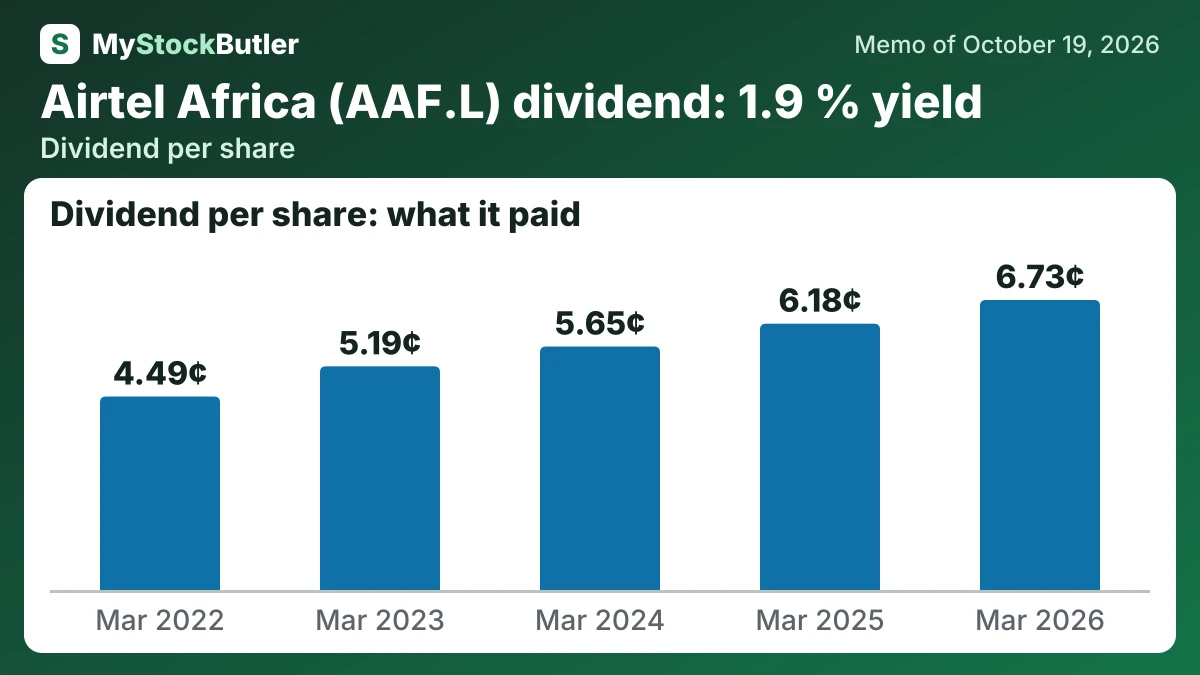
Dividend growth follows management’s stated mid- to high-single-digit policy. FY26 DPS was 7.1 cents after five consecutive annual increases. The base case compounds that history at roughly 7%; the bear case pauses at 6.0 cents after the first window; and the bull case maintains growth near the latest 9.2% increase. The $1.1bn FY27 capex plan, interest and lease payments explain why the bear case remains possible despite the policy.
| Mar 2026 | Mar 2025 | Mar 2024 | Mar 2023 | Mar 2022 | |
|---|---|---|---|---|---|
| EPS, diluted | 18.60 | 6.00 | -4.40 | 17.70 | 16.80 |
| Real free cash flow per share | 20.50 | 17.85 | |||
| − Dividends paid, per share | 6.73 | 6.18 | 5.65 | 5.19 | 4.49 |
| − Share buybacks, per share | 2.02 | 3.24 | 0.24 | 0.00 | 0.00 |
| = FCF not paid out, per share | 26.63 | 5.85 | 9.25 | 13.34 | 12.13 |
What this means. The company's own free cash flow per share is higher because it leaves out working capital, taxes, lease payments, and interest, while our count uses the cash actually left after these costs.
Is Airtel Africa’s dividend covered by its cash?
Cash from operations reached $3,195m in fiscal 2026, compared with $2,266m in fiscal 2025. Working capital released $401m. Customers’ payments, suppliers’ bills and other balances therefore supplied an important part of the cash increase. That release may not recur, so the quality of cash generation matters as much as its size.
The narrower cash bridge subtracts $753m of capital spending, $204m of lease payments and $839m of interest paid. It leaves $1,399m before further considerations. Airtel also paid $122m for intangible assets, including economically necessary rights such as spectrum. Dividends therefore need to be judged against cash after investment and debt service, not against EBITDA.
| Mar 2026 | Mar 2025 | Mar 2024 | Mar 2023 | Mar 2022 | |
|---|---|---|---|---|---|
| Free cash flow | 1,399 | 638 | 627 | 771 | 673 |
| − Dividends paid | 246 | 229 | 212 | 195 | 169 |
| − Share buybacks | 74 | 120 | 9 | 0 | 0 |
| = Free cash flow not paid out | 974 | 217 | 347 | 501 | 456 |
| Paid out, % of free cash flow | 22.9% | 54.7% | 35.2% | 25.3% | 25.1% |
| Paid out, % of real free cash flow | 25.3% | 25.2% |
What could change Airtel Africa’s dividend?
Through FY27–FY29, the decisive evidence will be whether the $1.1bn deployment earns revenue and cash returns. Rising wallet fees, stable margins and falling net debt would raise the forecast. Fuel inflation, higher tower costs, weak Nigerian monetisation or continued debt growth would lower EBITDA, dividends, buybacks and the valuation multiple.
What is Airtel Africa’s dividend yield against its share price?
| Today (Oct 19, 2026) | |
|---|---|
| Share price | 282.2 |
| P/E, last 12 months (calculated) | 19.10x |
| Free cash flow yield (calculated) | 10.3% |
| Dividend yield (calculated) | 1.9% |
What this means. The price-to-earnings figure for the next 12 months uses analysts' guesses about future profit, not profit the company has already earned.