BOCHK earnings
MyStockButler's October 2026 analysis: BOCHK earned HK$23.739 billion attributable to shareholders in the first half of 2026, 3% above one analyst estimate and 5% above company-compiled consensus. The next release should show whether loan growth holds up as margins weaken.
What has BOCHK guided for the year?
A regular dividend is the planned share of each year’s earnings paid to shareholders. An extra return is an additional dividend or buyback funded by surplus capital or accumulated resources. BOCHK plans regular dividends within a 40%–60% payout range for 2026 and extra returns of at least HK$10.5 billion across 2026–2028. For 2026, the extra return is a special dividend of HK$0.2388 per share; later returns may be special dividends or buybacks. This structure leaves part of each year’s profit inside the bank to support lending and absorb losses.
Margin pressure remains the central operating problem. Net interest margin is what remains after funding costs are deducted from interest earned on loans and investments. In the first half of 2026, BOCHK’s adjusted margin was 1.57%, while net interest income rose 3.3%. The coffee-shop example captures the logic: selling more cups at a smaller profit per cup can still increase total profit. BOCHK therefore seeks loan growth of 5.9% even as it expects margin pressure to continue.
| Period covered | Target in the bank's words | Date given | |
|---|---|---|---|
| Regular dividend payout range | Year to Dec 2026 | 40%-60% regular dividend payout range | 28 Aug 2026 |
| Shareholder return programme | 2026–2028 | an orderly increase of the regular dividend payout ratio within the established range | 28 Aug 2026 |
| Extra returns | 2026–2028 | extra returns of no less than HK$10.5 billion | 28 Aug 2026 |
| Net interest margin | Second half of 2026 | NIM will still be under pressure | 28 Aug 2026 |
| Net interest income | Second half of 2026 | striving to stabilise and achieve positive net interest income performance | 28 Aug 2026 |
| Loan growth | Year to Dec 2026 | achieve solid loan growth, striving to outperform the market for the full year | 28 Aug 2026 |
Has BOCHK kept its past promises?
Dividends provide a more concrete promise-and-delivery test. Management committed to quarterly dividends and a full-year payout between 40% and 60% of earnings. For 2025, the total dividend was HK$2.125 per share and the payout ratio was 56.0%. The board later announced at least HK$10.5 billion of extra returns over 2026–2028, including a special dividend of HK$0.2388 per share. Later arrangements still require approval, so they remain promises rather than completed payments.
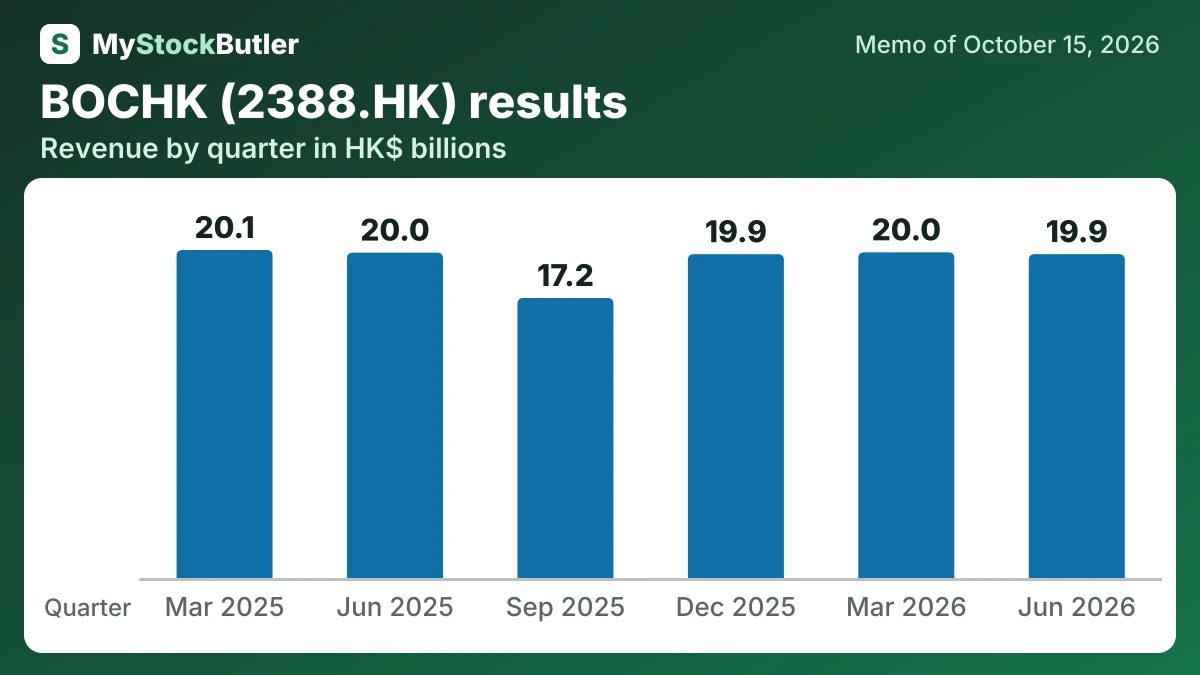
What do BOCHK's last eight quarters show?
BOCHK earned HK$23.739 billion attributable to shareholders in the first half of 2026. That was 3% above one analyst estimate and 5% above company-compiled consensus. Consensus means an average of analysts’ forecasts, not a promise from management. Hong Kong listed banks covered by analysts recorded average first-half profit growth of 33%, so BOCHK’s result sits within a strong sector period.
| Jun 2026 | Mar 2026 | Dec 2025 | Sep 2025 | Jun 2025 | Mar 2025 | Half-year to Dec 2024 | Half-year to Jun 2024 | |
|---|---|---|---|---|---|---|---|---|
| Revenue | 19,896 | 20,007 | 19,893 | 17,202 | 19,988 | 20,149 | 35,917 | 35,336 |
| Net interest income | 26,352 | 25,982 | ||||||
| Profit after tax | 11,863 | 12,493 | 8,981 | 9,431 | 11,125 | 11,679 | 18,655 | 20,463 |
| EPS, diluted | 1.72 | 1.90 | ||||||
| Net interest margin | 1.5% | 1.5% | ||||||
| CET1 capital ratio | 23.8% | 24.1% | 24.0% | 24.3% | 23.7% | 23.5% | 20.0% | 20.1% |
What this means. The bank’s safest-capital percentages before and after 2025 are not perfectly comparable because the rules used to calculate them changed.
What should people watch in BOCHK's next release?
As of 15 October 2026, BOCHK’s third-quarter financial and business review was expected in the mid-to-late October window, though no exact date was confirmed. Investors should look first at loan growth and then at whether income holds up as margins weaken. More lending helps only if pricing and eventual losses leave a satisfactory return.